The rollout of ETIAS could face another delay.
According to the Financial Times, the European Union is preparing to postpone the launch of its European Travel Information and Authorisation System, better known as ETIAS, until 2027. The requirement, often compared to the U.S. ESTA system, is set to apply to visa-exempt travelers visiting 30 European countries for short stays.
At this stage, however, no official postponement has been announced by the European Commission, eu-LISA or the Council of the European Union. Official pages still state that “ETIAS will start operations in the last quarter of 2026.” But the information reported by the British newspaper suggests the timeline is now under pressure.
A possible delay after EES difficulties
According to the Financial Times, discussions over a possible ETIAS delay come after difficulties with the European Union’s Entry/Exit System, known as EES.
Rolled out gradually from October 12, 2025, and fully operational since April 10, 2026, EES replaces manual passport stamping with a digital record of entries and exits by non-EU short-stay travelers. The system also collects biometric data, including facial images and fingerprints.
The rollout has led to queues at several border crossing points, particularly at some airports and busy land borders. The airline industry has been warning for several weeks about the risk of disruption during the peak summer travel season.
According to three people briefed on the matter and cited by the Financial Times, eu-LISA, the European agency responsible for the technical implementation of EES and ETIAS, has acknowledged that launching ETIAS before the end of the year is no longer realistic. The agency’s management board reportedly met in mid-June to discuss a delay, with another discussion expected in September on a revised timeline.
An eu-LISA spokesperson confirmed to the Financial Times that the management board had discussed the “entry into operation” of ETIAS on June 17, 2026, adding that “since then, there have been no further developments on this topic.”
The European Union still officially lists ETIAS for late 2026
Officially, the timeline has not changed.
On its dedicated portal, the European Union still says ETIAS is scheduled to start operations in the last quarter of 2026. The European Commission also states that the system is not yet operational and that no travel authorization applications are being collected at this time.
The EU also notes that the exact launch date will be announced several months before ETIAS goes live. In other words, travelers do not currently have to take any action and should be cautious of websites claiming to sell ETIAS authorizations already.
The legal framework also provides that the ETIAS start date must be set by the European Commission once the necessary conditions have been met, including testing and technical validation phases. It is therefore up to the Commission, not eu-LISA alone, to formally confirm the system’s launch.
ETIAS: a travel requirement expected to affect 1.4 billion travelers
ETIAS will apply to nationals of 59 visa-exempt countries traveling to the Schengen Area and Cyprus for short stays. This includes, among others, travelers from the United Kingdom, the United States, Canada, Australia, Japan, South Korea and Brazil.
According to the European Union, around 1.4 billion people from visa-exempt countries and territories will eventually be required to obtain an ETIAS electronic travel authorization before departure.
Applications will have to be submitted online, through the official ETIAS website or mobile app. The authorization fee was recently increased to €20, up from the €7 initially planned. Once approved, ETIAS will allow short stays under the usual 90-days-in-any-180-day-period rule.
ETIAS will not be a visa. It will be a pre-travel authorization for travelers who do not need a visa to enter the European countries concerned.
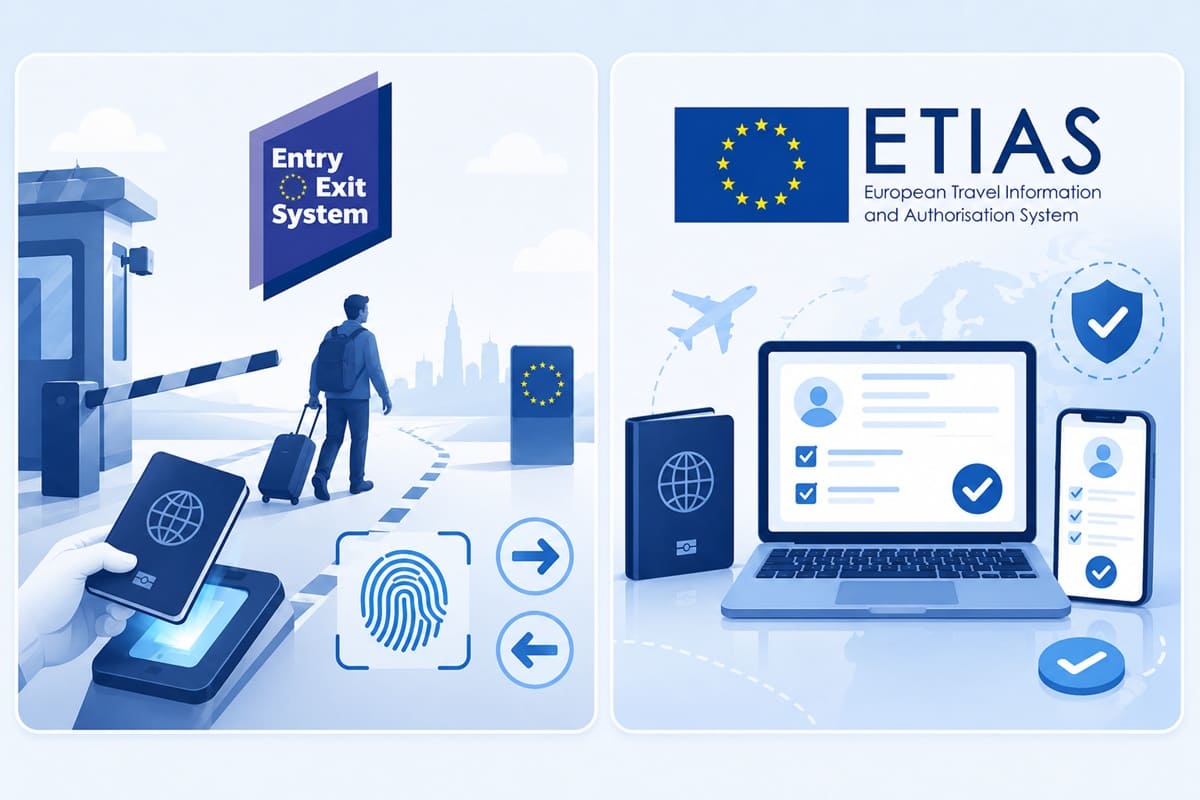
ETIAS and EES: two different systems, but closely connected
The possible postponement of ETIAS also highlights the challenge of bringing several major European border systems online at the same time.
EES applies at the border. It records entries, exits and refusals of entry for non-EU short-stay travelers, along with biometric data.
ETIAS, by contrast, will apply before departure. Visa-exempt travelers will need to obtain an electronic authorization before boarding for the European countries concerned. Once the system is operational, carriers will also be required to check that passengers hold a valid authorization.
In practice, the two systems are therefore complementary. But their technical and operational coordination remains sensitive, particularly for airports, airlines, land border crossings and national authorities responsible for border checks.
One person familiar with the discussions, cited by the Financial Times, said there were “still some IT issues” surrounding ETIAS. Another person close to the matter reportedly described a launch this year as “illusory.”
VisasNews Take
For travelers, ETIAS remains a requirement to watch, but not yet one to act on. A possible delay to 2027 would not come as a major surprise: Europe has already taken on a major operational step with EES, and immediately adding a pre-travel authorization could further complicate border checks. The best approach remains straightforward: wait for the official portal, avoid premature third-party websites and check the timeline before traveling to the Schengen Area.