Australia is preparing to phase out the familiar orange arrival card that travelers have traditionally filled out by hand during their flight.
On July 13, 2026, the Australian government announced the gradual rollout of the Australia Travel Declaration, a digital alternative to the Incoming Passenger Card currently handed to travelers before they enter the country.
The government will invest A$56.1 million over four years to modernize border procedures. Eventually, millions of passengers will be able to submit their declaration before arriving, without having to search for a pen on the plane or complete a paper form inside the terminal.
“The days of scrambling for a pen on the plane to fill out the orange passenger card are numbered,” said Acting Infrastructure and Transport Minister Kristy McBain.
Rollout planned across all international airports and seaports
The Australia Travel Declaration will be gradually introduced at every Australian international airport and seaport over the next 12 to 18 months.
“Over the next 18 months, we’ll be rolling out digital passenger cards at every Australian international airport, making the walk from the gate to exit as efficient and stress-free as possible,” McBain said.
The declaration will initially be available through an online form. Australian authorities then plan to work with airlines and other industry partners to develop features that can be incorporated directly into mobile apps.
The government has not yet released the address of the future public form or a detailed rollout schedule for each airport. Access will therefore expand in stages as the system is introduced.
Before the nationwide rollout, the pilot program operated with Qantas is expected to expand to Perth and Adelaide by the end of 2026.
More than 450,000 digital declarations already tested
The Australia Travel Declaration is not an entirely new system. The initial trial was launched in October 2024 through a partnership involving the Australian Border Force, the Department of Agriculture, Fisheries and Forestry, and Qantas.
Originally limited to certain passengers traveling from New Zealand to Brisbane, the pilot was gradually expanded to additional international flights and to Sydney and Melbourne airports.
According to the Australian government, more than 450,000 passengers on eligible inbound Qantas flights to Brisbane, Sydney, and Melbourne have already tested the digital declaration. Feedback gathered during the pilot persuaded authorities to make digital declarations a permanent part of Australia’s border system and extend the program nationwide.
Home Affairs Minister Tony Burke said the modernization effort should help travelers move through the border process more quickly. “When people arrive in Australia, I want them out of the airport and experiencing the best place in the world as fast as possible,” he said.
Burke added that “traveller modernisation is essential to Australia’s prosperity and national security.”
Paper arrival cards are still required for most travelers
Despite the announcement, the Australia Travel Declaration is not yet openly available to everyone traveling to Australia.
During the pilot phase, only certain eligible passengers using the Qantas mobile app are invited to complete the digital declaration. Travelers who do not receive an invitation must continue to fill out the paper Incoming Passenger Card, which is generally distributed during the flight or made available in the arrivals terminal.
Paper forms will therefore remain in use alongside the digital declaration throughout the transition period.
The government nevertheless intends to make digital declarations a permanent feature of Australia’s border system. “Visitors and Australian travellers alike will be able to take advantage of a seamless border process, which integrates into everyday digital life,” Burke said.
How does the Australia Travel Declaration currently work?
Under the existing pilot program, eligible passengers can complete their declaration through the Qantas mobile app up to 72 hours before departing for Australia.
Travelers must be able to complete the form in English and must generally be eligible to use automated kiosks and SmartGates at Australian airports.
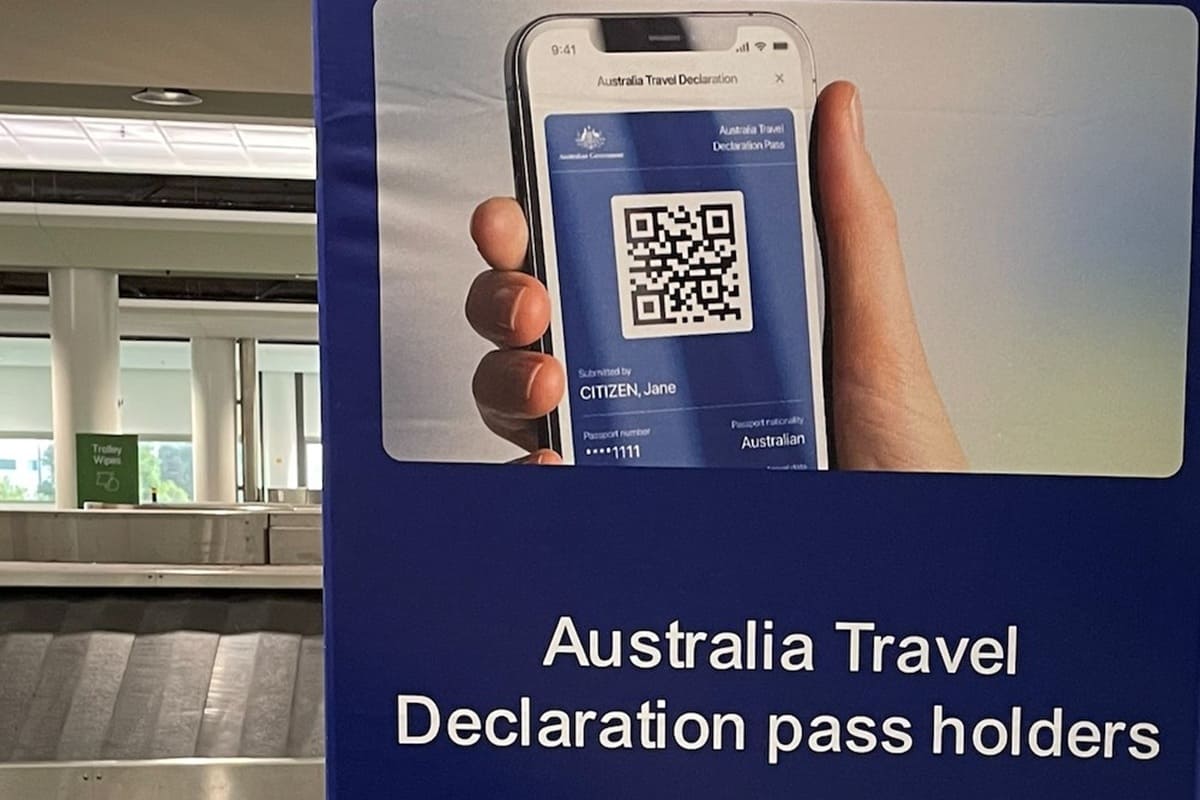
Once the declaration has been submitted, a digital pass containing a QR code is issued through the Qantas app and sent to the email address provided by the passenger. Travelers should keep the pass readily accessible so that it can be presented or scanned by border officials upon arrival.
Passengers may still be asked to complete a paper card if they encounter a technical problem, make a significant change to their travel plans, or arrive at a different airport from the one originally declared.
The future online form is expected to follow the same general process, although Australian authorities have not yet confirmed its final requirements.
Information submitted before arrival
The digital declaration collects the same general information currently requested on the Incoming Passenger Card, including details related to the journey, customs, and biosecurity.
Australia applies particularly strict rules to the entry of food, plant and animal products, seeds, wooden items, and equipment that may be carrying soil or organic material.
Moving the declaration online will not change these obligations. Travelers will still be required to declare relevant items, including when they are uncertain whether something may present a biosecurity risk.
Collecting information in advance should allow border agencies to begin assessments earlier, improve the quality of the data they receive, and update questions quickly in response to health alerts or emerging biosecurity threats.
Agriculture, Fisheries and Forestry Minister Julie Collins emphasized that modernization would not come at the expense of border controls. “Our Government will never compromise on biosecurity,” Collins said.
She said the Australia Travel Declaration would strengthen the country’s protections by “providing better quality information earlier,” helping authorities “identify and respond to potential biosecurity risks before they reach our shores.”
“Australia’s strong biosecurity system protects our farmers, environment, food security and economy, and modernising our border is an important part of maintaining that protection,” she added.
The digital declaration does not replace a visa or ETA
The Australia Travel Declaration is an arrival form. It does not replace the visa or electronic travel authorization required to travel to Australia.
Depending on their nationality and reason for travel, passengers must still hold a visa, a Subclass 651 eVisitor, a Subclass 601 Electronic Travel Authority (ETA), or another authorization appropriate to their circumstances.
Trade and Tourism Minister Don Farrell said simplifying arrival procedures would benefit both international visitors and Australia’s tourism industry.
“Making arrivals simpler and quicker means visitors can spend less time filling out forms and more time enjoying everything Australia has to offer,” Farrell said. “This is a win for tourists and a win for our tourism operators, helping make Australia an even easier and more welcoming place to visit.”
The modernization program is also intended to help Australian border agencies manage rising passenger numbers following the Covid-19 pandemic and prepare for the 2032 Brisbane Olympic and Paralympic Games.
VisasNews Take
The July 13, 2026, announcement marks the beginning of the broader rollout of the Australia Travel Declaration, but it does not mean the paper arrival card is disappearing immediately. For now, only travelers invited to participate in the Qantas pilot can use the digital declaration. A web-based form intended for a wider range of passengers will be introduced gradually over the next 12 to 18 months.