As the European Union continues to modernize checks at its external borders, two acronyms are increasingly appearing in travel preparations for the Schengen Area: EES and ETIAS.
The European Commission’s Directorate-General for Migration and Home Affairs has just published an official reminder explaining the distinction between the two systems. Both are linked to short stays, but they operate in very different ways.
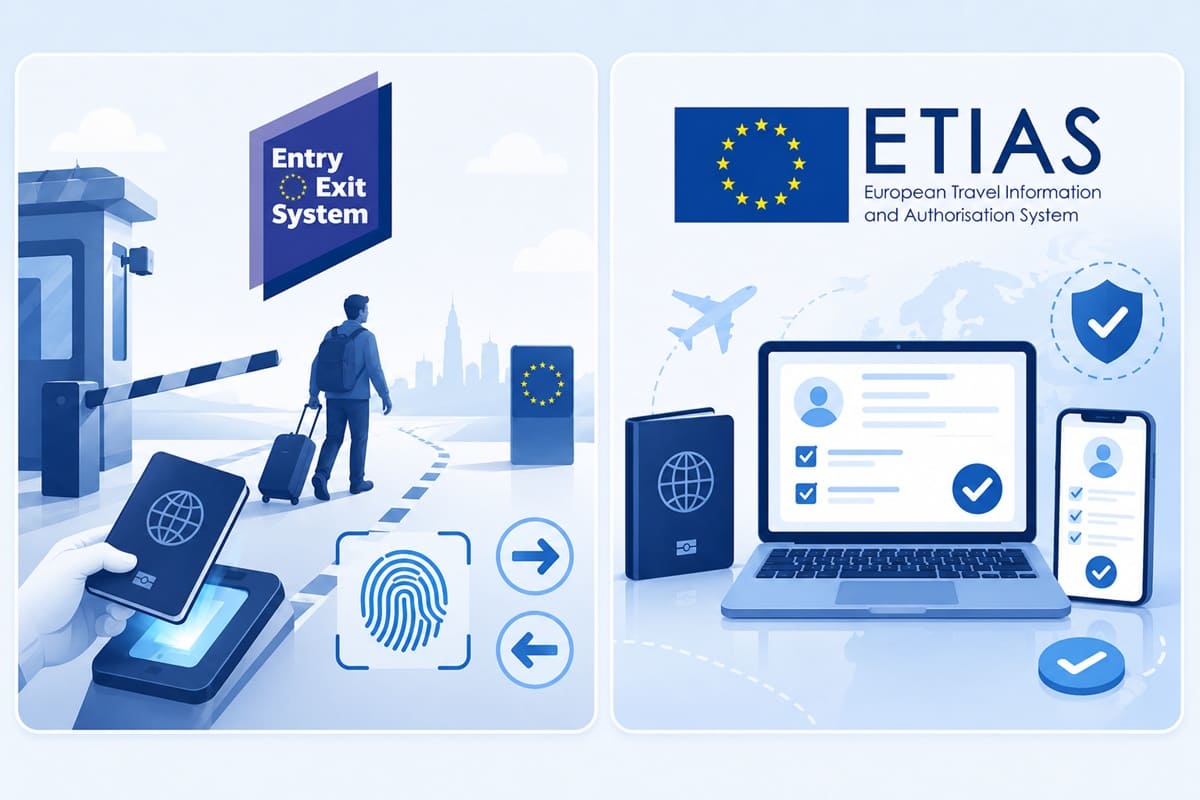
EES concerns the registration of entries and exits at borders, while ETIAS will be a travel authorization that certain visa-exempt travelers must apply for before departure.
The clarification comes as EES has been fully operational in the relevant Schengen countries since April 10, 2026, while ETIAS is expected in the last quarter of 2026. The Commission says the exact launch date for ETIAS will be officially announced later this year.
Two European systems, but two different approaches
In its article published yesterday, the European Commission recalls that EES, the Entry/Exit System, and ETIAS, the European Travel Information and Authorisation System, are both part of the modernization and digitalization of European border checks. But they do not take place at the same point in the journey and do not apply to exactly the same groups of travelers.
EES changes border-crossing procedures at the EU’s external borders for non-EU nationals traveling to the Schengen Area for a short stay, up to 90 days in any 180-day period. On arrival or departure, passport data, facial images, fingerprints, as well as the dates and places of entry and exit, are recorded in the system.
ETIAS, by contrast, will apply to travelers who do not need a visa to enter the Schengen Area and Cyprus for a short stay. Before starting their trip, these travelers will have to apply for an electronic travel authorization through the official ETIAS website or the dedicated mobile app.
EES happens at the border, ETIAS is requested before departure
The most important difference, therefore, is the timing of the procedure.
For EES, travelers do not submit a travel authorization request before departure. Their data is recorded when they cross an external European border. However, the Commission notes that some travelers may be able to pre-register their data within 72 hours before entering a European country, using the “Travel to Europe” mobile app, when the country of arrival uses this service.
With ETIAS, the logic is different. Once the system is launched, affected travelers will have to complete a digital form before departure, providing personal information, passport details and travel-related information. The authorization will then be electronically linked to the passport, with no document to print, and will be valid for three years or until the passport expires, whichever comes first.
Not all non-European travelers will be affected in the same way
The European Commission illustrates the difference with two examples.
A U.S. citizen wishing to travel to a European country covered by ETIAS will have to apply for a travel authorization once the system is operational. Carriers will check that authorization before departure, and the traveler’s data will then be recorded in EES on arrival at the external border.
By contrast, an Indian citizen traveling to the Schengen Area for a short stay will need a Schengen visa and will therefore not need an ETIAS authorization. However, that traveler’s data will still be recorded in EES when crossing the Schengen Area’s external border.
The Commission’s communication comes at a time when the two systems may still cause confusion. EES is already in operation, while ETIAS has not yet been launched.
The Commission also stresses the importance of using official channels for future ETIAS applications. According to the Commission, applications must be submitted through the official ETIAS website or mobile app to avoid fraudulent third-party websites that may charge additional fees or misuse personal data.
What travelers need to know
For travelers, the distinction can be summarized simply: EES is a border registration system, already fully operational in the relevant Schengen countries since April 10, 2026; ETIAS will be a prior travel authorization, expected in the last quarter of 2026 for visa-exempt travelers.
The two systems do not replace existing visa rules, but add to the framework for short stays in Europe. A traveler who requires a visa will not apply for ETIAS, but will be subject to EES when crossing the border. A visa-exempt traveler will eventually need to obtain ETIAS authorization before departure and will also be registered in EES on entry and exit.