
Thailand is preparing to significantly reshape its visa exemption policy.
After the Cabinet’s decision on May 19, 2026, approving a review of visa exemption and visa-on-arrival programs, Thailand’s Ministry of Foreign Affairs outlined the main features of the reform during its weekly press briefing, held the same day.
The briefing was attended by Panidone Pachimsawat, acting director-general of the Department of Information and deputy spokesperson for the Ministry of Foreign Affairs, as well as Mungkorn Pratoomkaew, director-general of the Department of Consular Affairs.
The documents released on that occasion, presented as a summary, provide an initial view of Thailand’s future visa policy. Above all, they confirm that the reform would not be limited to a simple reduction in the permitted length of stay. It would reorganize several entry regimes, drawing a clearer distinction between general exemptions, bilateral agreements and visas on arrival.
One of the principles adopted by Thai authorities would be to avoid having the same country or territory benefit from several overlapping exemption programs. Each nationality would therefore be assigned to one main category, in order to reduce the overlaps that had previously created confusion among travelers.
The new measures will not take effect immediately, however. Under the Cabinet resolution, they must first be published in Thailand’s Royal Gazette and will apply only 15 days after that publication.
A 30-day visa exemption for 54 countries and territories
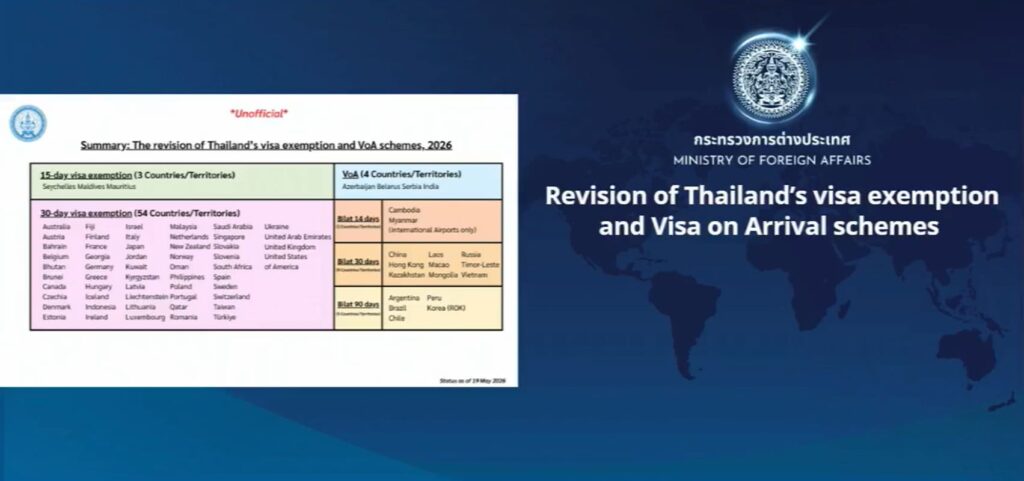
Thailand presented its revised visa exemption and visa-on-arrival programs | YouTube screenshot © Ministry of Foreign Affairs of Thailand
The main change will affect travelers currently covered by the 60-day visa exemption. This facility, currently granted to 93 countries and territories, will soon be abolished.
In its place, Thailand would notably introduce a 30-day tourist visa exemption for 54 countries and territories. This category would cover many of Thailand’s traditional tourism markets, including several European, North American, Asian and Gulf countries.
According to the summary presented on May 19, 2026, the 54 countries and territories concerned would be:
- Australia, Austria, Bahrain, Belgium, Bhutan, Brunei, Canada, Czechia, Denmark, Estonia, Fiji, Finland, France, Georgia, Germany, Greece, Hungary, Iceland, Indonesia, Ireland, Israel, Italy, Japan, Jordan, Kuwait, Kyrgyzstan, Latvia, Liechtenstein, Lithuania, Luxembourg, Malaysia, Netherlands, New Zealand, Norway, Oman, Philippines, Poland, Portugal, Qatar, Romania, Saudi Arabia, Singapore, Slovakia, Slovenia, South Africa, Spain, Sweden, Switzerland, Taiwan, Turkey, Ukraine, United Arab Emirates, United Kingdom, United States.
This list reflects a return to a shorter authorized stay for many travelers. Nationals of the countries concerned could still enter Thailand visa-free for tourism, but for 30 days rather than 60 days. The possibility of a 30-day extension inside Thailand will need to be confirmed through implementing texts or immigration instructions.
The reform responds to several objectives highlighted by Thai authorities: national security, tourism and economic interests, reciprocity, the removal of overlaps between different visa exemption programs and the development of Thailand’s electronic visa system (e-Visa).
Three countries would receive a 15-day visa exemption
The new policy would also introduce a 15-day visa exemption for three countries: Maldives, Mauritius and Seychelles.
This limited category reflects Bangkok’s intention to apply different lengths of stay depending on nationality, rather than maintaining a uniform system covering all countries currently eligible for the 60-day exemption.
Visa on arrival would be reduced to four countries
The visa on arrival program, or VoA, would also be revised.
According to the summary presented by Thailand’s Ministry of Foreign Affairs, only four countries would remain eligible for visa on arrival: Azerbaijan, Belarus, India and Serbia.
This reduction confirms the overall direction of the reform. Thailand appears to be seeking to limit facilities granted directly upon arrival and to prioritize, for some travelers, procedures completed before departure, particularly through the e-Visa system.
Bilateral visa exemptions would be maintained
The reform would not call all existing bilateral agreements into question. On the contrary, it appears designed to distinguish them more clearly from general visa exemption programs.
A 14-day bilateral visa exemption would apply to Cambodia and Myanmar, but only for arrivals through international airports.
A 30-day bilateral exemption would apply to nine countries and territories: China, Hong Kong, Kazakhstan, Laos, Macao, Mongolia, Russia, Timor-Leste and Vietnam.
Finally, a 90-day bilateral exemption would be maintained for five countries: Argentina, Brazil, Chile, Peru and South Korea.
This distinction is important for travelers. Some nationalities would no longer fall under the general visa exemption program but would continue to benefit from an entry facility based on a bilateral agreement with Thailand.
For travelers who will no longer be eligible for a visa exemption or visa on arrival, visa applications should be made through Thailand’s e-Visa system, depending on the purpose of stay.
No retroactive effect for travelers already in Thailand
Thailand’s Ministry of Foreign Affairs also said that travelers who have already entered Thailand under the current system, or those who arrive before the new measures take effect, will keep the length of stay granted upon arrival.
The reform should therefore not retroactively reduce stays that have already been authorized.
After the new rules take effect, however, travelers will have to comply with the new regime applicable to their nationality, whether that is a visa exemption, a bilateral agreement or an electronic visa application.
A reform still awaiting official publication
At this stage, these elements still need to be confirmed by the expected regulatory texts from Thailand’s Ministry of Interior.
The Cabinet has instructed the Ministry of Interior, in coordination with the relevant agencies, to issue the necessary announcements in accordance with the law. The Immigration Bureau, the Ministry of Labor and other competent authorities will also have to adjust their internal regulations to ensure consistent implementation.
The effective date will therefore depend on official publication in the Royal Gazette. The new rules will take effect 15 days after that publication. Until then, the currently applicable entry conditions remain in force.



Very disappointed at the charges Personally I have been sponsoring my partner for 10 years to help with living costs and her daughter education I’ve also been coming to Thailand for the last 25year(normally stayed for 3 months)
Have never been involved criminal activity nor have I ever worked have only spend money.
I have calculated my construction to the Thai economy to be around six million Thb.
So why are these changes beneficial for tourism I’m nearly 70 old and am wanting to stay longer up to 5 months spend money that is economical plus for your economy surely?