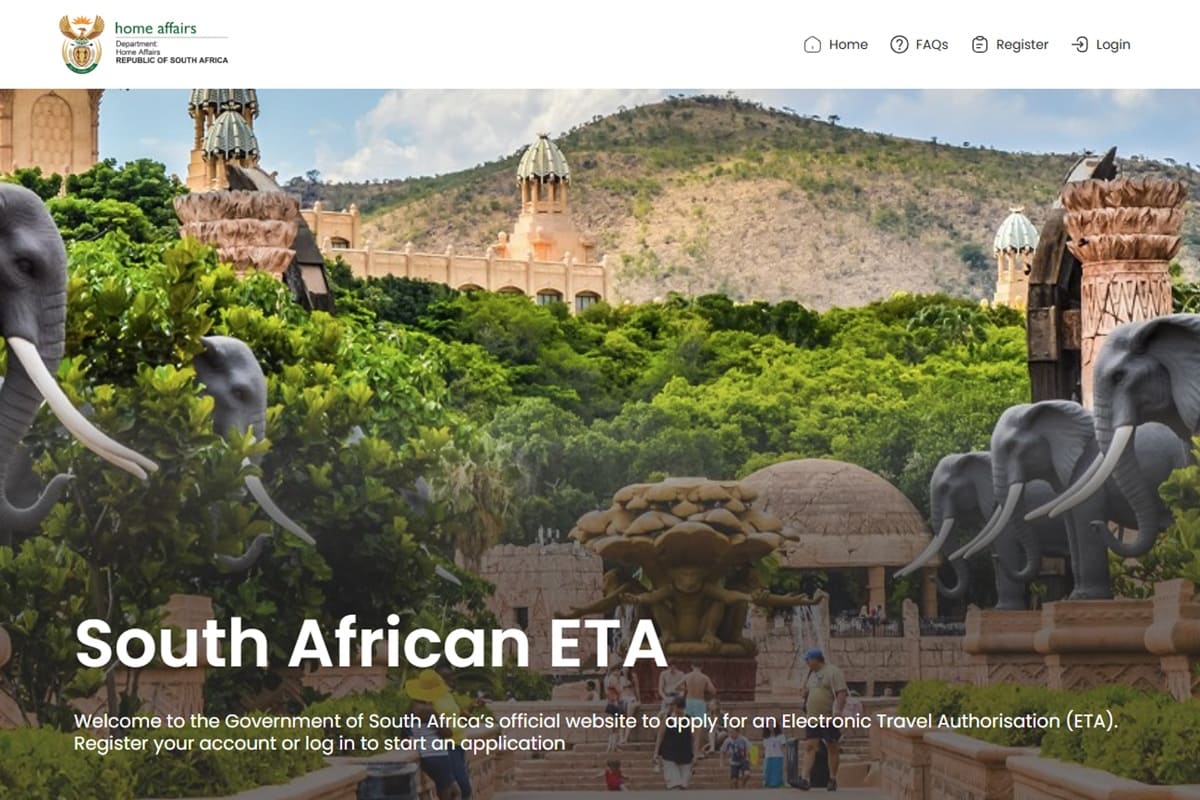
South Africa’s Electronic Travel Authorisation (ETA) has now been officially launched.
As announced last week by the South African Presidency, Cyril Ramaphosa visited OR Tambo International Airport near Johannesburg on Wednesday, August 12, 2026, to officially launch the Electronic Travel Authorisation system alongside Home Affairs Minister Leon Schreiber.
“It is therefore my honour and privilege to officially launch South Africa’s Electronic Travel Authorisation,” the president said at the conclusion of his address.
The ceremony did not, however, mark the ETA’s first use. The system has been operating since October 2025 as part of a pilot program initially introduced for South Africa’s G20 presidency before being opened to tourists from China, India, Indonesia and Mexico.
The August 12 launch primarily paves the way for the system to be gradually expanded to more travelers.
More than 216,000 ETA applications already processed
During the launch, Leon Schreiber released detailed figures on the use of the ETA system for the first time.
In his speech at OR Tambo, the Home Affairs Minister said 216,204 ETA applications had already been processed since the start of the pilot phase. Of those, 6,126 fraudulent applications were identified and rejected, including cases involving forged passports, manipulated documents and other indicators of fraud.
“All of these features are live as we speak,” Schreiber said, presenting the figures as evidence that the platform is already fully operational.
The data also illustrate one of Pretoria’s main objectives. The ETA is not simply designed to streamline visa applications: it is now a cornerstone of South Africa’s immigration reform, with a strong emphasis on biometric and automated checks.
For Cyril Ramaphosa, the modernization effort is intended to make travel to South Africa “easier, faster and more predictable,” while strengthening the country’s ability to detect abuse before travelers arrive. The president summed up the approach by saying that “a modern immigration system is not a weaker immigration system. It is a smarter immigration system.”
Passport, selfie and biometric checks: how South Africa’s ETA works
The process presented during the launch largely reflects the features already available on the ETA portal.
Applications begin on the government portal, eta.dha.gov.za, where travelers create a profile and verify their phone number and email address using a one-time password.
Applicants must then scan their passport and submit a selfie. The platform biometrically compares the applicant’s face with the passport photograph, while an algorithm automatically checks more than 40 parameters of the travel document to verify its authenticity.
An automated risk assessment is then carried out and, if the application is approved, authorities say the ETA can be issued in less than 24 hours. The authorization can be stored in a digital wallet accessible from the traveler’s smartphone.
Upon arrival, another facial recognition check confirms that the person presenting themselves at immigration is the same person who was granted the authorization.
The process relies on EMCS 2.0, the new biometric version of South Africa’s electronic movement control system used at airports. Dedicated counters for ETA holders are intended to speed up immigration clearance, ahead of plans to eventually integrate the system with electronic “eGates.”
The ETA will also allow travelers to apply for a stay extension
The launch also brought an important clarification for travelers already in South Africa.
Leon Schreiber announced that the platform now allows a traveler admitted for a stay of up to 90 days to apply online for an extension of up to an additional 90 days, in line with South African immigration law.
The Home Affairs Department is therefore seeking to digitize a procedure that has until now involved more administrative formalities. This feature is also expected to become available to visa-exempt travelers once they gain access to the ETA system.
More countries to be added to the ETA “in the coming weeks”
The next phase will focus on expanding the system geographically.
According to Leon Schreiber, the ETA is expected to gradually become mandatory for short stays by nationals of visa-required countries as those countries are added to the platform.
Travelers who are currently visa-exempt, meanwhile, will be able to use the ETA voluntarily to access dedicated arrival lanes or more easily apply for an extension of stay.
“Over the coming weeks, we will inform the embassies of countries as they are systematically added to the ETA,” the minister announced.
This wording provides further detail on the timeline outlined shortly before the launch. As VisasNews recently reported, the South African government included in its reform program a target of expanding the ETA to all eligible countries in September 2026.
The August 12 speech does not yet provide a list of the next nationalities to be included or a single launch date. Instead, it now points to countries being added gradually over the coming weeks.
The ETA portal remains limited to four nationalities for now
Despite the official launch, the announced expansion has not yet appeared on the application platform.
As of August 13, 2026, the official portal still states that the process is available to citizens of China, India, Indonesia and Mexico. It also continues to list OR Tambo International Airport, Cape Town International Airport and Lanseria International Airport as eligible arrival points.
Leon Schreiber did, however, announce yesterday that the system would initially be available to travelers arriving at four international airports:
- OR Tambo International Airport in Johannesburg;
- Cape Town International Airport in Cape Town;
- King Shaka International Airport in Durban;
- Lanseria International Airport near Johannesburg.
King Shaka therefore becomes the fourth airport announced for the ETA system, although that change has not yet been reflected on the government portal at the time of publication.
Authorities then plan to gradually equip land and sea border crossings with facial recognition and EMCS 2.0 over the coming months.
No final confirmation yet of the 500-rand fee
The minister also confirmed that the ETA process now includes an online payment stage, but the official communications released for the launch do not specify the amount travelers will be charged.
The Home Affairs Department recently proposed a processing fee of 500 rand per ETA application, or about $30. The amount appeared in draft regulatory amendments that were open for public comment until August 11, 2026.
The August 12 announcements therefore do not present the 500-rand fee as having definitively entered into force. Final regulations will still be needed to confirm the amount and its effective date.
French and other visa-exempt travelers remain exempt from any mandatory ETA
For French and other European travelers, the August 12, 2026 launch does not create any new immediate mandatory travel requirement.
Holders of French, Belgian, Swiss, British, Canadian and US passports, among others, continue to benefit from South Africa’s visa exemption for short stays of up to 90 days.
Once the platform is opened to them, visa-exempt travelers will be able to apply for an ETA voluntarily in order to use dedicated arrival channels or access certain digital services more easily. The minister confirmed that use of the ETA will remain optional for these travelers during the next phase of the rollout.
In the longer term, the government’s ambitions extend well beyond tourism. The ETA is intended to become the central digital gateway to South Africa’s immigration system, with student, spousal and work visas, as well as other immigration categories, gradually integrated into the platform.
VisasNews Take
The August 12, 2026 event primarily marks the official launch of a system that has already been tested for several months. For travelers heading to South Africa, the key development will now come over the next few weeks, as additional nationalities and entry points are gradually added. For now, the portal remains limited to citizens of China, India, Indonesia and Mexico, and no ETA is mandatory for European, American travelers or other nationalities that currently benefit from visa-free entry. VisasNews will continue to monitor updates to the platform and announcements from South African authorities regarding the next eligible countries.