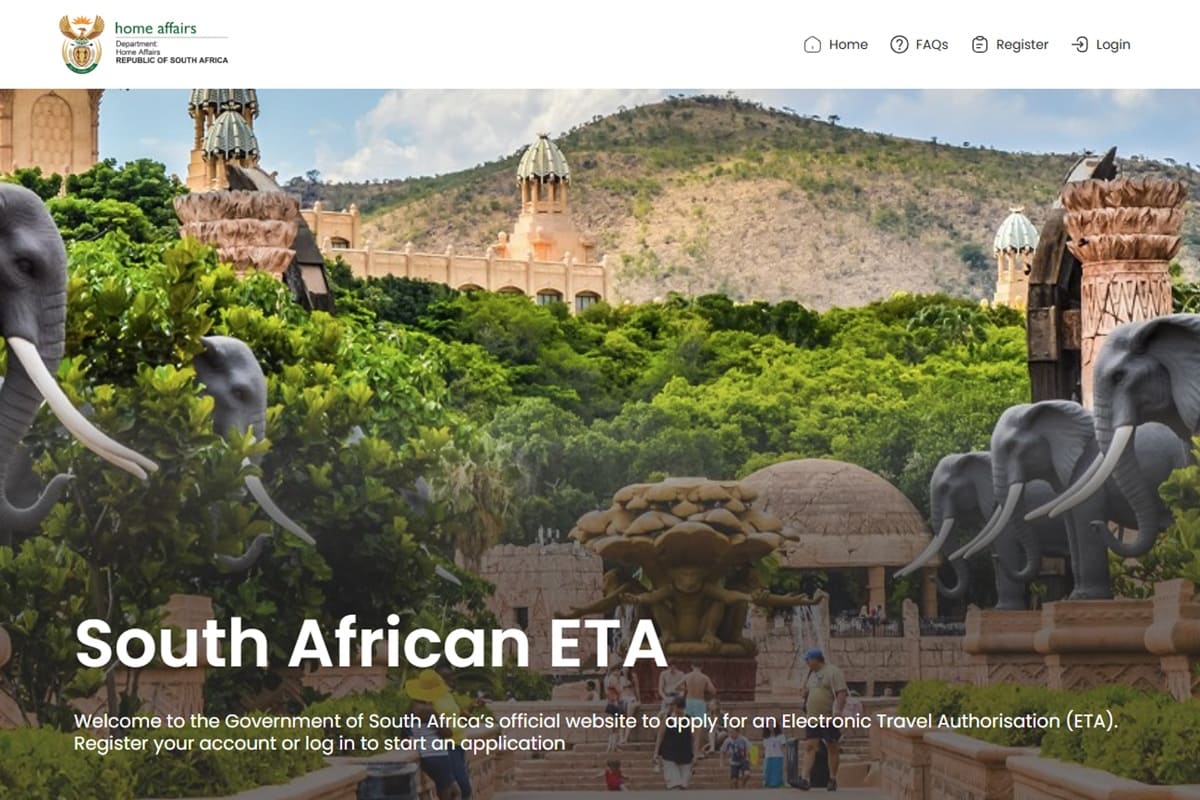
South Africa’s Electronic Travel Authorisation, or ETA, will be officially launched on August 12, 2026, at OR Tambo International Airport near Johannesburg.
President Cyril Ramaphosa will unveil the ETA system alongside Home Affairs Minister Leon Schreiber.
The event will also include a live demonstration of the platform and a guided tour led by Michael Masiapato, commissioner of the Border Management Authority, or BMA.
An official launch following a pilot phase
The August 12 ceremony will not mark the ETA’s first day of operation.
The platform was introduced in October 2025 as part of South Africa’s G20 presidency. Its initial phase covered nationals of China, India, Indonesia and Mexico, the four G20 countries whose citizens required visas to enter South Africa.
After initially being made available to participants attending G20 meetings, the ETA was opened more broadly to tourists from those four countries.
The official portal currently allows eligible travelers holding ordinary passports to apply online when arriving through OR Tambo International Airport, Cape Town International Airport or Lanseria International Airport. Travelers entering through other border crossings must continue to follow the standard visa procedures.
The August 12 event will therefore formally establish the system following its pilot phase and introduce the next stage of its rollout.
Biometrics and automated traveler screening
The South African Presidency describes the ETA as the cornerstone of the country’s future digital immigration system and one of the Home Affairs Department’s flagship reforms.
The platform combines a fully digital application process, biometric verification, machine learning and an upgraded electronic Movement Control System known as eMCS 2.0.
According to the Presidency, the system is intended to strengthen border security while making travel to South Africa “faster, simpler and more secure.”
The application process includes creating an account, taking a photo of the passport that will be used for travel, completing an online form and capturing a live biometric image.
Once approved, the ETA is electronically linked to the applicant’s passport. Eligible holders may use it for multiple trips during its validity period, although it does not authorize them to work in South Africa.
Authorities also expect the reform to make South Africa more attractive for tourism, business travel and investment while improving the efficiency of border management.
Expansion “to all countries” planned for September 2026
The official launch is expected to be followed within weeks by another major stage of the rollout.
In its first-quarter 2026/27 progress report, published under Operation Vulindlela, the government lists a September 2026 target to “expand the ETA to all countries.”
The report’s broader overview uses somewhat narrower language, stating that work is underway to expand the platform “to all eligible countries” and to additional visa categories.
A proposed fee regulation published several days earlier provides further clarification. It states that President Ramaphosa has committed to extending the ETA to tourists from every country whose nationals require a visa to visit South Africa.
The September announcement should therefore primarily be understood as a geographic expansion of the platform. It does not yet officially mean that every foreign visitor will be required to obtain an ETA from that date.
ETA to remain optional for visa-exempt travelers
The planned September expansion should not be confused with a new entry requirement for nationalities that already enjoy visa-free travel.
The official portal, eta.dha.gov.za, states that travelers from visa-required countries may use the ETA instead of applying for a traditional visitor visa. It also explains that visa-exempt nationals may voluntarily apply for an ETA to benefit from more efficient border processing.
The draft regulation published on July 27, 2026, explicitly confirms this distinction.
During the next phase, the ETA is expected to become mandatory for travelers from visa-required countries once their nationality is added to the platform. For visa-exempt travelers, however, its use will remain “initially voluntary.”
These travelers will therefore be able to continue using their existing visa waiver or choose to apply for an ETA to access what authorities describe as a faster and more streamlined border process. The department says this voluntary approach is intended to encourage adoption of the system without removing existing visa-free travel privileges.
Holders of European, British, US, Canadian, Australian and Japanese passports therefore remain visa-exempt for stays of up to 90 days in South Africa. No mandatory ETA has been announced for them, either for the August 12 launch or the expansion planned for September.
Applications processed in under 24 hours
According to the government, ETA applications can be completed in under 24 hours. At airports, ETA holders could clear immigration in less than 60 seconds through dedicated lanes.
These figures reflect the performance levels presented by authorities in their report. They should not necessarily be interpreted as guaranteed processing times for every application or every border crossing.
In the longer term, the government plans to turn the ETA into a single, secure digital platform that will replace older systems. Its scope is expected to gradually expand to include visitor, work and student visas.
Proposed fee of 500 rand has yet to be finalized
Although the ETA is currently free, applicants may soon have to pay to use the platform.
Under the proposed regulation, South Africa’s Home Affairs Department would introduce an electronic processing fee of 500 rand per application, equivalent to approximately $30.
The system has so far operated without a specific fee because its initial version did not include an integrated payment module. The department says that maintaining a service funded entirely by the government would not be sustainable and now plans to add a payment function.
For nationals who are required to obtain a visa and pay standard consular fees, the 500-rand electronic processing charge would be added to the existing 425-rand visitor visa fee. The total cost would therefore reach 925 rand.
Travelers who require a visa but are exempt from consular fees would pay only the 500-rand charge for processing their application through the platform.
Visa-exempt travelers would pay nothing if they continued to use their existing exemption. Those who voluntarily applied for an ETA, however, would also be charged 500 rand. The official fee table therefore distinguishes between a zero-rand cost for travel without an ETA and a 500-rand cost for a voluntary ETA application.
The fee has not yet been finalized. The draft regulation remains open for public comment through August 11, 2026. Although the text proposes an effective date of August 17, both the date and the fee will need to be confirmed in the final regulations.
VisasNews Take
The official ETA launch on August 12, 2026, and its planned expansion in September will not make the electronic authorization mandatory for travelers who are already visa-exempt. Eligible international visitors will still be able to stay in South Africa for up to 90 days without an ETA and without paying a fee. Once the system becomes available to them, they may voluntarily apply for an ETA to access faster border processing. Only those who choose to apply would pay the proposed 500-rand fee, subject to final approval of the regulations.