Thailand has now clearly announced plans to reduce its visa-free stay from 60 to 30 days, but the change has not yet taken effect.
A series of announcements over the past several months may have created the impression that the visa-free stay has already been shortened. As of August 11, 2026, that is not the case.
Nationals of the 93 countries and territories currently eligible, including the US, Canada, the UK, France, Belgium, and Switzerland, continue to benefit from the scheme introduced in July 2024, allowing visa-free stays of up to 60 days.
That period can currently be extended for an additional 30 days, at the discretion of Thai immigration authorities.
Under the upcoming rules, the initial visa-free stay is expected to be reduced to 30 days for many of the nationalities concerned. Before the changes can take effect, however, the new regulations must still be published in the Royal Gazette, Thailand’s official government journal.
From early siscussions to a formal decision
The plan has gradually taken shape since the beginning of 2026.
In February, the Thai government announced that it intended to review the 60-day visa exemption scheme, citing misuse of the program and repeated entries for purposes beyond those originally intended.
On March 20, 2026, Thai Foreign Minister Sihasak Phuangketkeow took the process a step further by announcing that a proposal to cut the visa exemption from 60 to 30 days would be submitted to the government.
He noted that most tourists stay in the country for less than 30 days and said travelers wishing to remain longer should continue to have access to an additional extension.
At that point, however, the reform had not yet received formal approval.
Government approves the end of the general 60-day scheme
The process moved forward on May 19, 2026, when the Thai Cabinet formally approved a revision of the country’s visa exemption and visa-on-arrival schemes.
The government approved the principle of ending the general 60-day visa exemption covering 93 countries and territories and adopted a new structure based in part on the “one country, one regime” principle, designed to eliminate overlaps between general visa exemptions, bilateral agreements and visa-on-arrival arrangements.
Under the initial framework presented in May, authorities planned:
- a 30-day visa exemption for 54 countries and territories;
- a 15-day visa exemption for three countries and territories;
- visa on arrival (VoA) for four countries and territories.
Authorities stressed, however, that the new measures would only take effect 15 days after their publication in the Royal Gazette.
That publication did not take place in the weeks that followed.
Thailand further revises its future visa rules in July
The Thai government has since made additional changes to the planned system.
On July 14, 2026, the Cabinet approved a revised version of the upcoming visa exemption policy, significantly changing the structure presented in May.
Under the latest announced framework, 59 countries and territories are expected to qualify for a 30-day visa exemption for tourism.
Six countries were added to this category: India, Croatia, Bulgaria, Cyprus, Malta and the Maldives.
Adding Croatia, Bulgaria, Cyprus and Malta will notably mean that nationals of all 27 European Union member states are covered by the same 30-day visa exemption scheme.
The future system is also expected to include:
- a 15-day visa exemption for Mauritius and Seychelles;
- visa on arrival (VoA) for nationals of Azerbaijan, Belarus and Serbia;
- the transfer of India from the VoA scheme to the 30-day visa exemption program.
Overall, 65 countries and territories are expected to be covered by these various arrangements, excluding certain provisions stemming from bilateral agreements.
Digital screening of travelers is also set to increase
The visa reform comes as Thailand continues to modernize its immigration procedures.
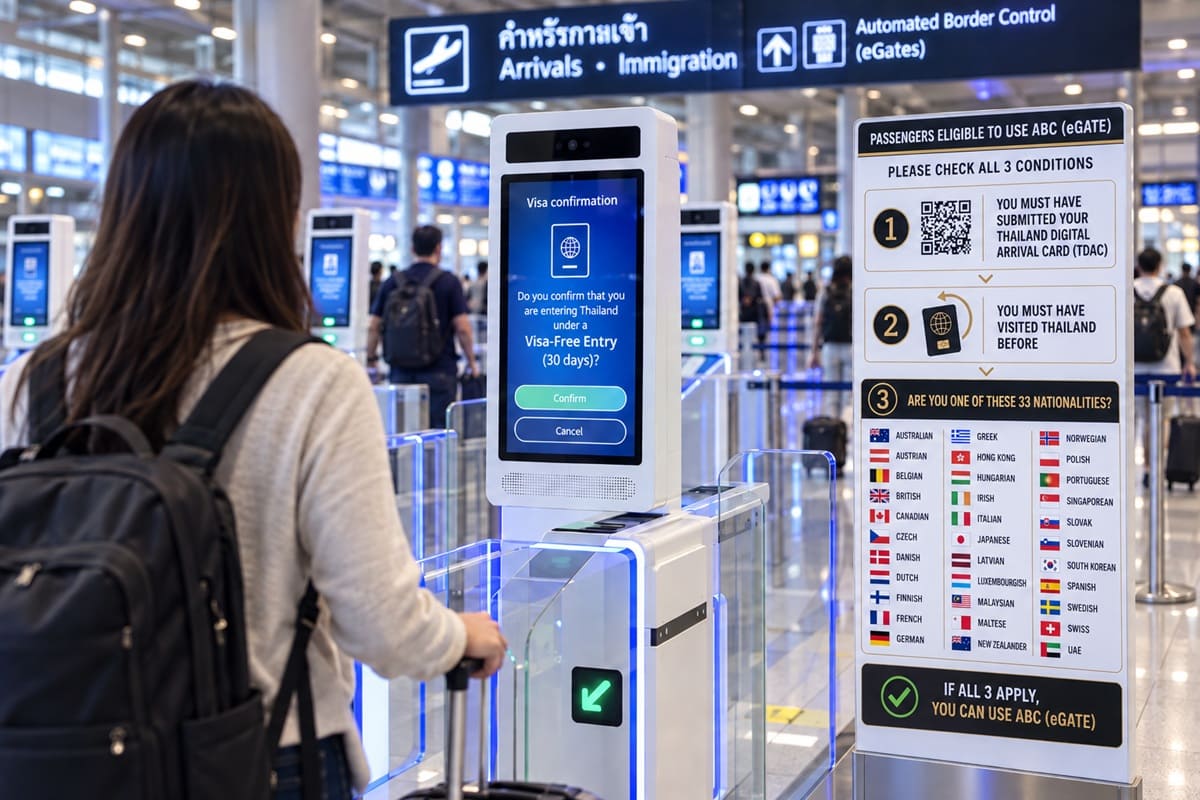
Since May 1, 2025, foreign travelers have been required to complete the Thailand Digital Arrival Card (TDAC) before entering the country.
As part of the reform approved in July, authorities also announced plans to strengthen the system, including through greater integration of government databases to improve risk assessment and the monitoring of foreign nationals entering and leaving Thailand.
This broader modernization effort also includes the development of THIM (Thailand Immigration Management), a new Thai immigration mobile app currently available on a pilot basis.
As of August 11, 2026, the Tourism Authority of Thailand (TAT) still states that the app’s official launch is expected sometime in August, although no specific date has been announced.
For now, THIM remains optional and is not a new mandatory entry requirement for Thailand. It also does not replace the TDAC.
The app allows travelers to photograph their passports so certain details can be captured automatically, before entering information about their stay, accommodation and travel plans. Group registration for up to 10 travelers is also available.
Over time, THIM is expected to develop into a broader immigration services platform, with features such as digital document submission, appointment scheduling and certain procedures that can be completed remotely. These functions are still under development, however, and remain subject to confirmation by Thailand’s Immigration Bureau.
As of August 11, 2026, the 60-day visa exemption still applies
Despite the numerous announcements, no effective date has yet been set for the new visa exemption system.
The regulations required to implement the changes are still awaiting publication in the Royal Gazette. The new rules will take effect 15 days after that publication.
In practical terms, an eligible traveler entering Thailand today under the general visa exemption scheme can still be granted a stay of up to 60 days, not 30 days.
Thai authorities have also indicated that travelers who enter the country before the new system takes effect will retain the length of stay granted to them upon arrival.
A traveler admitted for 60 days before the rules change should therefore not see that authorized stay automatically reduced once the new provisions come into force.
The key next step remains the publication of the regulations in the Royal Gazette. That publication, rather than the government announcements made so far, will determine the exact date from which travelers will have to comply with the new visa-free stay periods.
VisasNews Take
For travelers, the situation remains unchanged as of August 11, 2026: the announced reduction of visa-free stays to 30 days does not mean the shorter period is already in effect. The current 60-day scheme will remain in place until the new regulations officially take effect. At the same time, Thailand is preparing a broader modernization of its digital entry procedures through an upgraded TDAC system and the development of THIM, although the new app remains optional and in its pilot phase for now.