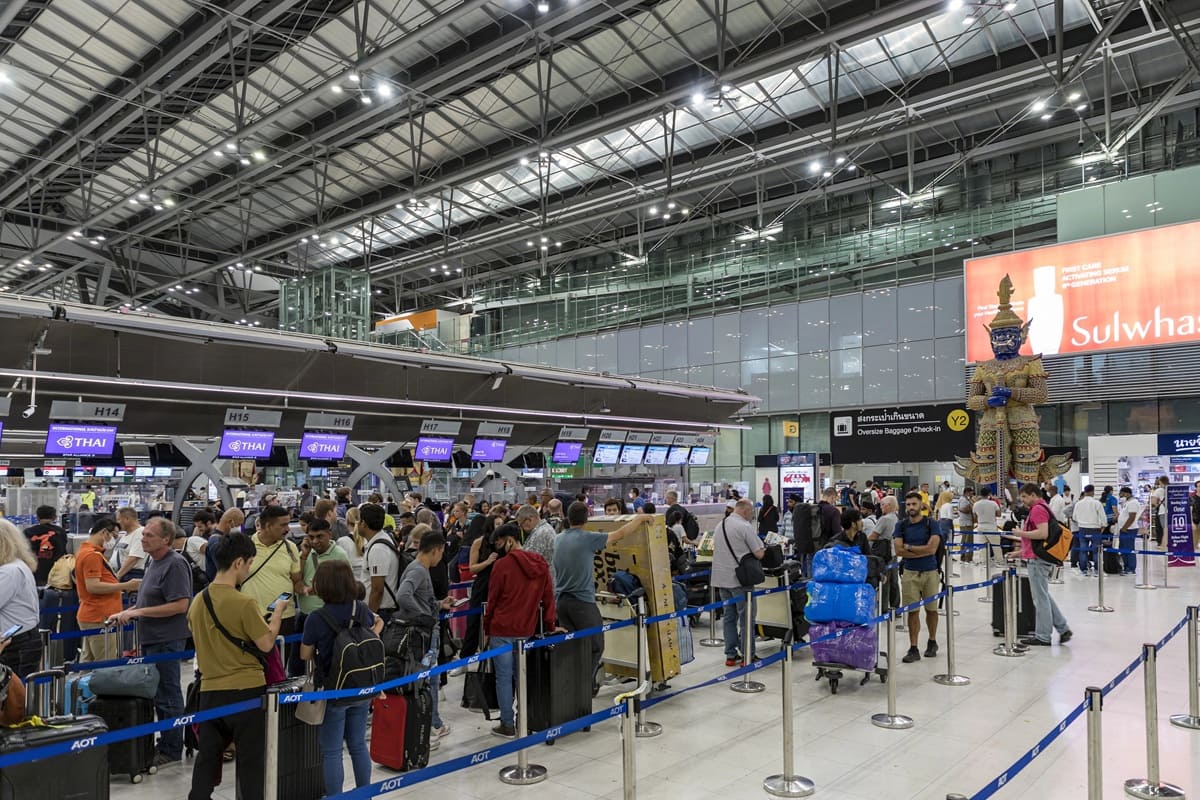
Starting October 16, 2026, security personnel at airports in Thailand will be allowed to open checked baggage without waiting for the passenger to be present when screening reveals a suspicious or potentially dangerous item.
The Civil Aviation Authority of Thailand (CAAT) recently clarified how regulations issued in February will be implemented. The authority stresses, however, that bags will not be opened routinely. The procedure will only be triggered when screening, including X-ray checks, identifies an item that could pose a threat to aviation security.
The Tourism Authority of Thailand (TAT) also briefed travelers on the new rules on August 11, 2026, advising passengers departing from a Thai airport with checked baggage to review the requirements of their airline, departure airport and the CAAT.
The change comes as Thailand’s entry rules could also be revised in the coming months. Authorities are still considering reducing the visa-free stay from 60 to 30 days for travelers from 93 countries and territories, although that change has not yet taken effect.
Inspections without requiring the passenger to return
When a checked bag requires additional screening, the airport operator will be able to open it without the passenger being present. The CAAT says the change is intended in part to avoid having to locate the bag’s owner and ask them to return to open it, a process that can delay baggage handling and flight departures.
The inspection must take place in a designated area and must be video recorded. Footage and records related to the inspection will be retained so authorities can later verify who opened the bag and what was found inside. Passengers must then be informed that their luggage was inspected, including through a “Notice of Baggage Inspection” placed inside the bag.
The CAAT notes that similar procedures are already used in Singapore, Japan, South Korea and the United States, as well as in several European and Middle Eastern countries.
Which items are prohibited or considered dangerous?
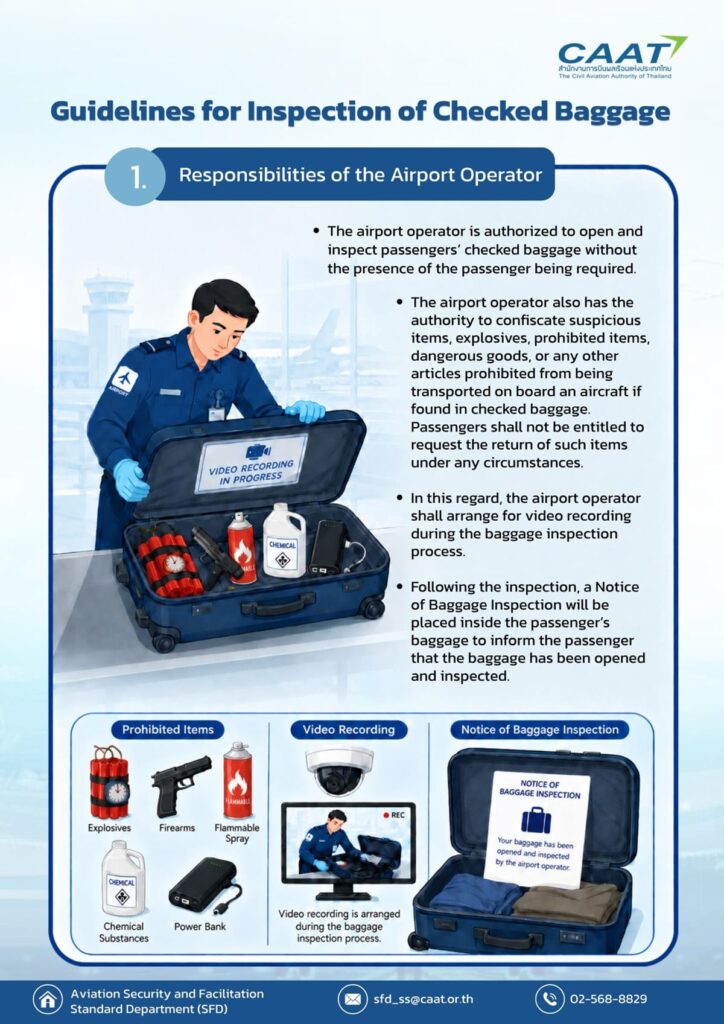
The CAAT advises travelers to carefully check the contents of their luggage before checking it in.
In its communications on the new screening procedures, the authority specifically highlights explosives, firearms, flammable aerosols, chemical substances and power banks among the items that may cause problems during screening.
Its broader dangerous goods list also includes fireworks and firecrackers, fuels and other flammable liquids, gas cylinders and cartridges, certain corrosive or toxic substances, pesticides, bleach and other chemicals, radioactive or highly magnetized materials, and some equipment containing lithium batteries.
Rules vary depending on the type of item, its quantity and the airline’s requirements. Some items are completely prohibited, while others may only be carried in the cabin or are permitted under specific conditions. This includes power banks and spare lithium batteries, which must not be placed in checked baggage.
If an item prohibited from being carried on board is found when a bag is opened, security personnel may confiscate it so it can be handled in accordance with applicable laws and regulations. The CAAT’s guidance for passengers also states that owners will not be entitled to reclaim such items.
The TAT also recommends keeping valuables, fragile items, important documents and essential personal belongings out of checked baggage. Travelers making international connections are advised to check the rules at their transit and destination airports as well, since requirements can vary from one country to another.
CAAT recommends TSA-compatible locks
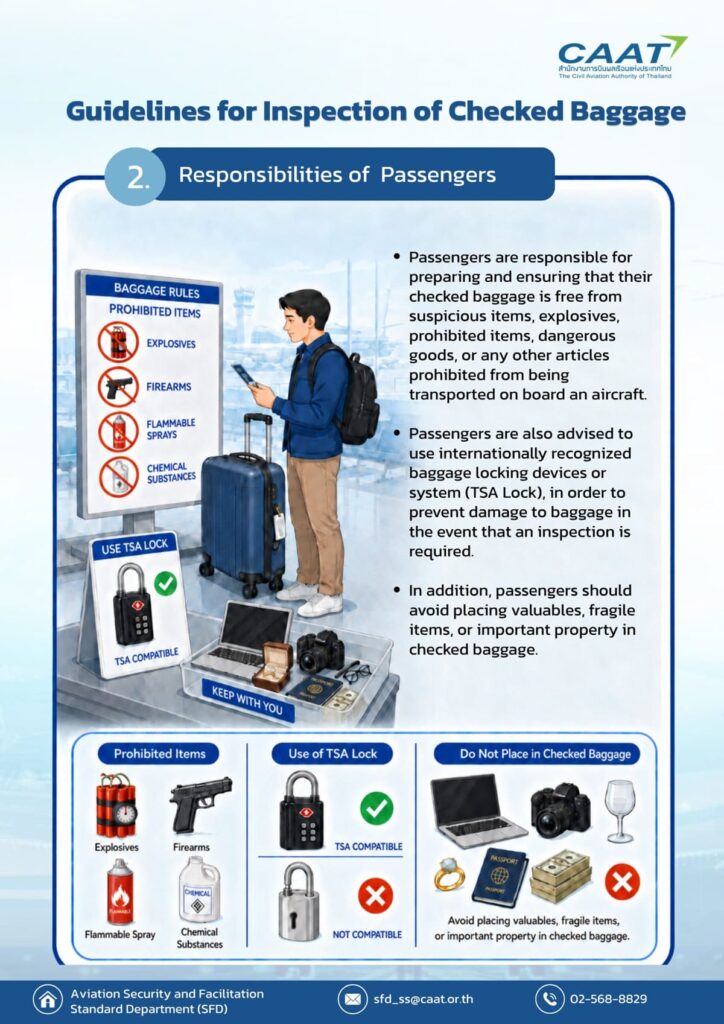
Another recommendation directly related to the new inspection procedures is to use an internationally recognized locking device, such as a TSA-compatible lock.
These locks can be opened by security personnel with a dedicated tool when an inspection is required, without damaging the lock or the bag. The CAAT had already issued this recommendation in February when it first presented the new rules.
This precaution will therefore be particularly relevant for travelers who lock their checked luggage. Thai authorities are also asking passengers to review the list of prohibited and restricted items before departure to reduce the likelihood of additional inspections.
If an inspection results in a problem or damage, travelers may contact their airline or file a complaint with the CAAT.
New rules take effect October 16, 2026
The regulations governing checked baggage inspections were issued in February 2026, but implementation was delayed to give airports, airlines and other stakeholders time to prepare their procedures, train staff and provide information to passengers.
The new procedures will officially take effect on October 16, 2026. Until then, the current checked baggage screening procedures at Thai airports will remain in place.
VisasNews Take
Starting October 16, 2026, checked baggage may be opened without the passenger present when security screening detects a suspicious item. This does not mean bags will be routinely opened. Travelers departing Thailand should nevertheless check the contents of their luggage carefully, particularly to make sure they have not left a power bank or spare lithium battery in a checked bag, and consider using a TSA-compatible lock if they plan to secure their luggage.