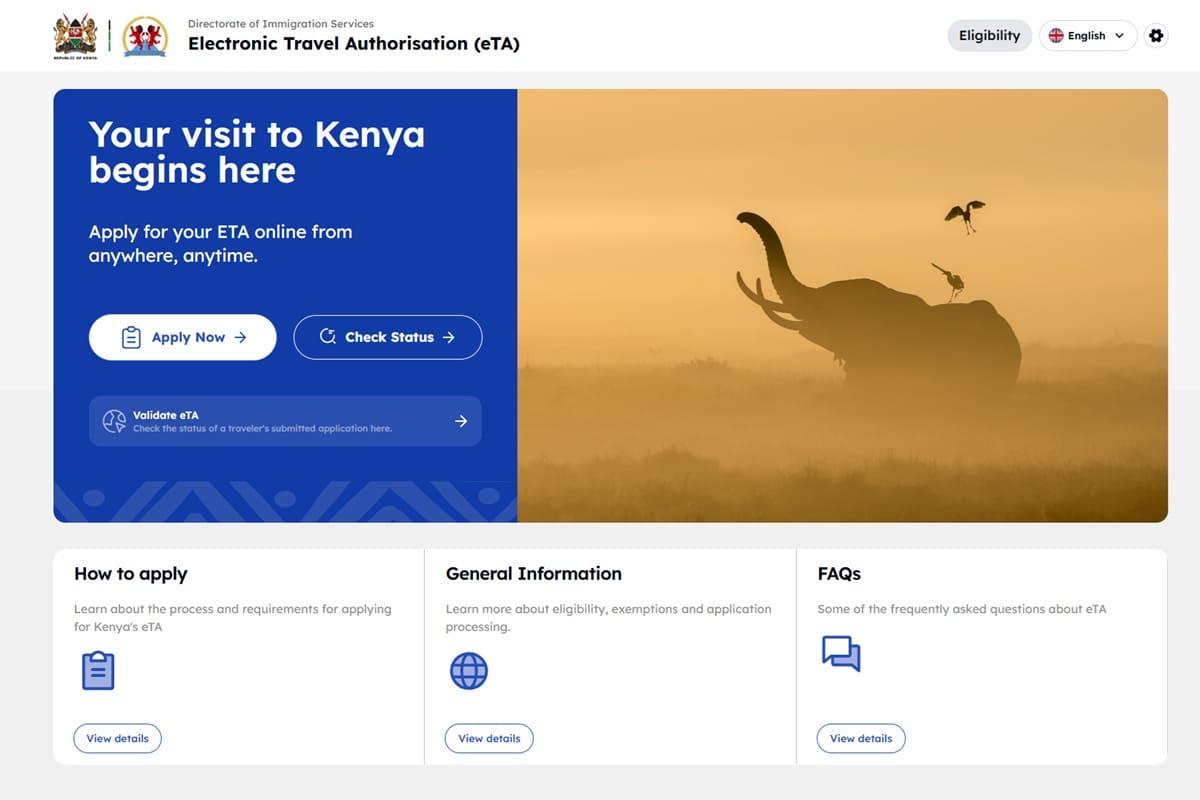
One day after mandatory travel insurance was integrated into Kenya’s ETA portal, the way the new system works is becoming clearer.
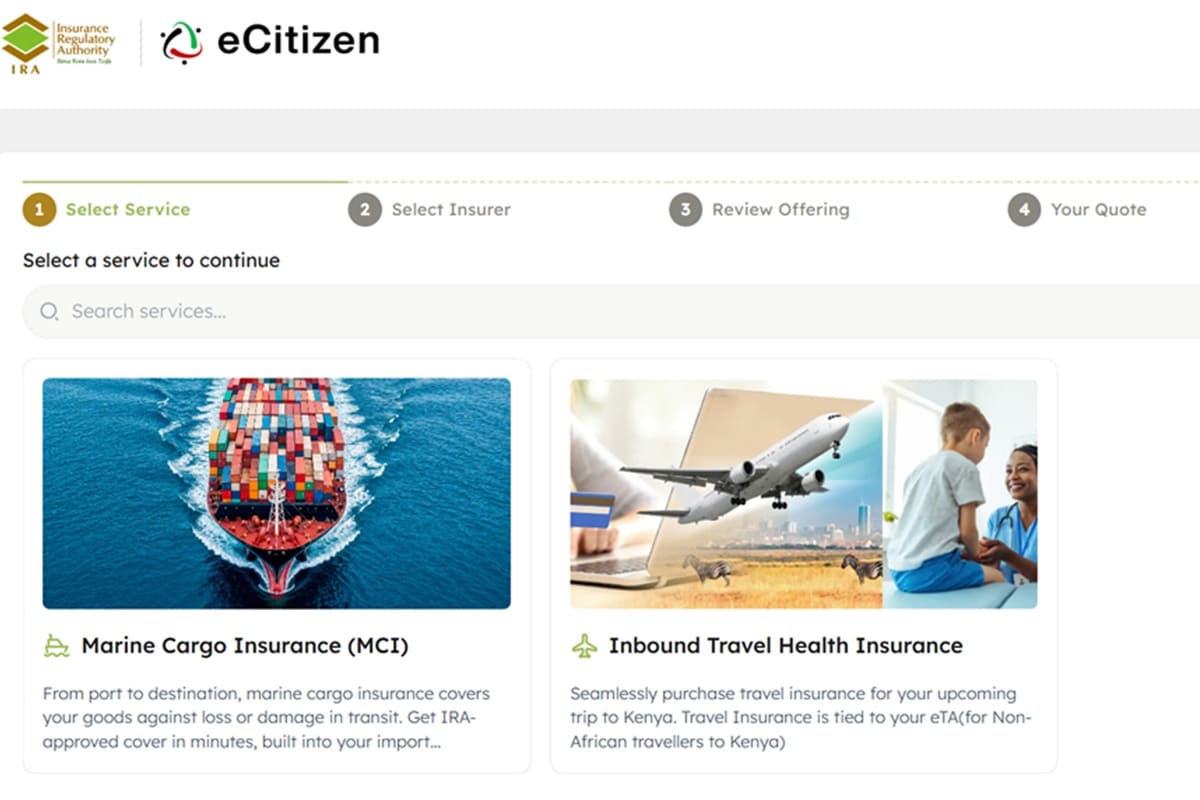
The insurance can also be purchased through a separate application process on the government-run eCitizen platform, allowing travelers to obtain coverage before even starting an ETA application.
VisasNews and Action-Visas tested the entire process on October 7, 2026, from purchasing the insurance to obtaining the electronic travel authorization.
Insurance can be purchased before applying for an ETA
The insurance.ecitizen.go.ke portal offers a dedicated service called “Inbound Travel Health Insurance.”
Travelers can apply directly for coverage by providing information including their nationality, passport, a photo or selfie, contact details, and the dates and purpose of their trip.
The system also performs a biometric comparison between the photo submitted and the image in the passport.
For travelers from the US, UK, Canada and Australia, among others, the portal indicates that an ETA is required, while still allowing them to proceed with the insurance application on its own.
No travel authorization application is created at this stage.
Insurance purchased separately is automatically detected
To verify how the two government platforms communicate, our travel documentation experts purchased two insurance policies before submitting the corresponding ETA applications.
After payment, each policy was assigned its own individual insurance reference number.
The “Search Status” function on the eCitizen portal then allows the policy to be retrieved using the passport number and displays its status as “Valid.”
A few minutes later, when the corresponding ETA application was submitted, the etakenya.go.ke portal automatically detected the insurance that had already been purchased, with no need to enter its reference number manually.
The system then displayed the message: “You already have a valid travel insurance,” along with the insurance reference.
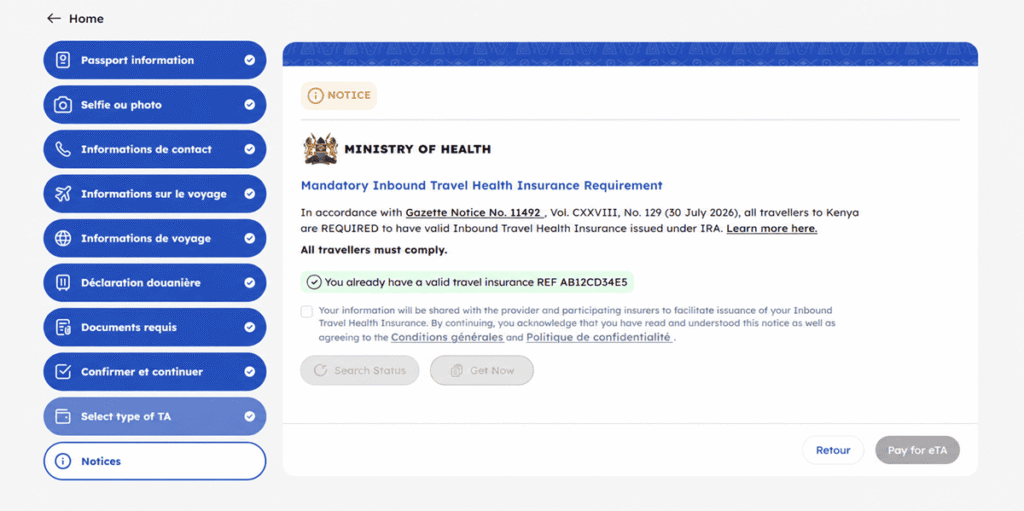
The button allowing the applicant to proceed directly to payment for the ETA then becomes available.
After the authorization has been paid for, the application summary continues to display the green “Insurance: Valid” status.
These tests therefore confirm that insurance purchased separately through eCitizen is automatically linked to the traveler within Kenya’s ETA system.
The final ETA does not mention the insurance
One notable detail remains once the ETA has been approved.
The final document issued to the traveler includes their identity details, passport number, authorization validity, number of entries and purpose of travel, but does not mention the insurance or its reference number.
For ETAs issued since this new check was introduced, approval nevertheless provides indirect confirmation that the Kenyan system recognized valid insurance coverage, since an application can no longer be completed unless coverage is detected or purchased.
That does not, however, make the ETA itself an insurance certificate.
As a precaution, VisasNews recommends that travelers keep their insurance reference number, along with, if possible, a screenshot or other proof showing the “Valid” status on eCitizen.
This appears particularly useful because, during Action-Visas’ tests, no downloadable insurance certificate or policy document was provided after payment, either immediately through the portal or by email.
An option for travelers who already have an ETA
The separate eCitizen portal also provides an important solution for travelers who received their ETA before the insurance requirement appeared in the application process.
They can now purchase the required coverage without submitting a new ETA application.
However, because their authorization was issued before the insurance check was built into the system, an older ETA obviously cannot be taken as evidence that coverage has been verified.
For these travelers, keeping the reference number of the separately purchased policy therefore appears particularly useful while further details are awaited on checks carried out upon arrival.
$44 premium, but $52 at checkout
The separate application process also confirms the amounts already observed within the ETA portal.
The insurance premium is listed at $44 per traveler, with an additional $1 access fee. Further charges are added at the payment stage. In tests conducted by VisasNews, the final amount charged was $52 per traveler.
The quote generated through eCitizen also showed a three-month coverage period.
However, there is still no information confirming whether the same policy can be used for multiple successive entries into Kenya.
All indications now point to Kenyan-issued insurance being required
Some ambiguity emerged in early August when Kenya’s Ministry of Health said that insurance purchased in a traveler’s home country could be accepted if it met the required minimum coverage levels.
Developments since then, however, point in a different direction.
During an August 20 meeting with travel industry representatives, authorities said that a standard travel insurance policy issued by a foreign insurer would not satisfy the new requirement. Instead, coverage would have to be issued under the Kenyan scheme by an insurer regulated by the Insurance Regulatory Authority.
The system now in operation appears to confirm that approach. eCitizen offers insurers participating in the IRA-backed scheme and, during tests conducted by VisasNews and Action-Visas, no option was provided to upload or submit a foreign insurance policy.
By contrast, a policy purchased through eCitizen is immediately recognized as valid within the ETA system.
In practice, all indications currently suggest that travelers must purchase coverage through the Kenyan scheme, even if they already have international travel insurance.
An updated statement from the Kenyan government would nevertheless be useful to definitively resolve the contradiction with the guidance published in early August.
High Court upholds the scheme
The last major legal uncertainty surrounding the program has also now been lifted.
According to several local media reports, on October 7, 2026, the High Court in Marsabit dismissed the petition filed by Edow Issack Mohammed and Zhulekha Mohamed Edin, which had led to the temporary suspension of the scheme in late August.
Justice Francis Rayola Olele found that Gazette Notice No. 11492 and its explanatory memorandum had been lawfully issued under the Social Health Insurance Act and its regulations.
The court also ruled that immigration officers could verify whether a traveler has the required insurance without taking over the regulatory responsibilities assigned to the Insurance Regulatory Authority.
The ruling comes just as the insurance scheme is becoming fully integrated into both the eCitizen and ETA government platforms.
A few details still need official clarification
The way the system works is now much clearer: insurance can be purchased separately, is automatically recognized during the ETA application, and continues to appear as valid after the travel authorization has been paid for.
A few points still require official clarification.
Authorities have not yet said whether a single policy can cover multiple entries into Kenya during its three-month validity period, nor have they explained why no downloadable insurance certificate is currently issued after purchase.
The status of foreign insurance policies also still deserves definitive government clarification, even though the system now in operation and information previously given to travel industry representatives both point toward mandatory use of the Kenyan scheme.
VisasNews Take
Tests conducted by VisasNews and Action-Visas now make it possible to follow the insurance process from start to finish: coverage purchased separately through eCitizen is automatically detected during the ETA application and continues to appear as valid after the authorization has been paid for. The approved ETA itself, however, contains no mention of the insurance. For authorizations issued since this new check was introduced, approval effectively confirms that the system validated the required coverage, without making the ETA an insurance certificate. Until Kenyan authorities provide further clarification, travelers are therefore advised to keep their insurance reference number and, if possible, proof of the “Valid” status shown on eCitizen.