Ghana has officially entered the e-Visa era.
Ghanaian President John Dramani Mahama inaugurated the country’s new national e-Visa platform on May 25, 2026, in Accra, during African Union Day.
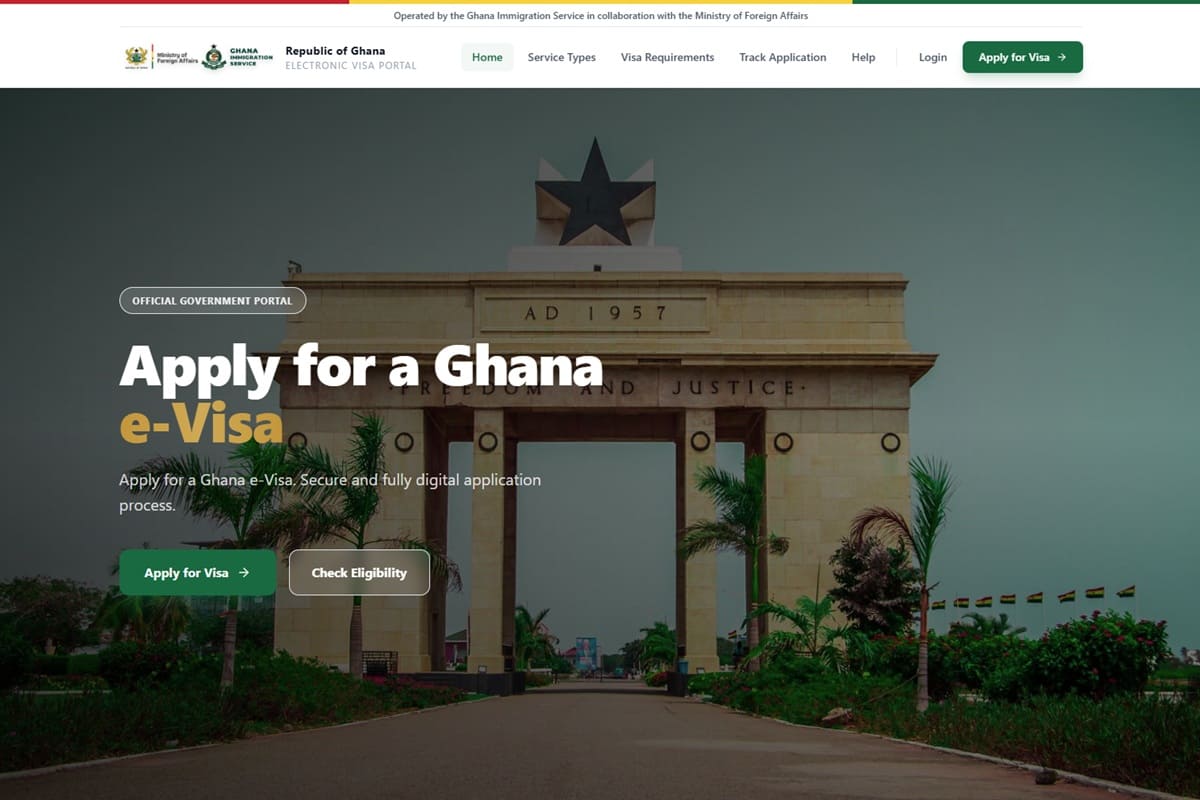
The new portal, available at evisa.immigration.gov.gh, allows eligible travelers to submit and pay for their visa application online, track their file and receive their authorization digitally. The official website says the platform is operated by the Ghana Immigration Service in collaboration with Ghana’s Ministry of Foreign Affairs.
VisasNews had previously reported the opening of the platform and detailed the main features of Ghana’s electronic visa system, including the visa categories available, processing times, visa fees and the development of an electronic travel authorization, or “ETA,” for African travelers. With its official launch, Ghana has now confirmed the rollout of this new digital tool, which is expected to become the central channel for visa applications to the country.
An official platform to replace manual procedures
According to the Ghanaian government, the e-Visa portal is intended to move visa processing from a manual system to a digital one, improving administrative efficiency, transparency and border control. The Ministry of the Interior says the reform is also aimed at strengthening authorities’ ability to identify certain risks before travelers arrive in the country.
President Mahama presented the initiative as a tool to modernize public services, as well as a way to facilitate business travel, tourism and international partnerships. For Ghanaian authorities, the e-Visa is also expected to help position Ghana as a leading digital destination in Africa.
The official portal lists several practical features, including an eligibility checker, user account creation, submission of required documents, online payment, application tracking and receipt of the electronic visa after approval.
Electronic visa fees are set at $260 for a single-entry e-Visa under normal processing of three to five business days, $338 for 48-hour priority processing and $442 for five-hour express processing. For a multiple-entry e-Visa, the listed fees are $468, $608 or $796, depending on the processing time selected.
African travelers exempt from visa fees
The launch of the e-Visa portal comes with a major political announcement.
As of May 25, 2026, holders of African passports traveling to Ghana for tourism or business no longer have to pay visa fees, according to communications from the Ghanaian presidency and the Ministry of Foreign Affairs.
However, the fee waiver does not mean entry without formalities. It takes the form of a free electronic travel authorization, or ETA, which must be requested before departure through the new online platform. Ghana is therefore maintaining a prior digital procedure that allows authorities to screen travelers before arrival, while removing the cost of the authorization for African nationals.
This distinction is important for travelers: eligible African citizens no longer have to pay visa fees for tourism or business trips, but they still need to obtain an electronic authorization before boarding for Ghana.
The move is part of Ghana’s effort to support African integration and free movement across the continent. President Mahama linked the decision to the objectives of the African Union, including the African passport initiative and the free movement of people envisioned under Agenda 2063.
A reform tied to security and the traveler experience
Ghanaian authorities have also emphasized the security dimension of the new platform.
Interior Minister Muntaka Mohammed-Mubarak said the e-Visa should strengthen border management by allowing better screening of travelers before they arrive. The Ministry of Foreign Affairs, for its part, says the platform includes a security framework that meets international standards.
The Ghanaian presidency also presented the reform as part of a broader set of improvements to the airport experience.
New 3D scanning systems are being installed in terminals at the country’s international airports to reduce certain requirements at security checkpoints, including the removal of laptops and liquids from carry-on bags. Starting in August, new equipment is also expected to eliminate the need to remove shoes and belts during screening, according to communications from Jubilee House.