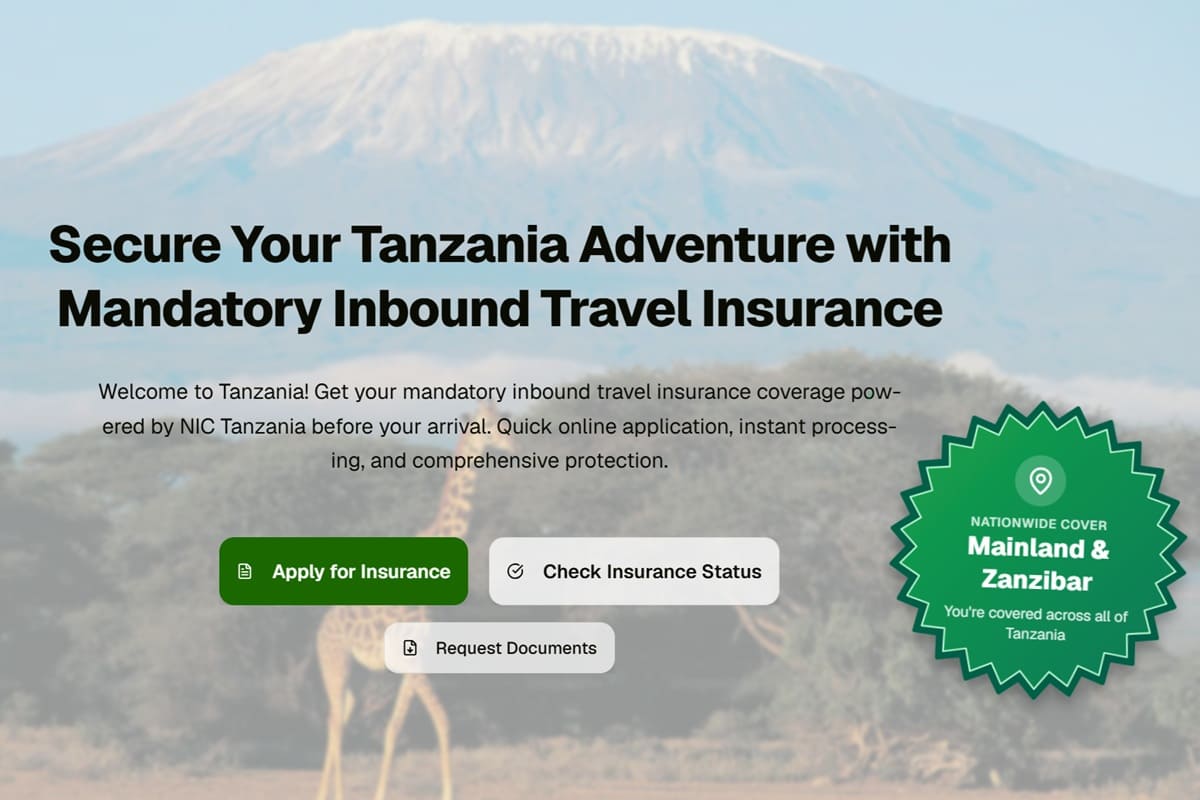
More than a year after announcing plans to require foreign visitors to purchase travel insurance, mainland Tanzania has now detailed how the system will work.
The move comes as neighboring Kenya continues to face legal hurdles over a comparable mandatory health insurance requirement for foreign visitors, after the High Court temporarily suspended its implementation in August 2026. Another case concerning, among other issues, the way the Kenyan scheme is to be implemented is due to be heard on September 29.
The Insurance (Inbound Travel Insurance) Regulations, 2026, published in Government Notice No. 256 on September 4, 2026, now set out the rules governing the new mandatory insurance requirement for foreign nationals entering mainland Tanzania. The regulations were issued under Section 134A of the Insurance Act, which was introduced through the Finance Act 2025.
Depending on the traveler’s nationality, this new mandatory insurance requirement will come in addition to Tanzania’s existing visa or e-Visa requirements.
Mandatory $44 travel insurance for entry into mainland Tanzania
Under the new regulations, foreign visitors covered by the requirement will need to hold Inbound Travel Insurance when entering Tanzania by air, sea or land.
The policy may be purchased before travel or directly at the point of entry. Once payment has been made, the insurer must issue the traveler with an insurance certificate and policy in either electronic or paper form.
The premium is set at the Tanzanian shilling equivalent of $44.
The insurance will be valid for up to 92 days from the date of arrival in mainland Tanzania and will allow multiple entries during that period. Travelers staying longer than 92 days will be required to purchase a new policy.
The regulations also provide that a foreign visitor subject to the requirement who arrives without valid insurance may be denied entry into mainland Tanzania.
What will Tanzania’s mandatory travel insurance cover?
The regulations establish four minimum areas of coverage:
- emergency medical treatment;
- emergency medical evacuation;
- emergency repatriation;
- loss of baggage.
Coverage limits, specific benefits and exclusions will have to be stated in the policy provided to the traveler.
The National Insurance Corporation (NIC), Tanzania’s state-owned insurer, will play a central role in the system. The regulations define an “inbound travel insurer” as the NIC or another registered insurer operating in partnership with it.
The NIC will also determine the conditions under which other registered insurers may participate in the scheme. Insurers’ systems will have to be connected with the relevant authorities to allow the validity of policies to be checked.
Who will be exempt from the insurance requirement?
The regulations define a “foreigner” as anyone who is not a citizen of the United Republic of Tanzania, but exclude from that definition residents of East African Community (EAC) Partner States and Southern African Development Community (SADC) Member States.
The wording is worth noting. Some reports published since the announcement have described the exemption as being based on nationality, whereas the regulations specifically use the term “residents” of EAC or SADC states.
For travelers from the US, UK, Canada, Australia and other countries who do not fall within this exemption, the insurance is therefore expected to become an additional entry requirement for mainland Tanzania once the scheme is implemented.
The rollout date has yet to be announced
Publication of the regulations is a major step, but it does not mean travelers currently need to purchase this insurance before departure.
The regulations published on September 4 do not specify when the requirement will start being enforced at the border.
The next step should therefore clarify the date from which the insurance will actually become mandatory at entry points, along with the practical arrangements for buying the policy online and for verifying coverage.
Mainland Tanzania + Zanzibar: will travelers have to buy two policies for a total of $88?
This is likely to become one of the main questions for travelers planning, for example, a safari in mainland Tanzania followed by a stay in Zanzibar.
Since October 1, 2024, Zanzibar has already required foreign visitors to purchase its own mandatory travel insurance policy.
That policy is issued by the Zanzibar Insurance Corporation (ZIC). It currently costs $44 per adult and also provides coverage for up to 92 days. It remains compulsory even when travelers already have their own medical or travel insurance.
Interestingly, ZIC documentation states that its policy is valid in Tanzania during the insured period, meaning that some of its benefits may also apply while the traveler is on the mainland.
That does not, however, necessarily mean that the Zanzibar policy will automatically satisfy the new regulatory insurance requirement for entry into mainland Tanzania.
The September 4, 2026 regulations specifically define the insurance required on the mainland as a policy issued by the National Insurance Corporation (NIC) or by a registered insurer operating in partnership with it.
In other words, already being insured by ZIC while in Tanzania and meeting the new mainland entry requirement are two separate issues.
So far, no official mechanism for mutual recognition between NIC and ZIC policies has been announced.
For an adult traveler following a typical Kilimanjaro or Arusha – safari – Zanzibar itinerary, there are therefore two possible scenarios:
- the authorities introduce mutual recognition between the two systems, avoiding the need to buy a second policy;
- the two insurance schemes remain legally separate, requiring the traveler to pay $44 for mainland Tanzania and another $44 for Zanzibar, for a total of $88.
The $88 total cannot yet be described as a confirmed requirement. It is, however, a possible consequence of the new system if no arrangement is introduced between the NIC and ZIC.
The same question also applies in the other direction: there is currently no indication that travelers holding the future mainland NIC policy will be exempt from purchasing the ZIC policy when traveling onward to Zanzibar.
Clarification from the Tanzanian and Zanzibar authorities will therefore be particularly important on this point.
After Zanzibar, mainland Tanzania finalizes its own system
When the Tanzanian government first presented the plan in 2025, it opted for a system closely modeled on the one already in place in Zanzibar, including the $44 premium and maximum 92-day validity period.
The Finance Act 2025 subsequently established the principle of mandatory insurance in Tanzanian law. It already provided that a foreign national entering mainland Tanzania by land, sea or air would be required to purchase insurance at the equivalent of $44.
The publication of Government Notice No. 256 on September 4, 2026 now provides the regulatory details that were still missing, including the period of validity, multiple-entry coverage, minimum benefits, issuance requirements and the role of the NIC.
The authorities still need to announce the operational launch date, the system travelers will use to purchase the policy before departure and, for the many trips combining the mainland and Zanzibar, how the two insurance schemes will interact.
VisasNews Take
Publication of the September 4, 2026 regulations brings mainland Tanzania significantly closer to implementing its mandatory $44 travel insurance requirement. However, no rollout date has yet been announced. Another key issue still needs to be clarified: will travelers combining mainland Tanzania and Zanzibar really have to purchase two separate $44 policies, or will the NIC and ZIC systems recognize each other’s coverage? Until the authorities provide further guidance, the potential $88 total for an adult traveler remains a possibility rather than a confirmed new travel requirement.