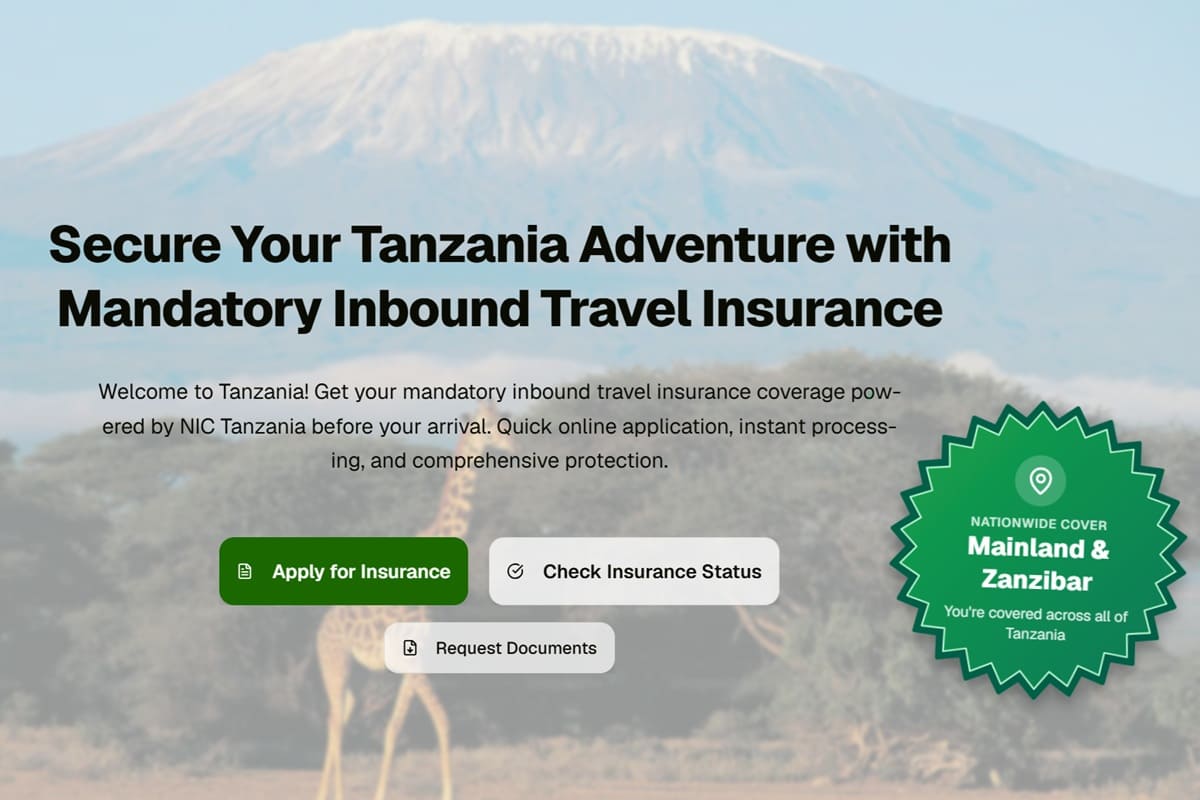
The timeline is now official. Beginning October 1, 2026, eligible foreign visitors entering mainland Tanzania will be required to hold the new mandatory travel insurance introduced by the authorities.
In a notice dated September 25, 2026 and now being shared by Tanzanian diplomatic missions, the Ministry of Finance confirmed that the Inbound Travel Insurance program will officially take effect on October 1. The announcement follows the regulations published on September 4, 2026, which set out the rules for the new coverage but did not yet specify when the requirement would begin.
The measure stems from amendments to the Insurance Act adopted in 2025. The law provides for a dedicated insurance policy for foreign visitors entering Mainland Tanzania by air, sea or land.
Mandatory $44 insurance valid for up to 92 days
The premium has been confirmed at $44 per visitor, payable in practice in the equivalent amount in Tanzanian shillings.
The policy is valid for up to 92 days from the date of arrival and also covers multiple entries into Mainland Tanzania during that period. If a stay exceeds 92 days, the regulations require the traveler to purchase a new policy.
The insurance includes four main areas of coverage:
- emergency medical treatment;
- emergency medical evacuation;
- emergency repatriation;
- loss, theft or permanent loss of baggage during the coverage period.
The coverage limits and detailed terms for each benefit must be specified in the policy issued to the traveler.
This insurance is a mandatory local entry requirement. An international travel insurance policy already held by the traveler does not automatically replace it: the regulations require coverage issued by the National Insurance Corporation (NIC) or by a registered insurer operating in partnership with NIC under the system approved by Tanzanian authorities.
The new insurance requirement does not replace existing entry formalities. Travelers who require a visa must still obtain one for Tanzania, including online through the official Tanzanian e-Visa portal.
Insurance can be purchased before departure or upon arrival
The National Insurance Corporation’s official portal, inbound.nicinsurance.co.tz, dedicated to the new requirement, is now accessible.
The regulations allow travelers to purchase the insurance before travel or directly at the point of entry. However, the Ministry of Finance recommends arranging coverage before departure to avoid additional procedures or delays upon arrival.
On the portal, travelers are asked to provide information including their identity, passport number, nationality, arrival date, contact details and expected length of stay. Once payment has been completed, an electronic certificate with a QR code is sent to the registered email address. It can be kept digitally or printed for presentation during entry checks.
The official NIC FAQ states that online payments can be made by debit or credit card, among other methods, while payment will also be available upon arrival. It also notes that travelers may be asked to present either a digital or printed certificate for verification.
The regulations are particularly clear on enforcement: a foreign traveler subject to the requirement who arrives in Mainland Tanzania without valid insurance may be denied entry.
Mainland Tanzania or Zanzibar: the insurer depends on the point of entry
The Ministry’s latest announcement also provides an important clarification for travelers combining, for example, a safari in Mainland Tanzania with a stay in Zanzibar, which has already required mandatory travel insurance since October 1, 2024.
Two insurance providers are now designated:
- the National Insurance Corporation (NIC) for travelers entering the United Republic of Tanzania through Mainland Tanzania;
- the Zanzibar Insurance Corporation (ZIC) for travelers entering through Zanzibar.
Most importantly, the Ministry states that if an emergency occurs anywhere within the United Republic of Tanzania, the traveler will receive services from the insurance provider from which the Inbound Travel Insurance policy was purchased, subject to the terms and conditions of that policy.
This wording is significant because it organizes the system according to the traveler’s point of entry into Tanzania, rather than treating the mainland and Zanzibar as entirely separate parts of the trip.
A traveler arriving first in Dar es Salaam, Kilimanjaro or at a land border in Mainland Tanzania must therefore obtain coverage through NIC. A traveler whose first point of entry is Zanzibar falls under the ZIC system.
The government notice does not, however, explicitly state that “one insurance policy is sufficient for both Mainland Tanzania and Zanzibar.” It does indicate that coverage purchased from either provider applies to emergency services occurring anywhere within the United Republic of Tanzania. VisasNews will therefore continue monitoring operational guidance issued by NIC and ZIC as the October 1 implementation date approaches.
Residents of some African countries are exempt
The requirement does not apply to every foreign visitor.
Tanzanian law excludes from the definition of travelers subject to the insurance requirement residents of partner states of the East African Community (EAC) and the Southern African Development Community (SADC). Importantly, the regulations refer to residency, rather than nationality alone.
The NIC FAQ currently reflects the same exemption for residents of EAC and SADC member states.
For travelers from the US, UK, Canada, Australia and Europe who do not qualify for one of these exemptions, the $44 insurance will therefore become an additional entry formality for arrivals in Mainland Tanzania beginning October 1, 2026.
VisasNews Take
With implementation just days away, the new system is now much clearer: the $44 price, maximum 92-day validity, online purchase portal and October 1, 2026 start date have all been confirmed. For travelers from countries such as the US, UK, Canada and Australia who do not qualify for an exemption based on residence in an EAC or SADC member state, this local insurance will need to be factored into pre-travel formalities even if they already hold their own international travel insurance. Purchasing the policy online before departure remains the simplest option, allowing travelers to have the certificate and its QR code ready for inspection upon arrival.