The world’s most powerful passports have been ranked again, with the latest figures revealing some notable changes in global travel freedom.
In its October 9, 2026 update, the Henley Passport Index confirms Singapore’s continued dominance. Singaporean passport holders can now travel to 193 destinations without obtaining a visa in advance, up from 192 in July.
Published by Henley & Partners, the index draws on Timatic data from the International Air Transport Association (IATA). It evaluates 199 passports based on the access they provide to 227 destinations worldwide.
While the top of the rankings remains largely unchanged, several developments stand out, including Malaysia’s rise and the United Arab Emirates’ continued presence among the world’s highest-ranked passports.
Singapore holds the top spot as the U.S. remains in the top 10
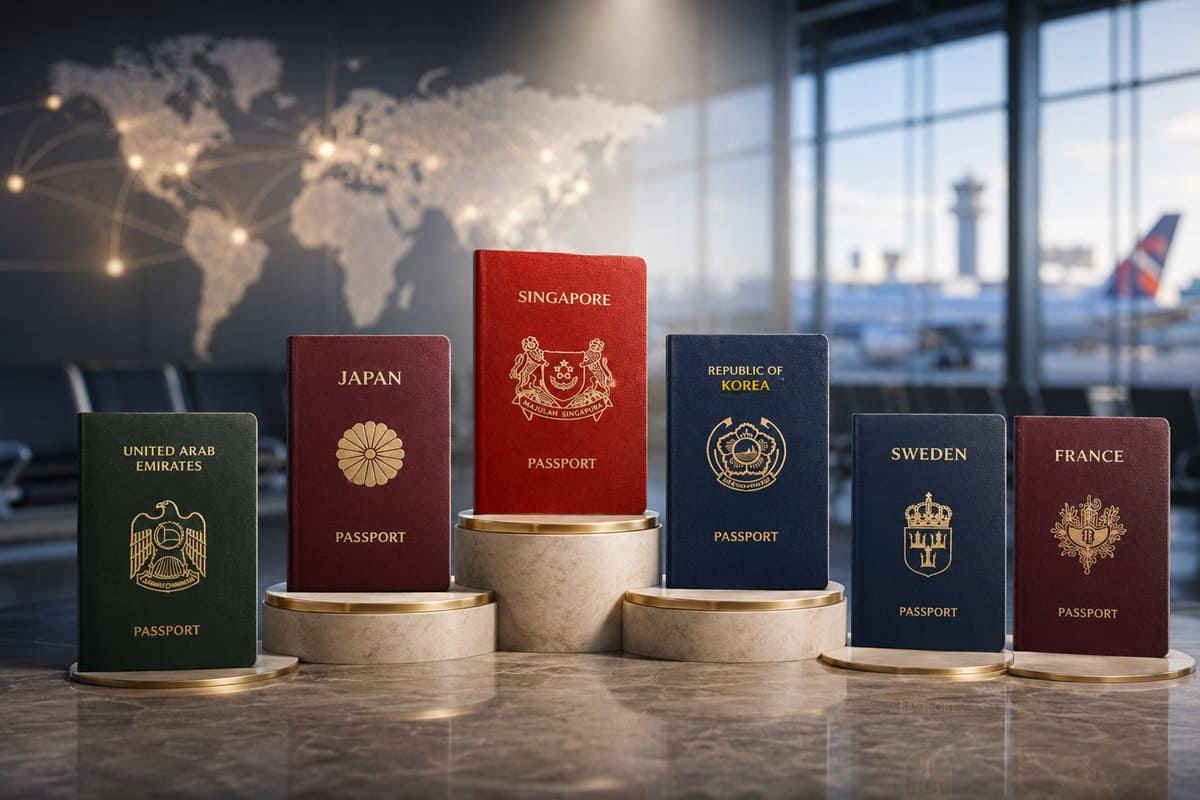
With access to 193 destinations without a prior visa, Singapore has extended its lead at the top of the global rankings. The country has gained one additional destination since July 2026, slightly widening the gap with its closest competitors.
Japan, South Korea, and the United Arab Emirates share second place, each offering access to 188 destinations without a prior visa. Sweden holds third place with 187 destinations.
Fourth place is shared by 11 European countries, all with access to 186 destinations: Belgium, Denmark, Finland, France, Germany, Ireland, Italy, Luxembourg, the Netherlands, Norway, and Spain.
These European passports remain among the world’s strongest in terms of international travel access, with France gaining one additional destination compared with the first 2026 edition of the rankings, released in January.
The United States, meanwhile, remains in 10th place, tied with Iceland, with access to 180 destinations without a prior visa.
The world’s 10 most “powerful” passports in October 2026
Here are the top 10 positions in the Henley Passport Index, based on the rankings published on October 9, 2026.
| Rank | Countries | Destinations without a prior visa |
|---|---|---|
| 1 | Singapore | 193 |
| 2 | Japan, South Korea, United Arab Emirates | 188 |
| 3 | Sweden | 187 |
| 4 | Belgium, Denmark, Finland, France, Germany, Ireland, Italy, Luxembourg, Netherlands, Norway, Spain | 186 |
| 5 | Austria, Greece, Malta, Portugal, Switzerland | 185 |
| 6 | Hungary, Malaysia, Poland, United Kingdom | 184 |
| 7 | Australia, Canada, Czech Republic, Latvia, New Zealand, Slovakia, Slovenia | 183 |
| 8 | Croatia, Estonia | 182 |
| 9 | Liechtenstein, Lithuania | 181 |
| 10 | Iceland, United States | 180 |
A total of 38 passports occupy the top 10 positions, with multiple countries sharing the same rank when their passport holders have access to an identical number of destinations without a prior visa.
European countries continue to dominate much of the top 10, although Singapore and the second-place trio of Japan, South Korea, and the United Arab Emirates hold the two highest positions.
Which passports have gained ground in 2026?
The October update does not dramatically reshape the global rankings, but it highlights several notable improvements since the beginning of 2026.
Singapore now offers access to 193 destinations, after holding steady at 192 in earlier editions of the index this year.
Malaysia has recorded one of the more notable gains. Ranked ninth in January with access to 180 destinations, the Malaysian passport has climbed to sixth place with 184 destinations. Compared with July, it has gained one destination and moved up one position.
The United Arab Emirates has also continued its remarkable rise. Ranked fifth in January with access to 184 destinations, the Emirati passport now shares second place globally with Japan and South Korea, offering access to 188 destinations.
This upward trajectory was already highlighted in Henley & Partners’ July report, which marked the 20th anniversary of the index.
The United Kingdom now ranks sixth with access to 184 destinations, up from seventh place in January.
The United States remains in 10th place with access to 180 destinations without a prior visa. The American passport has maintained its position among the world’s 10 highest-ranked passports after briefly dropping out of the top 10 in late 2025.
Afghanistan remains last, with access to just 22 destinations
At the other end of the rankings, disparities in international travel freedom remain substantial.
Afghanistan continues to occupy the bottom position in the Henley Passport Index, ranking 106th with access to just 22 destinations without a prior visa.
It is preceded by Syria (25 destinations), Iraq (28), Pakistan (29), and Yemen (30).
The gap between Singapore and Afghanistan has now widened to 171 destinations, compared with 170 in July 2026.
As the Henley Passport Index marks its 20th anniversary this year, these figures underscore the stark inequalities in international mobility based on travelers’ nationality.
A powerful passport doesn’t mean visa-free travel everywhere
Although the Henley Passport Index measures how many destinations passport holders can visit without obtaining a visa in advance, its scores do not necessarily reflect countries where travelers can enter without completing any formalities.
Under Henley & Partners’ official methodology, the index generally includes destinations offering visa-free entry, visas on arrival, and certain electronic travel authorizations (ETA).
However, destinations requiring travelers to obtain a preapproved electronic visa (e-Visa) before departure are generally excluded from the visa-free access score.
As a result, even holders of the world’s highest-ranked passports may still need to meet specific entry requirements, such as obtaining an electronic travel authorization, completing a digital arrival card, ensuring their passport meets minimum validity requirements, or presenting supporting documents at immigration.
VisasNews Take
The October rankings confirm that European passports remain among the world’s strongest, while countries such as the United Arab Emirates and Malaysia have made significant gains since the beginning of 2026. Singapore continues to lead the way, and the United States retains its place in the top 10.
Still, passport rankings alone cannot tell travelers exactly what they need to enter a particular country. Visa exemptions, electronic travel authorizations, visas on arrival, and changing border requirements can all affect entry conditions, regardless of a passport’s global ranking. Checking official government information and consulting experienced visa and travel documentation specialists therefore remains essential before traveling.