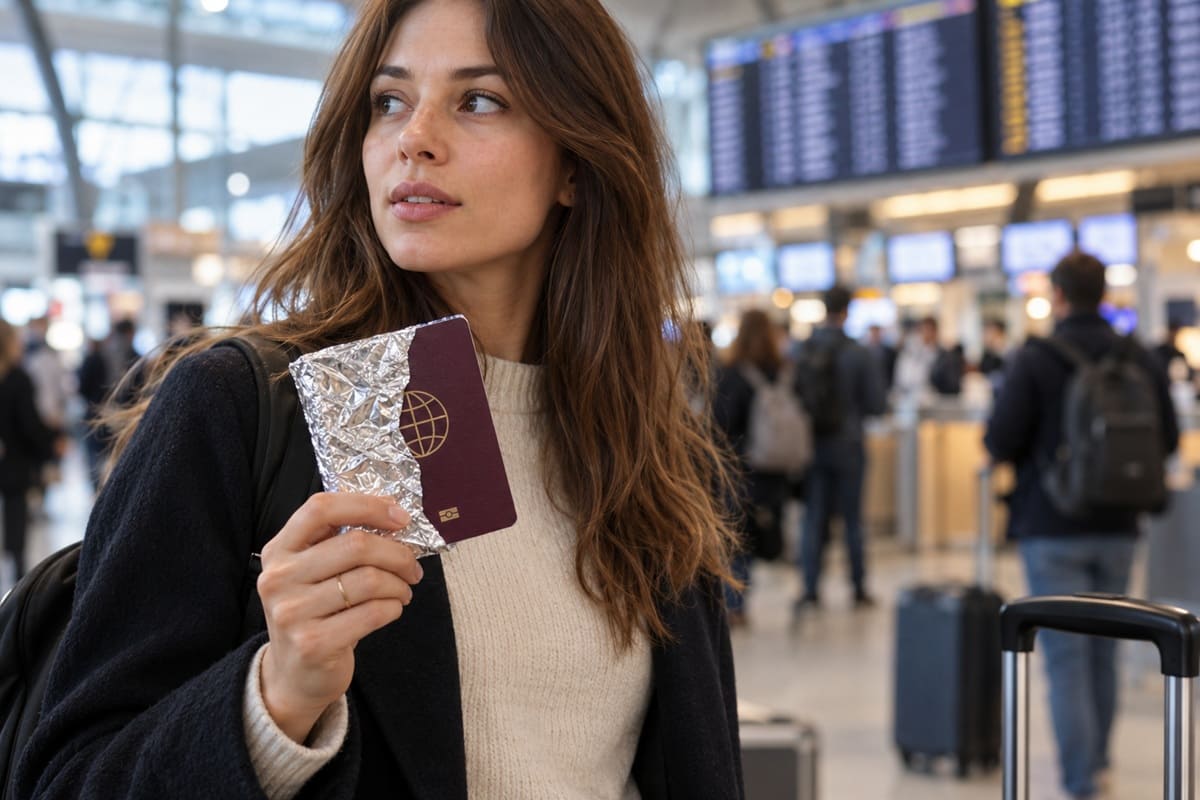
After RFID-blocking card sleeves and so-called “anti-hacking” wallets, aluminum foil has become the latest addition to the growing list of travel security tips circulating online.
In recent days, several media outlets have highlighted a practice spreading across TikTok, Reddit and online forums: wrapping a biometric passport in aluminum foil to prevent someone from secretly reading the information stored on its chip.
The goal is to protect against “skimming,” or the unauthorized contactless reading of an electronic chip.
Yes, aluminum can block radio signals
There is a genuine physical principle behind the hack.
A biometric passport contains a contactless chip that communicates with a reader using radio frequency technology. When the chip is sufficiently surrounded by a conductive material such as aluminum, radio communications can be significantly weakened or even blocked altogether.
Fully wrapping a passport in aluminum foil can therefore prevent or interfere with electronic communication with the chip for as long as the foil remains in place.
The principle itself is nothing new. Radio-frequency shielding has long been used for various contactless cards and documents.
But that does not mean a passport sitting in a pocket or bag can simply have its contents “harvested” by any RFID reader passing nearby.
A passport chip is not freely accessible
The threat described in some social media posts is far more dramatic than the way biometric passports actually work.
As the International Civil Aviation Organization (ICAO) explains, data stored in electronic passports is generally protected by access-control mechanisms. Before accessing the chip’s contents, an inspection system must establish that it is authorized to communicate with it.
Historically, one of these safeguards has been Basic Access Control (BAC). The reader uses information from the passport’s machine-readable zone (MRZ), located at the bottom of the identity page, to establish a secure connection with the chip.
In other words, the fact that a passport contains a contactless chip does not mean its contents are openly available to any nearby RFID reader.
ICAO specifically notes that these mechanisms were designed to prevent chip data from being skimmed and to protect communications between the passport and the inspection system from eavesdropping.
European passports use more advanced protections
BAC is also no longer the only security mechanism used in newer European passports.
To strengthen communication security, the European Union required the implementation of Supplemental Access Control (SAC) based on the PACE (Password Authenticated Connection Establishment) protocol.
In a decision adopted in 2011, the European Commission set December 31, 2014 as the deadline for EU member states to implement PACE v2 in their passports.
ICAO explains that PACE was specifically developed to address limitations in BAC and provide stronger cryptographic protection against the interception of communications.
In the US, electronic passports also include built-in protections against unauthorized scanning. According to the State Department, metallic anti-skimming material incorporated into the passport cover helps prevent the chip from being read when the booklet is fully closed, while access-control technology adds another layer of protection against unauthorized reading and interception.
What about fingerprints?
This is likely one of the biggest concerns surrounding the possibility of secretly scanning a biometric passport.
U.S. passport chips do not store fingerprints. According to the State Department, the chip contains the same biographical information shown on the passport’s data page, along with a digital image of the holder’s photograph.
Other countries, however, store additional biometric data on their passport chips. In the European Union, for example, passports generally include digitized images of two fingerprints in addition to the holder’s facial image.
But not all biometric data can be accessed in the same way.
Fingerprint data benefits from an additional layer of protection known as Extended Access Control (EAC). Among other requirements, a terminal attempting to access this sensitive information must be authenticated and authorized.
Simply having a contactless reader is therefore not enough to secretly retrieve all the biometric data stored on a passport chip.
Wrapping a passport in foil also has no effect on electronic visas (e-Visa) or electronic travel authorizations (ETA). These authorizations are stored in government systems and linked to the traveler’s passport details; they are not stored on the passport’s electronic chip.
So should you wrap your passport in aluminum foil?
Aluminum can indeed block radio communication with a passport chip. From a strictly technical standpoint, the idea is therefore not entirely baseless.
Its practical value for travelers, however, is far more questionable.
Biometric passports already incorporate several layers of security designed to prevent unauthorized access. The idea that someone could simply walk through an airport and remotely collect all the personal data, photographs and fingerprints from every passport around them does not reflect how these documents actually work.
Regularly wrapping and unwrapping a passport also means handling the document more often, particularly at checkpoints. What matters most is avoiding damage to the passport booklet, identity page or electronic chip, since a damaged travel document can cause problems during a trip.
And when it comes to protecting personal information, one much simpler precaution remains important: avoid sharing a full image of your passport identity page on social media, through messaging apps or on untrusted websites.
VisasNews Take
Aluminum foil can indeed block radio communication with the chip inside a biometric passport. But that does not mean it is an essential travel security measure. Modern passports already rely on several access-control and encryption mechanisms designed to prevent unauthorized reading of their data. The viral hack therefore addresses a risk that is technically possible in principle, but far more difficult to exploit than some social media posts suggest.