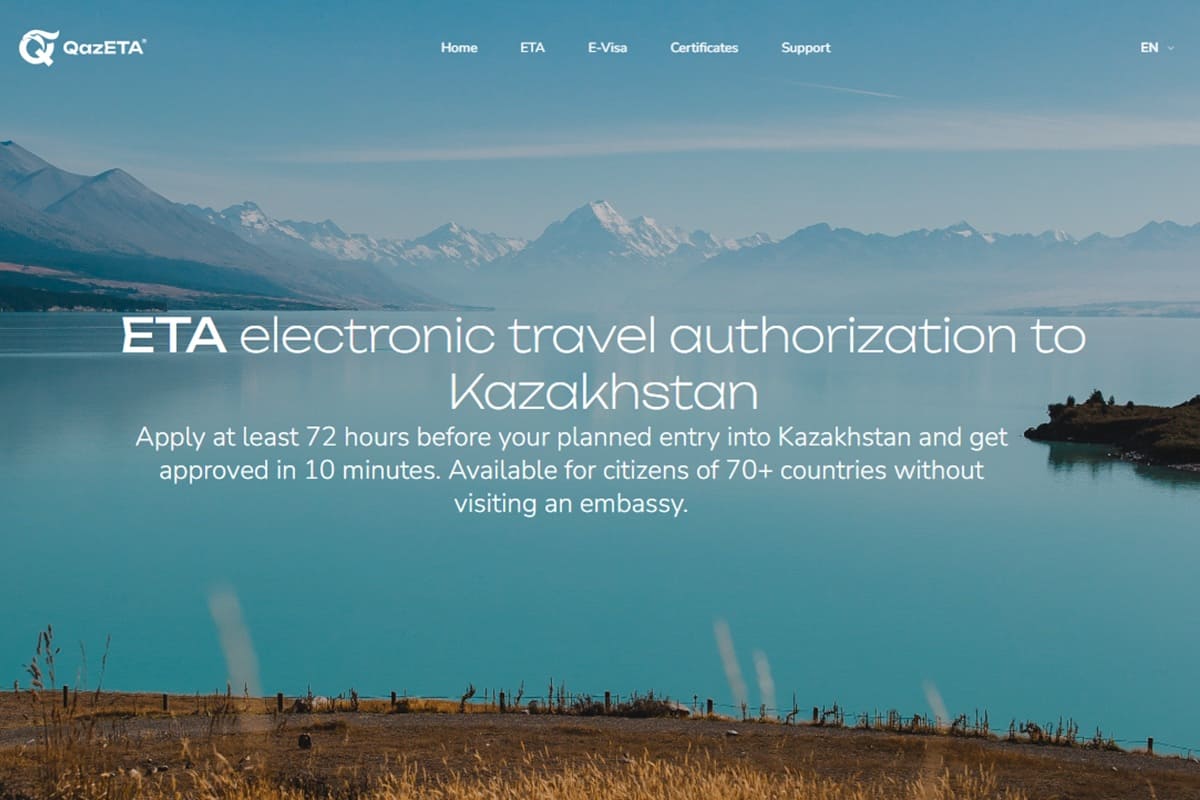
Kazakhstan is moving ahead with the rollout of its ETA, a new electronic entry requirement for visa-exempt travelers.
The Kazakh Ministry of Internal Affairs has opened a draft proposal for public consultation that would establish rules governing the issuance of an electronic travel authorization, or ETA, to foreign nationals and stateless persons before they travel.
Published on the government’s « Open NPA » portal on July 31, 2026, the proposal would amend regulations adopted in 2012 governing the entry, stay, and departure of foreign nationals. The public consultation is scheduled to remain open through August 17, 2026.
The official project summary points to a gradual rollout between August and December 2026, allowing time to adapt the country’s digital, logistical, and border infrastructure. However, it does not yet specify the ETA fee, the official list of nationalities that will be covered, or the date the requirement will actually become mandatory.
The development comes as Kazakhstan is also supporting renewed efforts to establish a common tourist visa for Central Asia, a proposal recently revived by Kyrgyzstan with backing from Uzbekistan.
An ETA for visa-exempt travelers

According to the QazETA platform, applications for the electronic travel authorization will need to be submitted through the mobile app, available on the App Store and Google Play.
Kazakh authorities have made clear that the authorization is intended for nationals of countries whose citizens can currently enter Kazakhstan without a visa.
The ETA will therefore not replace a visa. Eligible travelers will retain their visa exemption, but will eventually be required to obtain an electronic travel authorization before departure, similar to systems already used by several other countries.
QazETA is currently operating as a pilot program. During this phase, obtaining an ETA is recommended but not mandatory. Authorities say the requirement will be introduced gradually after the pilot ends.
Under the procedures currently outlined, travelers should submit their application through the mobile app no later than 72 hours before departure. The authorization will be valid for 180 days.
That validity period does not determine how long its holder may stay in Kazakhstan. The permitted length of stay will continue to depend on the visa-free regime applicable to the traveler’s nationality.
Obtaining an ETA will not guarantee admission to Kazakhstan. The final decision will remain with Kazakh border authorities at the port of entry.
The ETA will be a paid requirement
The ETA is expected to become a paid travel requirement.
Kazakhstan’s Law No. 326-VIII of June 24, 2026, creates the legal framework for the electronic entry authorization. It defines the authorization as a digital document containing the competent authorities’ decision to grant a foreign national or stateless person the right to enter Kazakhstan or transit through its territory.
The authorization will be issued by agencies under the Ministry of Internal Affairs, subject to approval by the national security authorities.
The government must still determine the fee and payment procedures. Part of the revenue collected will be used to operate and modernize the country’s digital migration-control systems, while the remainder will help support tourism development in Kazakhstan.
Strictly speaking, this does not mean that entry into Kazakhstan will become paid for all foreign visitors. The charge will apply to the electronic authorization required from certain categories of travelers.
August 25, 2026, does not yet mark the start of the requirement
Most provisions of Law No. 326-VIII are scheduled to take effect 60 calendar days after its first official publication, on August 25, 2026.
That date marks the entry into force of the legal framework allowing Kazakhstan to issue a paid ETA. It does not mean that all visa-exempt travelers will be required to present an electronic travel authorization beginning August 25.
The law states that the absence of an authorization may be grounds for denying entry to nationals of countries designated by the Kazakh government.
Implementing regulations are therefore still needed to determine:
- which nationalities will be subject to the ETA;
- any exemptions or transitional arrangements;
- the date the requirement will take effect for each category of traveler;
- the authorization fee;
- processing times and application conditions;
- the grounds for refusal or cancellation.
Holders of diplomatic or official passports, members of official delegations, and accredited diplomatic representatives in Kazakhstan are expected to be exempt from the ETA requirement.
Which travelers could be required to obtain a Kazakhstan ETA?
The Kazakh government has not yet published the official list of nationalities that will be required to obtain an ETA.
The list below covers the 85 countries and territories whose ordinary passport holders currently qualify for visa-free entry into Kazakhstan. It therefore represents the potential scope of the future ETA, but does not mean that all of these nationalities will necessarily become subject to the requirement at the same time.
Visa-free stay in Kazakhstan for up to 14 days
- Hong Kong, India, Iran, and Macao.
Visa-free stay in Kazakhstan for up to 28 days
- Barbados.
Visa-free stay in Kazakhstan for up to 30 days
- Argentina, Australia, Austria, Bahrain, Belgium, Brazil, Bulgaria, Canada, Chile, China, Colombia, Croatia, Cyprus, Czechia, Denmark, Ecuador, Estonia, Finland, France, Germany, Greece, Hungary, Iceland, Indonesia, Ireland, Israel, Italy, Japan, Kuwait, Latvia, Liechtenstein, Lithuania, Luxembourg, Malaysia, Maldives, Malta, Mexico, Monaco, Morocco, the Netherlands, New Zealand, Nicaragua, Norway, Oman, the Philippines, Poland, Portugal, Romania, Saudi Arabia, Serbia, Seychelles, Singapore, Slovakia, Slovenia, South Korea, Spain, Switzerland, Thailand, the UAE, the UK, the US, Vatican City, and Vietnam.
Visa-free stay in Kazakhstan for up to 60 days
- Dominican Republic.
Visa-free stay in Kazakhstan for up to 90 days
- Albania, Andorra, Belarus, Georgia, Kyrgyzstan, Moldova, Mongolia, Russia, Saint Kitts and Nevis, San Marino, Tajikistan, Turkey, Ukraine, and Uzbekistan.
Visa-free stay in Kazakhstan for up to 90 days within a 180-day period
- Armenia and Azerbaijan.
The future implementing regulations could establish a more limited list, introduce different timelines depending on the country, or exclude certain categories of travelers, particularly under bilateral or regional agreements.
VisasNews Take
The ETA, available through the QazETA mobile app, is expected to become an additional requirement for travelers who can currently enter Kazakhstan without a visa, rather than a replacement for the visa exemption itself. No mandatory action is required at this stage: the ETA remains in its pilot phase, and authorities have not yet announced a general implementation date or a fee. August 25, 2026, marks the entry into force of the legal framework, but not necessarily the start of mandatory ETA checks for travelers.