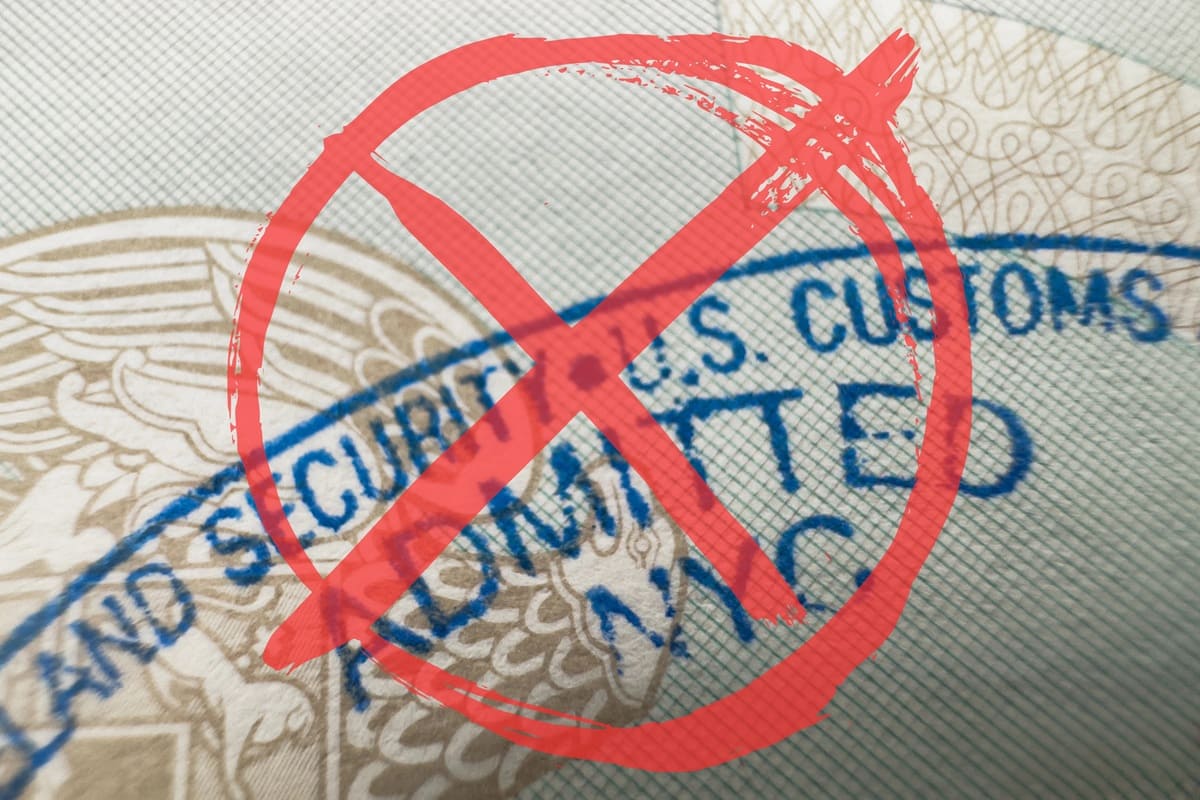
The traditional entry stamp placed in travelers’ passports upon arrival in the US will no longer be routinely issued.
In a bulletin published on October 1, 2026 by its Carrier Liaison Program, US Customs and Border Protection (CBP) announced that it will stop routinely using admission stamps during primary inspection, the initial border inspection travelers undergo when entering the United States.
The agency says the change is part of its broader modernization of border processing, which already includes greater automation of forms, expanded mobile services and increased use of facial biometric comparison.
According to CBP, eliminating routine passport stamping should help reduce both primary inspection processing times and operating costs.
US entry stamps are not disappearing entirely
The announced change does not mean passport stamps will disappear altogether.
CBP says officers may still use admission stamps during secondary inspection, when a traveler is referred for additional examination after the initial border check.
Stamps may also continue to be issued in certain specific situations during primary inspection, including in connection with immigrant visa processing.
Importantly, CBP also says travelers will still be able to request an admission stamp.
Travelers who want a physical record of their entry in their passport will therefore be able to ask a CBP officer for one, even though stamping will no longer be part of the standard procedure.
The October 1 bulletin does not, at this stage, specify a separate effective date for the change. CBP simply states that it will discontinue the routine use of admission stamps as part of its modernization efforts.
The I-94 becomes the main proof of admission to the US
In practice, the end of routine passport stamping does not mean that entry into the United States will no longer be recorded.
For foreign travelers concerned, this information is contained in the electronic I-94 record, the official arrival and departure record maintained by CBP.
After being admitted to the United States, travelers can check their proof of admission, immigration status and authorized period of stay through the official I-94 website or the free CBP Link mobile app.
The electronic record can be viewed and printed whenever proof of lawful admission to the United States is required, for example by a government agency, educational institution or employer.
CBP also advises travelers who spot an error in their I-94 record to contact the agency so that the information can be corrected.
Traveling with ESTA: no passport stamp does not change the rules
The change will notably affect the many European visitors who enter the United States under the Visa Waiver Program (VWP) with an ESTA authorization, whose fee is set to increase soon.
The absence of a passport stamp does not change the requirements of the Visa Waiver Program or the length of stay travelers are granted.
Eligible VWP nationals must still obtain an approved ESTA before traveling and may visit the United States for tourism or business for up to 90 days under the program. An approved ESTA allows a traveler to seek entry to the United States, but the final decision on admission remains with CBP at the port of entry.
The main difference will therefore be a physical one: a traveler admitted to the United States may leave border control without any visible record of that entry in their passport.
After passing through immigration, travelers will be able to check the information recorded by US authorities in their electronic I-94 record.
CBP continues to digitize US entry procedures
The gradual move away from passport stamps is the latest step in a process that has been underway for several years.
CBP had already automated Form I-94 at airports and seaports, replacing the paper form in most cases with an electronic record created from travel information transmitted to US authorities.
The agency has also rolled out its Simplified Arrival system, which uses facial comparison technology during primary inspection to verify travelers’ identities and streamline border processing.
In its latest bulletin, CBP also reminds airlines of the importance of submitting accurate information through the Advance Passenger Information System (APIS). These data feed directly into electronic entry records and the I-94 system. Incorrect or late information can therefore affect the records later available to travelers.
With routine passport stamping set to end, the electronic record will become more important than ever for confirming the terms under which a traveler was admitted to the United States.
VisasNews Take
The absence of a passport stamp after passing through US border control should therefore no longer be considered unusual. Foreign travelers, particularly those admitted under the Visa Waiver Program with ESTA, may find it useful to check their I-94 record after arrival to confirm the information recorded by CBP and their authorized period of stay. Travelers who still want a physical record of their entry will be able to expressly request an admission stamp from a CBP officer.