
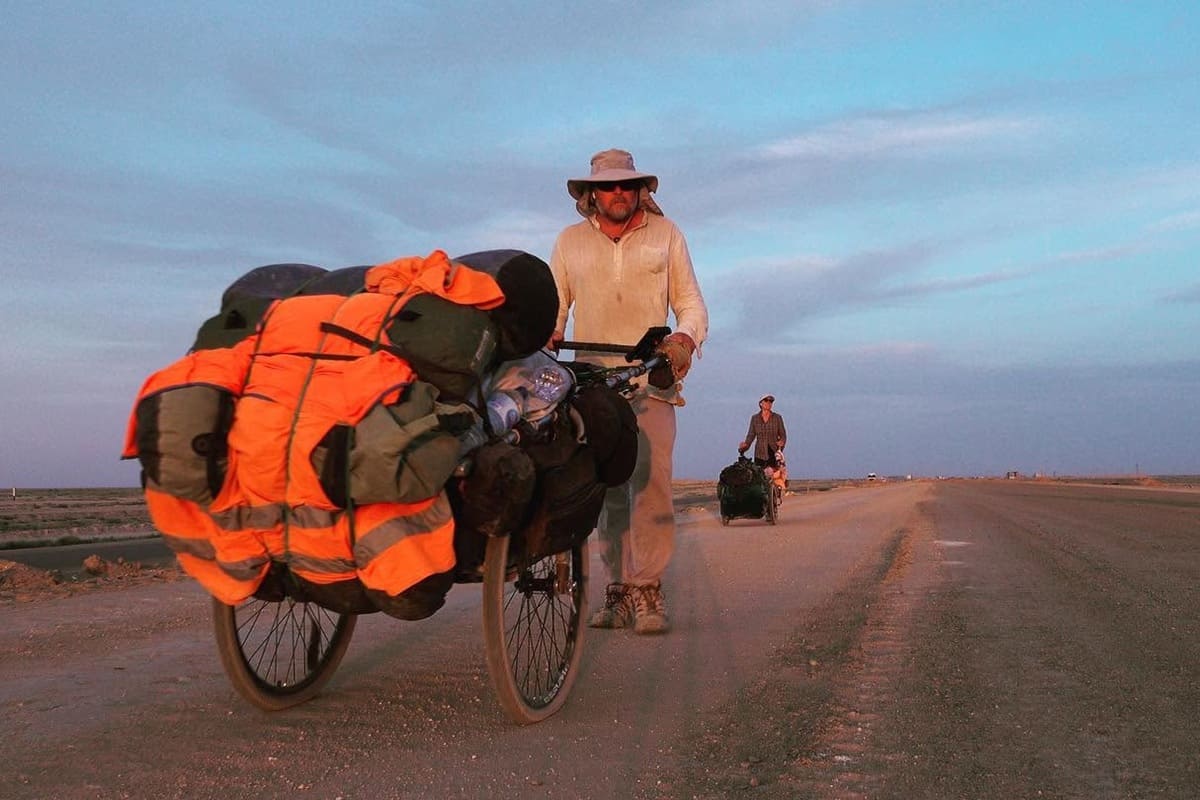
Walking home, even when the starting point is on the other side of the world. That was the challenge Bushby set himself when he left Punta Arenas, in southern Chile, on November 1, 1998.
The former British paratrooper initially expected to reach Hull in about 12 years. Nearly three decades later, his Goliath Expedition is finally entering its last stage. His official website recorded 49,110 kilometers traveled as of August 30, 2026.
In a BBC interview published on January 11, 2026, Bushby described a journey shaped as much by administrative decisions as by physical endurance. Over the years, difficulties obtaining visas have been added to conflicts, funding problems and geopolitical upheaval.
“If I had it my way, I would keep going. But the rules mean that I have to visa bounce,” he told the BBC.
Walking forward, but sometimes having to leave the country
The basic rule of the expedition concerns how Bushby moves forward: he cannot use transportation to advance along his route and cannot return home until the journey is complete. Interruptions and trips made between stages therefore do not break the continuity of the route itself.
In January 2026, Bushby was speaking from Mexico. Before Christmas, he had reached Győr, Hungary, just a few days’ walk from the Austrian border. He then left Europe for several months to comply with stay rules before returning to the exact point where he had stopped walking.
Mexico has become his main base between stages over the years. He had already spent about two years there after the 2008 financial crisis cost him financial backing while he was trying to continue across Siberia. In his BBC interview, Bushby pointed to Mexico’s relatively low cost of living, the welcome he receives there and its proximity to his supporters in the US.
In Turkey, the 90-day limit forces him to leave
A few months earlier, Turkey had provided a particularly clear example of what Bushby calls “visa bouncing.”
Bushby entered the country from Georgia in February 2025. After walking across Turkey, he reached Istanbul in early May and was exceptionally granted permission to walk across the July 15 Martyrs Bridge over the Bosphorus. For the first time in decades, he had reached the European side of his route.
But that symbolic milestone came almost exactly as his permitted stay was running out. Bushby left Istanbul that same day and returned to Mexico before being able to resume his walk in Turkey several months later.
In a Facebook Reel published on August 9, 2025, he personally discussed the 90-day restriction that forced him to temporarily leave his cart and route immediately after crossing the Bosphorus. On The Go Solo’s detailed tracking of his journey also recounts the episode.
One distinction is important when it comes to the word “visa,” a term frequently used by Bushby himself and in media coverage of his journey. British citizens traveling on an ordinary passport can visit Turkey visa-free for tourism for up to 90 days in any 180-day period. Strictly speaking, Bushby was therefore not leaving because a visa had expired, but because he needed to comply with the maximum length of his visa-free stay, in line with the entry rules published by Turkey’s Ministry of Foreign Affairs.
After spending enough time outside the country, Bushby returned to his route and finally completed his crossing of Turkey on September 1, 2025, entering Bulgaria near Edirne, as Daily Sabah reported.
His journey, then, has not been 28 uninterrupted years of walking. It has also involved waiting, paperwork, leaving countries and later returning to the exact point where his progress had stopped.
In Russia, crossing the border outside an official entry point
Long before Turkey, Russia provided one of the clearest examples of how border rules could affect Bushby’s expedition.
In March 2006, together with French-American adventurer Dimitri Kieffer, he crossed the Bering Strait between Alaska and Russia. After 14 days on shifting sea ice, the two men finally reached the Russian coast near the village of Uelen.
But they had entered Russia outside an official border crossing.
They were immediately detained by border guards. The expedition faced the prospect of deportation and Bushby being barred from returning to Russia. Legal proceedings and diplomatic intervention eventually allowed him to continue his journey.
Progress across Siberia then created another challenge: Bushby had to combine permits required for certain restricted areas, winter conditions that made it possible to walk across frozen rivers and marshland, and stays limited to 90 days in any 180-day period.
Winter therefore became both a geographical necessity and a race against the immigration clock.
In 2012, another Russian visa refusal brought the expedition to a halt. Bushby responded with an unusual approach: he set off on foot from Los Angeles to Washington to take his case to the Russian Embassy.
The roughly 5,600-kilometer walk took him in the opposite direction from Hull, but ultimately helped produce the result he wanted. In 2014, Bushby obtained another visa allowing him to continue through Russia, according to the detailed timeline of his expedition.
How an Iranian visa problem helped close the overland route
Russia was not the only country where immigration formalities altered the expedition’s route.
In 2019, after crossing part of Central Asia, Bushby reached the border between Turkmenistan and Iran. His plan was to continue west overland.
He was unable, however, to obtain the visa required to enter Iran. At the same time, his permission to remain in Turkmenistan was expiring. Once again, he had to leave the region and suspend his progress. ExplorersWeb examined what it called his “Iranian conundrum” in detail in 2021.
Tensions between Iran and Western countries, US sanctions that complicated funding for the expedition’s sponsors, and then the Covid-19 pandemic gradually closed off the available options.
By the time the journey could resume, heading north through Russia was no longer a viable alternative either, particularly after the invasion of Ukraine.
The map ultimately left Bushby with a radical alternative: swim across the Caspian Sea.
In 2024, Bushby reached Kazakhstan before crossing roughly 300 kilometers of the Caspian Sea to Azerbaijan with Angela Maxwell and Azerbaijani swimmers, supported by a dedicated crew. The crossing took 31 days and involved around 132 hours in the water. The BBC explained at the time that the route allowed him to avoid traveling through Russia or Iran.
On an expedition built around maintaining one continuous route, a visa obstacle had therefore helped turn what might have been an overland section into a sea crossing several years later.
In Europe, stay limits also force him to pause
Entering the European Union after Turkey did not mean the end of Bushby’s administrative constraints.
He entered Bulgaria on September 1, 2025, before continuing through Romania, Hungary, Austria, Germany, Belgium and finally France.
For a British citizen making a short stay, all of those countries are now part of the Schengen Area. Bulgaria and Romania became full members on January 1, 2025, following the EU Council’s decision to lift internal land border controls.
Here again, there is an important distinction between a “Schengen visa” and a visa-free stay.
British citizens can make short trips to the Schengen Area without a visa, but they are limited to 90 days in any rolling 180-day period. UK authorities note that the limit applies across the Schengen Area as a whole, regardless of how many individual countries a traveler visits.
Crossing from Bulgaria into Romania, Hungary into Austria or Germany into Belgium therefore does not reset the clock.
For someone traveling by plane, train or car, 90 days may seem more than enough time to cross Europe. For someone moving on foot, sometimes covering only 20 to 25 kilometers a day, the cumulative stay limit becomes an important part of route planning.
That is precisely why Bushby returned to Mexico after reaching Hungary in late 2025. In his January 11, 2026 interview, he said he planned to resume walking near the Hungary-Austria border in March.
The English Channel, one final border to cross
Only one major natural boundary now separates Karl Bushby from the UK: the English Channel.
His original plan was to seek permission to walk through the Channel Tunnel’s service tunnel. In January, he told the BBC that he hoped to begin discussions with the tunnel’s operators.
But in June 2026, Eurotunnel ultimately rejected the request.
The company explained that the service tunnel is a critical safety and maintenance facility and that taking it out of normal use for the time required to complete the crossing would create significant operational constraints.
Swimming then became the fallback option.
After several weeks of discussions, Bushby announced in early September that he had finally secured permission from the French authorities to attempt the English Channel crossing.
The target date is now October 1, 2026, subject to weather and tidal conditions. Bushby plans to complete the crossing in several swimming sessions, with a support boat where he can recover between periods in the water.
Once he reaches England, he will still have to walk to Hull.
His goal is now to reach his hometown by November 1, 2026, exactly 28 years after the Goliath Expedition began.
The schedule will, of course, depend on the weather and on the Channel crossing going according to plan.
After so many years, Bushby has acknowledged that reaching the end will bring mixed emotions. “It’s going to be a hard stop; the end of a life. There is also uncertainty about what happens next,” he told the BBC in January.
Before he reaches Hull, one sea crossing, one border and several hundred kilometers still remain.
And as has so often been the case over the past 28 years, the administrative work needed to make the crossing possible began long before the first step — or, this time, the first swim stroke.
VisasNews Take
Karl Bushby’s journey offers an extraordinary illustration of a familiar reality for long-term travelers: crossing a border is not simply a matter of geography. Visa exemptions, maximum stay periods, authorized entry points and closed routes can fundamentally reshape an itinerary. From Russia to Turkey, Iran to the Schengen Area, these rules have at times forced Bushby to wait for months, travel thousands of additional kilometers or even swim across a sea. His journey is also a reminder that visa-free entry does not mean an unlimited stay. On trips lasting several months, carefully tracking the number of permitted days can become as much a part of route planning as distance and weather.

