
Israel may be preparing a major expansion of its electronic visa (e-Visa) program, which has so far been available to only a limited number of travelers.
In an official announcement updated on October 23, 2026, the Israeli Embassy in Singapore invites citizens of numerous countries to apply for a B/2 electronic tourist visa through the Israel Population and Immigration Authority (PIBA) portal.
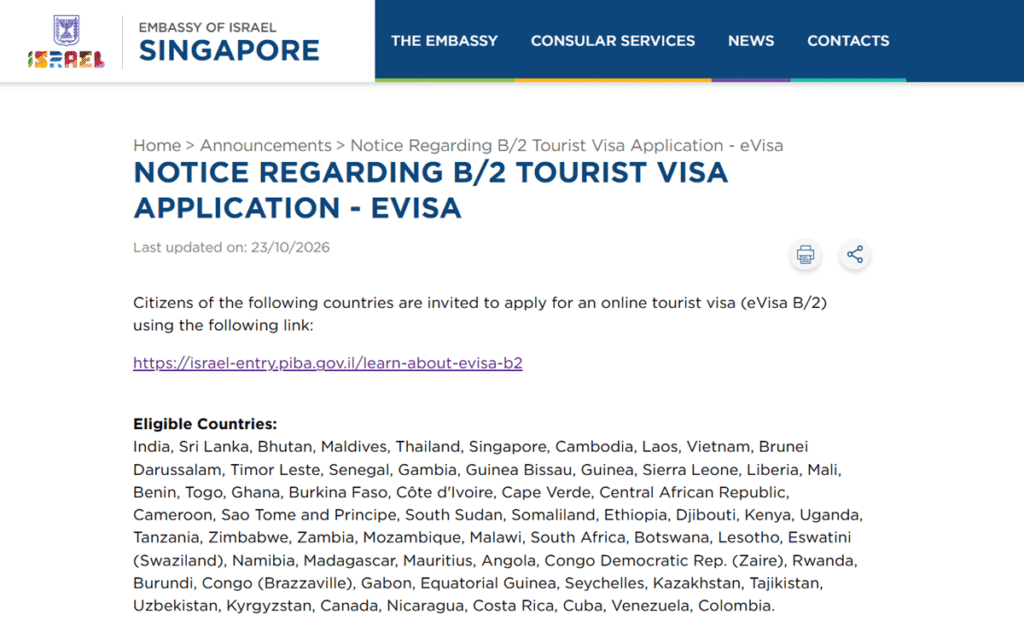
The announcement suggests a potentially significant expansion of the program, but several details warrant caution. The list published by the embassy does not match the eligibility requirements currently displayed on the government portal, which still appears to be operating under its pilot program.
Israel’s e-Visa program could expand to more than 60 countries and territories
Israel introduced its B/2 electronic visa in January 2025, initially making it available only to Indian nationals.
The program was subsequently extended to Sri Lankan citizens. Since June 25, 2025, Israeli authorities have indicated that Indian and Sri Lankan passport holders residing in India and Sri Lanka, respectively, can submit their B/2 visa applications online.
However, the new announcement from the Israeli Embassy in Singapore provides a substantially broader list, covering 63 countries and territories.
In Asia (15): Bhutan, Brunei, Cambodia, India, Kazakhstan, Kyrgyzstan, Laos, Maldives, Singapore, Sri Lanka, Tajikistan, Thailand, Timor-Leste, Uzbekistan, and Vietnam.
In Africa (42): Angola, Benin, Botswana, Burkina Faso, Burundi, Cameroon, Cape Verde, Central African Republic, Côte d’Ivoire, Democratic Republic of the Congo (DRC), Djibouti, Equatorial Guinea, Eswatini, Ethiopia, Gabon, Gambia, Ghana, Guinea, Guinea-Bissau, Kenya, Lesotho, Liberia, Madagascar, Malawi, Mali, Mauritius, Mozambique, Namibia, Republic of the Congo, Rwanda, São Tomé and Príncipe, Senegal, Seychelles, Sierra Leone, Somaliland, South Africa, South Sudan, Tanzania, Togo, Uganda, Zambia, and Zimbabwe.
In the Americas (6): Canada, Colombia, Costa Rica, Cuba, Nicaragua, and Venezuela.
If confirmed, the expansion could allow citizens of many countries that currently require a visa to complete the application process online, potentially eliminating the need to go through traditional consular procedures.
However, the embassy has not specified when the expanded eligibility would take effect.
Israel’s government portal is still blocking certain applications
Despite the announcement, the official Israel Entry portal does not appear to have been updated to reflect the expanded list.
As of October 23, 2026, the PIBA website continues to describe the B/2 e-Visa as a pilot program available to Indian and Sri Lankan citizens residing in their respective countries.
Several tests conducted by VisasNews on the application portal, using different nationalities included in the list published by the Israeli Embassy in Singapore, triggered a blocking message stating that, during the pilot phase, only Indian citizens residing in India can apply for an e-Visa.
For now, there is a clear discrepancy between the embassy’s announcement and the eligibility rules actually enforced by the application system.
The list also includes countries whose citizens already enjoy visa-free entry to Israel
Another point of concern is that the list published by the Israeli Embassy in Singapore includes several nationalities whose citizens are normally exempt from visa requirements for short visits to Israel.
This includes Canadian and Singaporean citizens, who fall under the ETA-IL electronic travel authorization system, which has been mandatory for visa-exempt travelers since January 1, 2025.
Colombia’s inclusion is particularly surprising.
Israeli authorities announced that the reciprocal visa exemption agreement between Israel and Colombia would be reinstated effective September 1, 2026.
As a result, Colombian citizens traveling to Israel for short tourist visits would normally need to obtain an ETA-IL rather than a B/2 tourist visa.
These examples raise questions about the actual scope and accuracy of the list published by the embassy in Singapore. It may have been released before being finalized or before the relevant application procedures were fully updated.
It is important to distinguish between the two systems: the B/2 e-Visa is an electronic visa intended for travelers who require a visa, while the ETA-IL is a travel authorization for citizens of visa-exempt countries.
An early announcement ahead of a broader rollout?
The communication from the Israeli Embassy in Singapore could be an early indication that a wider rollout of the B/2 electronic visa is approaching.
One possible explanation is that the announcement was published before the government application system was technically updated to accept the newly listed nationalities.
However, the possibility that the embassy released a preliminary list or one containing errors cannot be ruled out.
So far, no general confirmation of the expansion or official implementation timeline has been identified from the Israel Population and Immigration Authority.
Meanwhile, information currently available from Israeli diplomatic missions in India continues to reflect the original pilot program requirements.
Until Israeli authorities provide further clarification, travelers should rely on the eligibility requirements currently enforced through the Israel Entry portal.
Citizens of visa-required countries who are not yet able to apply for a B/2 e-Visa should continue to seek guidance from the relevant Israeli diplomatic or consular mission. Travelers from visa-exempt countries, meanwhile, remain subject to the ETA-IL requirement.
VisasNews Take
The list published by the Israeli Embassy in Singapore on October 23, 2026, suggests a major expansion of the B/2 electronic visa program, which has so far been limited to Indian and Sri Lankan nationals under a pilot scheme.
However, the announcement does not mean that travelers from all 63 listed countries and territories can already apply for an e-Visa. The government portal continues to enforce restrictions, while the inclusion of nationalities that already benefit from visa-free entry raises questions about the accuracy of the list.
One plausible explanation is that the announcement was released ahead of the program’s actual expansion. Until the Israel Population and Immigration Authority (PIBA) provides official confirmation, travelers should continue to follow the eligibility requirements currently enforced through the Israel Entry portal.