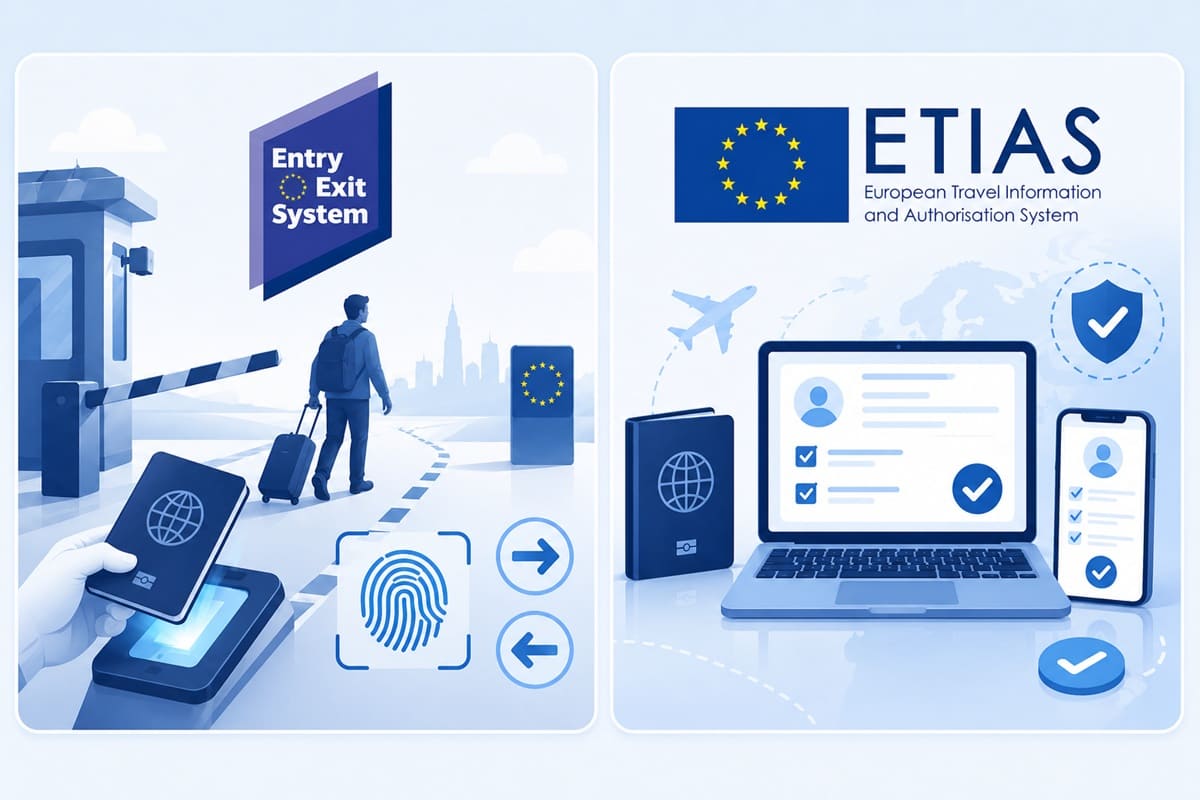
More than a year after its launch, Europe’s Entry/Exit System (EES) continues to raise concerns across the travel industry.
Designed to modernize checks at the Schengen Area’s external borders, strengthen security, and replace manual passport stamping for eligible non-EU travelers, the system has yet to fully deliver on its promise of smoother border crossings.
In a statement released on November 26, 2026, the European Tourism Manifesto is urging EU institutions to address the ongoing operational challenges associated with the EES.
The alliance brings together major industry bodies, including Airports Council International Europe (ACI Europe), the International Air Transport Association (IATA), the European Tourism Association (ETOA), and the European Travel Agents’ and Tour Operators’ Associations (ECTAA).
EES: Operational challenges persist at European airports
Introduced gradually starting October 12, 2025, and fully operational since April 10, 2026, the EES digitally records the entry and exit of non-EU nationals visiting the Schengen Area for short stays, regardless of whether they require a visa.
The system applies to travelers from visa-exempt countries such as the United States, the United Kingdom, Canada, and Australia, as well as those traveling on short-stay Schengen visas.
It collects passport information, a facial image and, depending on the traveler’s circumstances, fingerprints.
Since transitional provisions allowing the temporary suspension of biometric data collection during exceptionally busy periods expired on September 6, 2026, several European airports have reported significant operational difficulties.
Tourism industry representatives have reported lengthy lines at border control, missed connecting flights, and passengers being forced to remain on board aircraft until airport terminals have sufficient capacity to accommodate them.
Regional airports appear particularly vulnerable, especially those serving as the main gateways to popular island destinations.
Providing adequate assistance to travelers with disabilities is another area of concern, while staffing shortages, infrastructure limitations, and equipment reliability issues continue to complicate border processing.
Up to 41 million international arrivals could be at risk
Beyond the disruption experienced by travelers, tourism industry leaders are increasingly concerned about the economic consequences of these challenges and their potential impact on Europe’s appeal as a travel destination.
The European Tourism Manifesto points to research released in June by the World Travel & Tourism Council (WTTC), whose key findings were previously covered by VisasNews.
According to the study:
- 63% of international travelers would consider choosing a destination outside the Schengen Area if border delays became a recurring problem;
- 33% would be significantly less likely to visit, or would abandon their travel plans altogether, if they faced the possibility of waiting three hours or longer at border control;
- 39% of British travelers would be much less likely to visit the Schengen Area if excessive border delays became commonplace.
The WTTC estimates that up to 41 million international arrivals and $45.4 billion in tourism spending could be at risk if these operational difficulties persist over the long term.
These figures represent an assessment of the potential risks facing Europe’s tourism industry, rather than actual losses recorded to date.
In October, the WTTC also called on Europe to simplify its travel requirements, notably by improving the operation of the EES and accelerating the transition to digital Schengen visas.
Could Europe temporarily suspend EES biometric checks again?
Industry concerns are particularly acute given that stricter enforcement of biometric registration requirements is expected starting in January 2027, according to the tourism alliance.
With the busy year-end holiday season fast approaching, the organizations believe European countries are unlikely to secure the staffing and resources needed to address all the outstanding operational challenges in time.
They are therefore calling on the European Union to reinstate the option to temporarily suspend biometric data collection at border crossings until the EES is operating reliably throughout the Schengen Area.
The proposal is not intended to challenge the existence of the EES or eliminate border checks altogether. Rather, it seeks to give national authorities greater operational flexibility when border crossings become overwhelmed.
For international travelers heading to Europe in the coming weeks, however, nothing has changed for now.
The European Union has yet to announce any new measures in response to the industry’s appeal, meaning travelers subject to the EES must continue to comply with existing border entry requirements.
VisasNews Take
The collective appeal from more than 80 organizations highlights the growing concern across the tourism industry over the operation of Europe’s Entry/Exit System. While the need to modernize European borders is not in question, the system’s effectiveness remains closely tied to the operational capabilities of individual countries. With the launch of ETIAS approaching, Europe faces the challenge of demonstrating that its expanding array of digital border management tools can genuinely make international travel easier without compromising security or the appeal of its destinations.