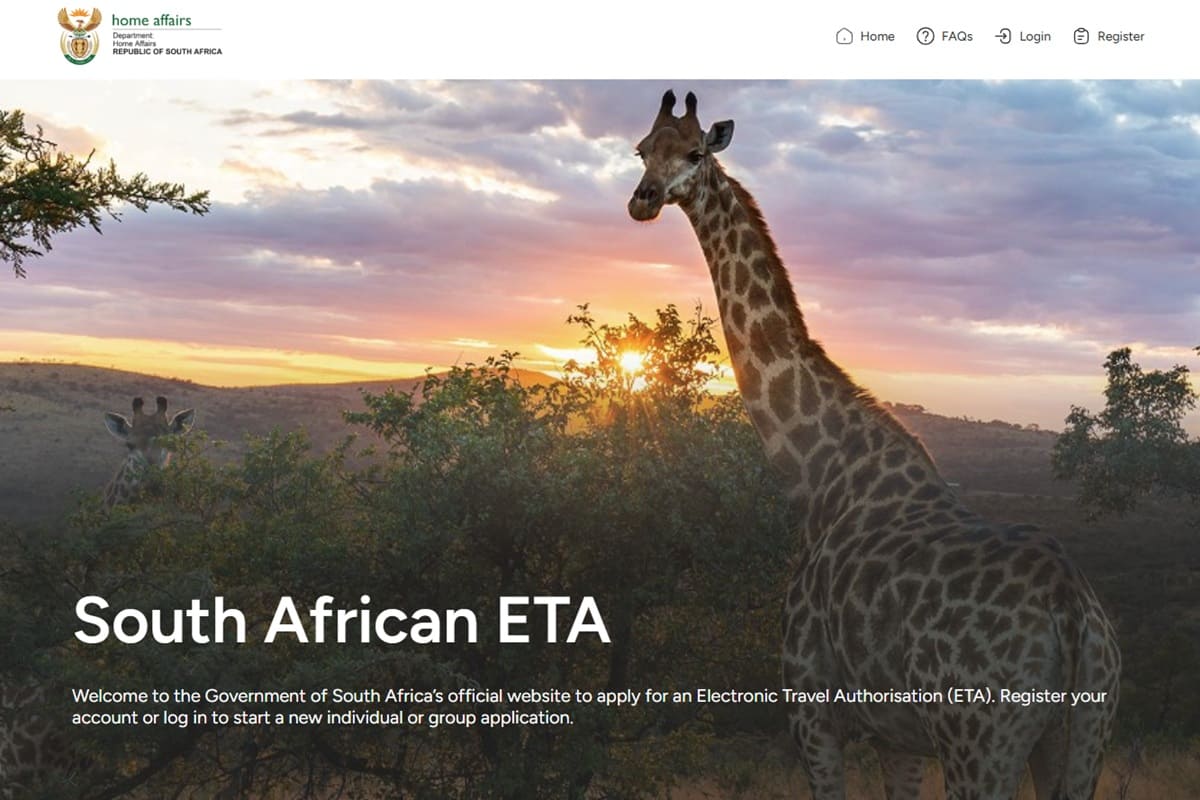
South Africa is moving forward with its transition to a new digital travel authorization system.
According to a statement from South African Tourism, reported by travel industry media on November 6, the country’s official tourism promotion agency has announced several updates to the Electronic Travel Authorisation (ETA) program. These include expanded access for 53 countries, applications for children, and new options for families and groups traveling together.
The agency also confirmed that South Africa’s existing electronic visa (e-Visa) system will be discontinued on December 1, 2026, with the new ETA platform taking its place.
The upcoming shutdown marks another step in the country’s efforts to modernize its entry procedures.
South Africa’s ETA now available to 53 countries
Officially launched on August 12, 2026 by President Cyril Ramaphosa, South Africa’s ETA was initially introduced for nationals of four countries: China, India, Indonesia, and Mexico.
The program expanded rapidly throughout August and September, with additional nationalities gradually gaining access.
On October 1, 2026, South Africa’s Minister of Home Affairs, Leon Schreiber, officially confirmed that the platform could process short-stay applications from 53 countries, while outlining plans for further expansion.
The latest announcement from South African Tourism confirms that the system now covers all markets previously included in the country’s e-Visa program.
Unlike the previous system, the ETA uses a digital application process that combines passport verification, facial recognition, and automated background checks.
Which 53 countries are eligible for South Africa’s ETA?
Although South Africa’s Department of Home Affairs does not currently provide a complete list of eligible nationalities on the public pages of its ETA portal, an infographic published on October 19, 2026, by the South African Embassy in Caracas identifies the countries added during the different phases of the rollout.
Here are the 53 countries and territories currently included in South Africa’s ETA program:
Africa (17 countries)
- Algeria, Cameroon, Comoros, Côte d’Ivoire, Democratic Republic of the Congo, Egypt, Ethiopia, Ghana, Guinea, Kenya, Liberia, Mali, Morocco, Niger, Nigeria, Senegal, and Uganda.
Americas (4 countries)
- Colombia, Cuba, Mexico, and the United States.
Asia (16 countries)
- Armenia, Bangladesh, China, Georgia, India, Indonesia, Iran, Israel, Japan, Malaysia, Oman, Pakistan, Palestine, Philippines, Saudi Arabia, and Singapore.
Europe (16 countries)
- Albania, Belarus, Bulgaria, Croatia, France, Germany, Lithuania, Moldova, Netherlands, Romania, Russia, Serbia, Slovakia, Switzerland, Ukraine, and the United Kingdom.
However, being included in this list does not mean that travelers from all 53 countries are required to obtain an ETA.
The program covers both nationalities that need a visa to enter South Africa and travelers who already benefit from visa-free entry for short stays.
For visa-exempt travelers, applying for an ETA remains optional.
New features for families and children
The expansion of South Africa’s ETA program also comes with improvements designed to make the application process more convenient.
According to South African Tourism, the platform now accepts applications for minors, whereas some of the program’s initial stages were restricted to adults.
The system also supports biometric data collection and registration in the Home Affairs National Identification System (HANIS) for children ages seven and older.
Another addition allows families and groups to submit multiple applications through a single account.
This feature is intended to simplify travel arrangements for groups, removing the need to create a separate account for each traveler.
Eligible applicants can therefore obtain their travel authorization online without visiting a visa application center to submit a traditional visa application.
South Africa’s existing e-Visa system to shut down December 1, 2026
The next major milestone will be the replacement of South Africa’s existing electronic visa platform.
According to information released by South African Tourism on November 6, the current e-Visa portal, ehome.dha.gov.za/epermit/home, is scheduled to be deactivated on December 1, 2026, with the relevant applications moving to the new ETA system.
The transition is intended to bring digital short-stay application procedures together on a single platform.
However, South Africa’s Department of Home Affairs has broader plans for the system.
Speaking on October 1, Minister Leon Schreiber explained that the ETA would gradually become the central platform for processing visa applications, permits, and other immigration services.
Additional categories, including study and work visas, are expected to be introduced beginning in 2027.
The planned closure of the existing e-Visa portal therefore does not mean that every category of South African visa will immediately become available through the ETA system in December 2026.
How to apply for South Africa’s ETA
Eligible travelers can submit their applications through the official Department of Home Affairs portal: eta.dha.gov.za.
The process is fully digital, but applicants need a smartphone to scan their passport and complete biometric identity verification.
The application involves the following steps:
- Create an account: Applicants enter their contact information on the ETA platform and verify their email address and phone number using verification codes.
- Start an application: Once logged in, travelers can begin an individual application or use the multiple-application feature for families and groups.
- Connect a smartphone: At the “Scan passport” stage, the portal displays a QR code on the computer screen. Applicants must scan this code using their phone’s camera to open the identity verification process on their smartphone.
- Scan the passport: Applicants follow the instructions on their phone to capture and scan the passport they will use for their trip.
- Complete biometric verification: The system also requires a facial image. Facial recognition technology is used to compare the captured image with the photograph in the passport.
- Complete the travel information: Applicants review their personal details and provide the required information about their planned stay.
- Pay the fees and submit the application: After checking the information, travelers pay the applicable fees and submit their application for processing.
Connecting a smartphone is therefore an important part of the application process. Travelers applying on a computer cannot simply upload a copy of their passport. Instead, they must scan the QR code generated by the platform and complete the document capture and identity verification steps on their phone.
The information collected allows South African authorities to carry out automated checks, including verifying the authenticity of the passport and confirming that it matches the applicant’s identity.
Since August 17, 2026, an electronic processing fee of 500 South African rand, approximately US$30, has applied to ETA applications. Additional visa fees may apply depending on the applicant’s nationality and circumstances.
Once approved, the ETA is linked to the traveler’s passport. It may allow multiple entries during its validity period and can be stored digitally, including on a smartphone.
The system currently covers travelers arriving through four international airports: OR Tambo International Airport in Johannesburg, Cape Town International Airport, King Shaka International Airport in Durban, and Lanseria International Airport near Johannesburg.
South African authorities plan to extend the program to additional border crossings, including land and sea entry points.
An approved ETA serves as advance travel authorization but does not automatically guarantee admission to South Africa. Final entry decisions remain with immigration officials at the border.
Do US citizens need an ETA to travel to South Africa?
No. US passport holders are not required to obtain an ETA for short tourist visits to South Africa.
American travelers continue to benefit from visa-free entry for tourism stays of up to 90 days.
However, US citizens may choose to apply for an ETA voluntarily to take advantage of expedited border processing or potentially simplify certain immigration procedures, including a possible extension of their stay.
This optional application process has been available to visa-exempt travelers since August 2026, as confirmed by tests conducted by VisasNews and Action-Visas using a French passport.
Americans who choose not to apply for an ETA can continue traveling to South Africa under the existing visa-free entry rules.
Their passports must have at least two blank pages and remain valid for at least 30 days beyond their intended departure date from South Africa.
Travelers should also ensure they meet all other applicable entry requirements before departure.
Further ETA expansion planned ahead of the 2027 Cricket World Cup
South Africa does not intend to stop at the 53 countries currently included in the ETA program.
According to South African Tourism, the next phases of the rollout will target additional international tourism markets, particularly ahead of the 2027 Cricket World Cup, which South Africa will co-host with Zimbabwe and Namibia.
The authorities aim to make travel easier for international visitors expected to attend the tournament.
However, no additional list of eligible countries or specific expansion dates has been announced so far.
For now, the immediate priority remains the transition to the ETA platform and helping travelers and tourism industry professionals prepare for the planned shutdown of the existing e-Visa system.
VisasNews Take
With 53 countries and territories now included, South Africa’s ETA is gradually becoming the country’s main digital platform for short-stay travel applications. The planned shutdown of the existing e-Visa portal on December 1, 2026, represents another milestone in this transition, although traditional visa procedures will not disappear entirely. Applicants should also be prepared to use a smartphone to scan their passport and complete biometric identity verification. For US citizens and other visa-exempt travelers, the ETA remains optional, and existing visa-free entry rules for short visits are unchanged. Travelers who require a visa should check their eligibility directly on the official ETA portal before applying.