Tanzania is stepping up health surveillance measures for international travelers.
In a new travel advisory issued on October 17, 2026, the Tanzanian Ministry of Health announced that the Traveler’s Health Surveillance Form, an online health declaration, is now mandatory for all arrivals.
The requirement took effect immediately and applies to everyone entering mainland Tanzania, regardless of nationality or country of departure.
Previously, under health guidelines issued on May 18, 2026, the declaration was required only for travelers arriving from or transiting through the Democratic Republic of the Congo (DRC) or Uganda.
The form itself is not new, but the requirement has now been extended to all travelers, including tourists flying directly from the United States, Europe, or other regions.
Tanzanian authorities say travelers can complete the declaration before departure or upon arrival.
Why Tanzania is tightening health screening at its borders
In its latest directive, Tanzania’s Ministry of Health links the expanded screening measures to the evolving Ebola outbreak in East Africa.
Officials point to two developments in particular: the ongoing outbreak in the Democratic Republic of the Congo and the emergence of cases in neighboring Kenya, initially involving a traveler who had arrived from the DRC.
The situation in Kenya worsened over the weekend.
Three cases had been confirmed as of October 16, before Kenyan health authorities reported four additional infections the following day, including several healthcare workers who had treated the initial patient.
According to Reuters on October 18, Kenya had recorded eight confirmed Ebola cases, including one death.
All confirmed infections were linked to the same chain of transmission, with no evidence at that point of widespread community transmission.
Against this backdrop, Tanzania has decided to extend its preventive measures to all international arrivals.
Travelers are now subject to health screening at ports of entry, including airports, seaports, and land border crossings. Checks include temperature screening and assessments for possible symptoms of infectious diseases.
Anyone presenting suspected symptoms may undergo additional medical examinations in accordance with national health protocols.
The Ministry of Health has also introduced mandatory 21-day health monitoring for travelers classified as being at high risk of infection.
Those individuals may receive daily automated messages or other communications to monitor their health. They must respond throughout the monitoring period, even if they have already left Tanzania.
This enhanced monitoring does not automatically apply to every visitor and should not be confused with a blanket 21-day quarantine requirement.
Mainland Tanzania and Zanzibar: Different health entry requirements
Travelers heading to Zanzibar should be aware of an important distinction.
Although Tanzania is one country, mainland Tanzania and Zanzibar have separate health authorities, which may issue different travel health requirements.
Zanzibar’s Ministry of Health published its own Ebola-related travel advisory on October 9, 2026.
Unlike the latest mainland Tanzania directive, Zanzibar’s advisory specifically targets travelers arriving from or transiting through the DRC, Uganda, or Kenya.
Travelers covered by the advisory must complete a health declaration, which can be submitted through Zanzibar’s official health surveillance portal: healthtravelznz.mohz.go.tz.
However, there is an important discrepancy: Zanzibar’s online portal more broadly states that electronic health declarations are mandatory for arriving travelers, without limiting the requirement to the three countries identified in the October 9 advisory.
Travelers flying directly to Zanzibar are therefore advised to complete the declaration through the island’s dedicated platform before departure and check the latest instructions from local authorities.
Those entering Tanzania through the mainland first, such as through Dar es Salaam or Kilimanjaro International Airport, must follow the new requirements administered through the AfyaMsafiri portal.
Visitors combining a mainland safari with a stay in Zanzibar should therefore pay attention to the health requirements applicable at each point of entry.
How to complete Tanzania’s AfyaMsafiri health declaration
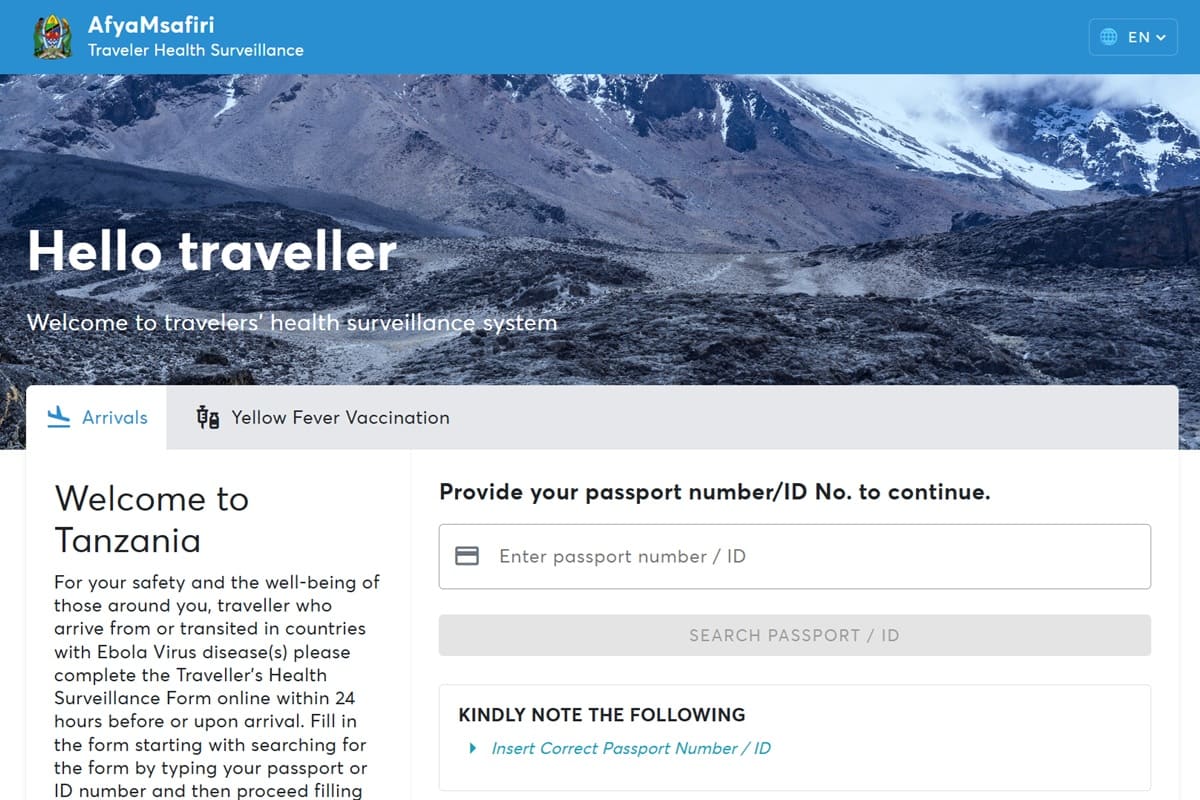
Travelers arriving in mainland Tanzania must submit their health declaration through the Ministry of Health’s official portal: afyamsafiri.moh.go.tz
The website is available in several languages and guides travelers through a series of steps.
VisasNews tested the online process to identify the information required and how travelers receive their health clearance confirmation.
1. Enter Passport and Arrival Details
On the homepage, travelers must first enter their passport or identity document number.
The system then asks them to select their point of entry into Tanzania and expected arrival date.
Entry points are organized into several categories, including airports, land borders, seaports, and lake ports.
Air travelers can choose from several airports, including Dar es Salaam’s Julius Nyerere International Airport, Kilimanjaro International Airport, and other airports across Tanzania.
2. Provide Personal Information and Trip Details
The form then collects basic personal information, including the traveler’s first and last names, sex, age or date of birth, and nationality.
Additional travel details are also required, including:
- Flight, vessel, or vehicle number, along with the seat number;
- Purpose and duration of the stay in Tanzania;
- Accommodation details and local address;
- Phone number and email address;
- Country of departure.
Authorities specify that each traveler must complete a separate declaration, including children traveling with a parent or guardian.
3. Complete the Health Questionnaire
The next section focuses on recent travel history and the traveler’s health.
Applicants must indicate how many countries they have visited during the previous 21 days and answer questions about any symptoms they may have experienced.
The questionnaire covers symptoms such as fever, headaches, muscle pain, vomiting, diarrhea, and unusual fatigue.
Travelers are also asked whether they have recently visited an outbreak-affected area, cared for someone who was ill, or attended a funeral.
Before submitting the declaration, applicants must confirm that the information provided is accurate.
4. Receive and Save the Health QR Code
Once the form has been submitted, the platform generates a confirmation document containing a QR code and a Unique Health Code (UHC).
The document includes the traveler’s identity details, nationality, passport number, arrival date, and selected point of entry.
The portal then displays an explicit instruction to save the QR code or take a screenshot and present it upon arrival in Tanzania.
Health authorities may check this confirmation during entry screening.
When should travelers complete the health declaration?
The October 17 directive states that travelers may submit the declaration before departing for Tanzania or upon arrival.
However, the AfyaMsafiri homepage currently advises travelers to complete the form within 24 hours before arrival, or upon entering the country.
During our test, VisasNews was nevertheless able to complete the process and obtain a QR code for an arrival date more than 24 hours in advance.
At this stage, the government’s official advisory does not specify a mandatory pre-travel submission window.
There is another noteworthy inconsistency: the AfyaMsafiri homepage still displays instructions referring only to travelers arriving from or transiting through Ebola-affected countries.
The website’s introductory guidance has apparently not yet been fully updated to reflect the October 17 directive, which now applies to all travelers entering mainland Tanzania.
To avoid additional paperwork during arrival screening, travelers are advised to complete the declaration online before departure and keep an accessible copy of their QR code.
Another entry requirement following Tanzania’s mandatory travel insurance
The expanded health declaration requirement comes just weeks after another entry formality was introduced for international visitors.
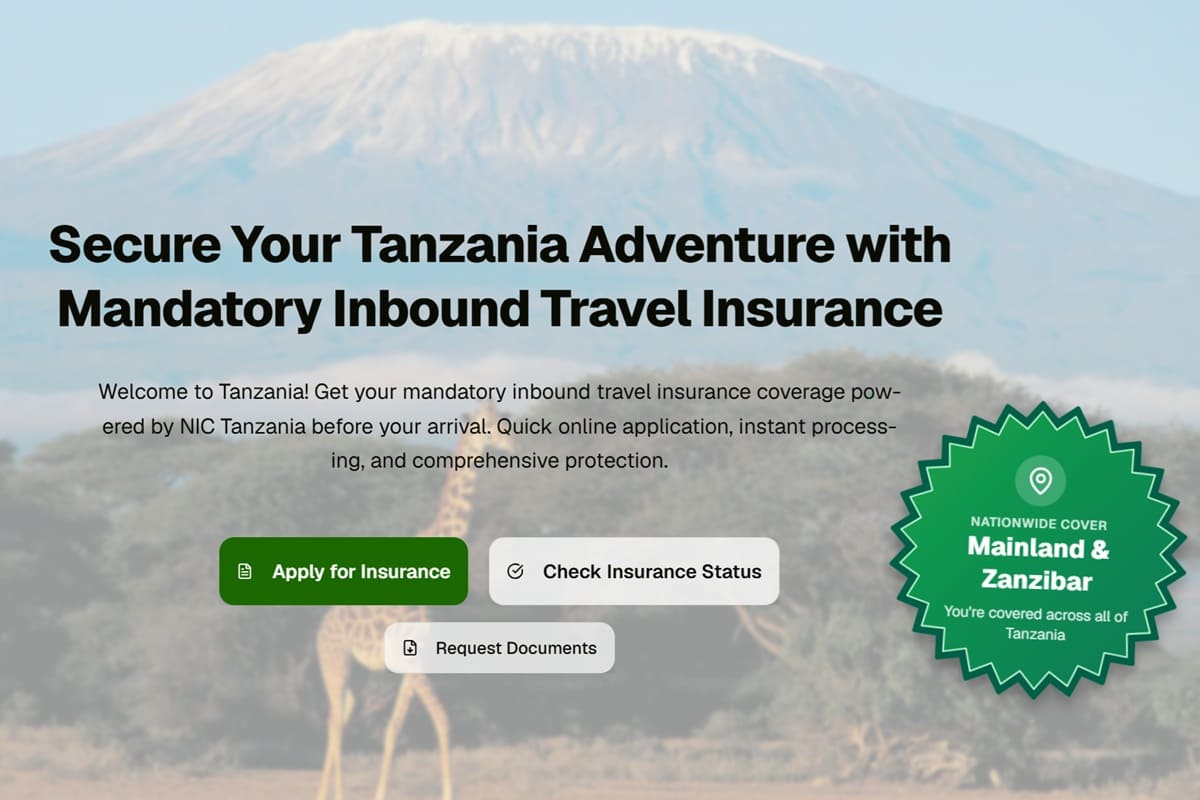
Since October 1, 2026, Tanzania has required mandatory travel insurance for covered visitors, with a standard fee of $44 for adults.
Tanzanian authorities have also clarified how the insurance requirements apply to travel between the mainland and Zanzibar.
The AfyaMsafiri health declaration is a separate requirement from this insurance coverage, as well as from any applicable visa or e-Visa procedures.
The tighter screening measures reflect heightened health vigilance across the region. As early as May, several countries had already strengthened border health checks in response to Ebola.
Tanzania’s Ministry of Health says the new guidelines may be reviewed and updated as the epidemiological situation evolves.
VisasNews Take
Under the October 17, 2026 directive, mainland Tanzania has expanded a health declaration requirement previously limited to travelers arriving from certain high-risk areas. The AfyaMsafiri portal allows travelers to obtain a QR code after providing their trip details and completing a health questionnaire. Although the website still displays outdated guidance referring to Ebola-affected countries, the new requirement applies to all travelers, regardless of their country of departure. Travelers flying directly to Zanzibar should follow the island’s separate health entry procedures.