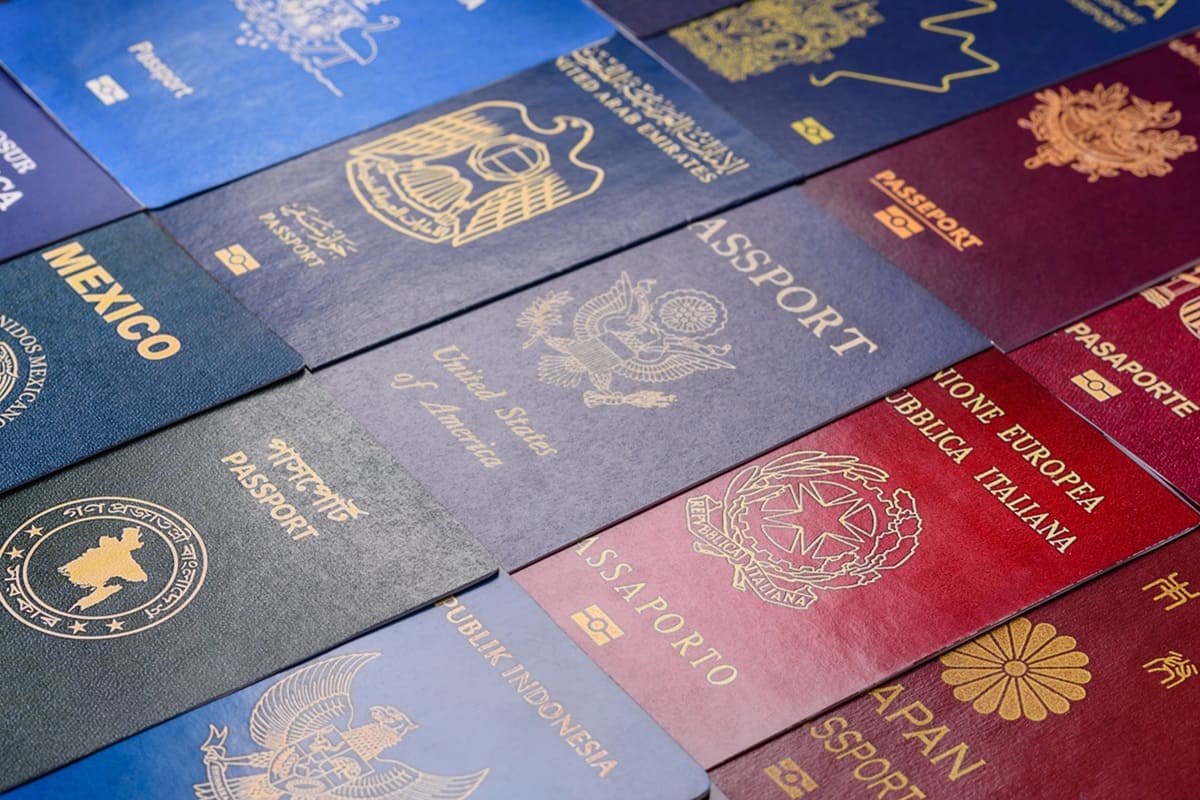
For the second year in a row, Singapore retains the title of the world’s “most powerful” passport, offering visa-free access to 192 destinations. At the other end of the scale, Afghanistan once again ranks last, with passport holders able to travel to just 24 destinations without a prior visa.
The 168-destination gap starkly illustrates how wide mobility disparities have become in 2026, a divide that has deepened significantly since 2006.
Henley & Partners notes that the Henley Passport Index, marking its 20th anniversary, is based on exclusive Timatic data from IATA and ranks passports according to the number of destinations their holders can enter visa-free.
“Over the past 20 years, global mobility has expanded significantly, but the benefits have been distributed unevenly,” explains Dr. Christian H. Kaelin, Chairman of Henley & Partners and creator of the Henley Passport Index.
He emphasizes that “passport privilege plays a decisive role in shaping opportunity, security, and economic participation,” with advantages increasingly concentrated in economically powerful and politically stable nations.
The Top 10 “most powerful” passports in 2026
Beyond Singapore, the top of the index is dominated by Asia and Europe, with Japan and South Korea tied for second place (188 destinations), and a large group of European countries filling the podium.
Here is the Top 10 for 2026:
| Rank | Passport | Visa-free score |
|---|---|---|
| 1 | Singapore | 192 |
| 2 | Japan, South Korea | 188 |
| 3 | Denmark, Luxembourg, Spain, Sweden, Switzerland | 186 |
| 4 | Austria, Belgium, Finland, France, Germany, Greece, Ireland, Italy, Norway, Netherlands | 185 |
| 5 | Hungary, Portugal, Slovakia, Slovenia, United Arab Emirates | 184 |
| 6 | Croatia, Czech Republic, Estonia, Malta, New Zealand, Poland | 183 |
| 7 | Australia, Latvia, Liechtenstein, United Kingdom | 182 |
| 8 | Canada, Iceland, Lithuania | 181 |
| 9 | Malaysia | 180 |
| 10 | United States | 179 |
The ranking underscores the strong concentration of European passports at the top while confirming the rise of several non-European nations, including the United Arab Emirates, Malaysia, New Zealand, Australia, and Canada.
A relative decline for the U.S. and the U.K.
While the United States has re-entered the Top 10 after briefly falling out in late 2025, the return masks a longer-term downward trend. Both the U.S. and the U.K., which jointly held first place in 2014, recorded their steepest single-year declines in visa-free access in 2025.
Over two decades, the United States has fallen from 4th to 10th, the third-largest drop of any country, while the United Kingdom has slid from 3rd to 7th.
According to Misha Glenny, award-winning journalist and Rector of the Institute for Human Sciences in Vienna:
“Passport power ultimately reflects political stability, diplomatic credibility, and the ability to shape international rules.” He adds that the erosion of mobility rights for the U.S. and the U.K. “is less a technical anomaly than a signal of deeper geopolitical recalibration.”
UAE, the Balkans, and China: The big climbers
Over the long term, the United Arab Emirates is the standout success story, adding 149 destinations since 2006 and rising 57 places to reach 5th position, driven by active diplomacy and widespread visa liberalization.
Countries across the Western Balkans and Eastern Europe have also surged upward thanks to regional integration and closer alignment with the European Union: Albania, Ukraine, Serbia, North Macedonia, Bosnia-Herzegovina and Georgia all gained dozens of places over the past 20 years.
China also emerges as a major mover, climbing 28 places over the last decade and now granting access to 141 destinations, reflecting a deliberate strategy of gradual openness.
Open borders, closed doors: Mobility as soft power
The report highlights a widening contrast between outbound mobility and inbound access.
While U.S. passport holders can travel visa-free to 179 destinations, the United States only allows 46 nationalities to enter visa-free, placing it 78th on the Henley Openness Index.
By contrast, China now admits 77 nationalities visa-free, having opened up to more than 40 countries in just two years.
“There is a visible shift underway in the global balance of power, marked by China’s renewed openness and the USA’s retreat into nationalism,” analyzes Dr. Tim Klatte, Partner at Grant Thornton China. “As countries increasingly compete for influence through mobility, openness is becoming a critical component of soft power, ” he adds.
Tightening U.S. and EU border controls
The Henley Global Mobility Report 2026 warns that a U.S. Customs and Border Protection proposal could effectively end hassle-free travel to the United States for citizens of 42 allied nations by requiring extensive biometric and personal data, stored for up to 75 years.
“For Europeans long accustomed to near-frictionless travel, the implications go far beyond inconvenience,” warns Greg Lindsay, non-resident senior fellow at the Atlantic Council. He argues that such requirements enable “real-time ideological screening” and carry risks of data repurposing or misuse.
In Europe, commissioned research shows that recent visa reforms reinforce barriers for African travelers: Schengen rejection rates for African nationals rose from 18.6% in 2015 to 26.6% in 2024, despite only small increases in applications.
“These policies do not simply regulate mobility — they institutionalize it,” argues Prof. Mehari Taddele Maru, describing a “form of conditional racial discrimination” driven more by geopolitical power than individual risk.




En ce moment mieux vaut être européen qu’américain. Chez nous, on ne te passe pas les menottes et on ne t’ enferme pas dans une prison pour avoir oublié tes papiers à la maison. On vous laisse le rêve ou plutôt le cauchemar de l’oncle Donald. Que dieu vous aide.