
The United Arab Emirates (UAE) is expanding its visa-on-arrival program to a new group of foreign travelers.
In a statement published on June 25, 2026, the UAE Ministry of Foreign Affairs announced that nationals of Indonesia, Vietnam, Thailand, the Philippines, Kenya, and South Africa can now obtain a visa on arrival in the United Arab Emirates. The measure applies to holders of ordinary passports, as well as their accompanying family members.
However, this facility is not a general visa exemption for all citizens of these six countries. It applies to travelers living outside their home country who hold a valid residence permit issued by one of the countries or regions listed by the Emirati authorities.
A foreign residence permit is still required
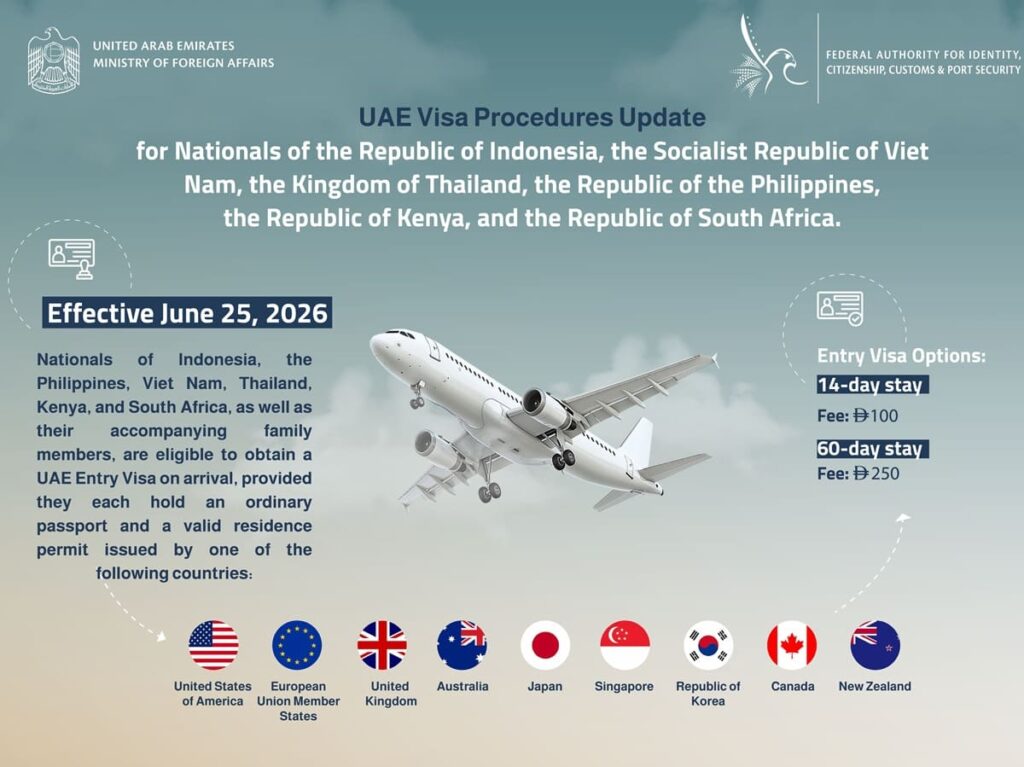
To qualify, eligible travelers must present a valid residence permit issued by the United States, an EU member state, the United Kingdom, Singapore, Japan, South Korea, Australia, New Zealand, or Canada.
The same condition also applies to accompanying family members. In other words, a Filipino, Vietnamese, Thai, Indonesian, Kenyan, or South African national cannot automatically obtain a visa on arrival based solely on their passport.
The Ministry of Foreign Affairs describes the expansion as a measure designed to make travel to the UAE easier, while strengthening economic, cultural, and people-to-people ties with the countries concerned.
Two lengths of stay available
The program offers two visa-on-arrival options: a 14-day visa and a 60-day visa.
The 14-day visa can be extended once during the stay in the United Arab Emirates. The 60-day visa, by contrast, is issued for a single stay and cannot be extended. Travelers must leave the UAE once their visa expires.
The issuance fees are set at AED 100 for the 14-day visa and AED 250 for the 60-day visa. Travelers who overstay their authorized period of stay are subject to a fine of AED 50 per day.
VisasNews Take
This measure could make entry into the United Arab Emirates easier for many travelers already living in the United States, Europe, the United Kingdom, or several major Asia-Pacific countries. Still, the rule remains clearly conditional: nationality alone is not enough, and the valid foreign residence permit is the key document. Before departure, eligible travelers should therefore check not only their passport, but also the issuing country and validity of the residence permit they plan to present on arrival.