The Philippine government has decided to extend the temporary relief measures put in place in early March for foreign travelers stranded in the country.
In a new order signed on March 30, the Department of Justice extended through May 1, 2026, the easing of stay requirements granted to individuals affected by flight cancellations and ongoing restrictions that continue to disrupt international return travel.
The decision comes just ahead of the deadline set by the initial order, which had until now allowed eligible foreign nationals to remain lawfully in the Philippines through April 1.
In Manila, authorities said that many travelers have still been unable to arrange their departure under normal conditions. “We do understand that there are still some visiting foreigners who have difficulty going back because of the restrictions, of the various constraints,” Acting Justice Secretary Fredderick A. Vida said at a press conference.
An extension with no fees, fines, or penalties
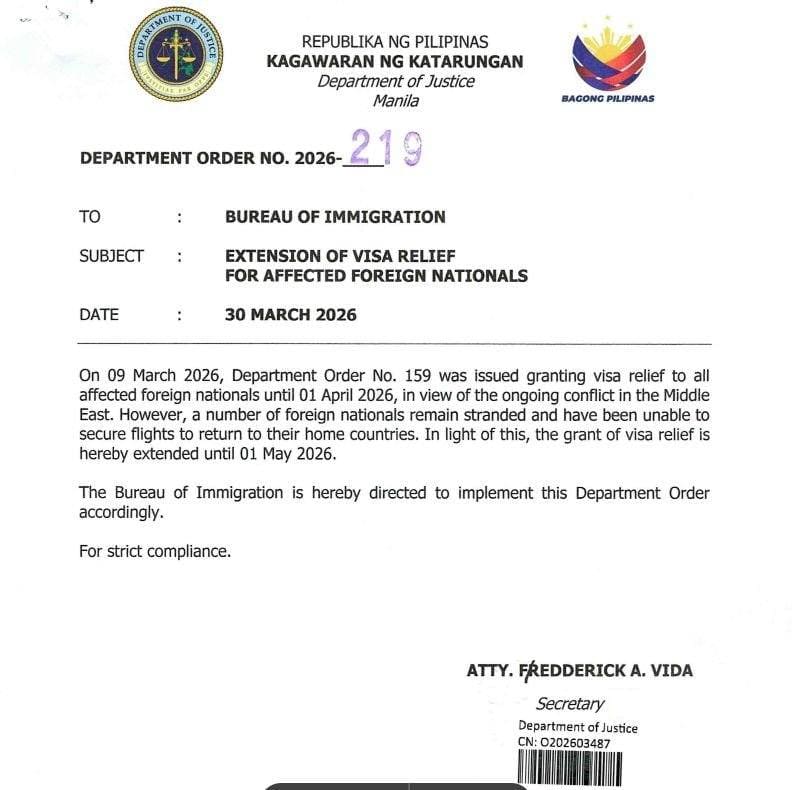
In practical terms, the new measure extends the policy first announced on March 9 under Department Order No. 159.
That order applied to foreign nationals whose authorized stay expired on or after February 28, 2026, against a backdrop of disrupted international air traffic caused by the conflict in the Middle East.
According to details provided today by the Department, the extension through May 1 will not involve any payment of fees, fines, or penalties for individuals covered by the measure. The aim is to prevent travelers who are unable to leave for reasons beyond their control from falling out of lawful status.
The Bureau of Immigration has been tasked with implementing the new directive, in line with the initial order.
A decision framed on humanitarian grounds
Philippine authorities are presenting the extension as a pragmatic response to a situation that remains unstable.
The Department of Justice emphasized the humanitarian dimension of the decision, noting that its primary purpose is to provide relief to foreign nationals still stranded in the archipelago. “We did this unilaterally for humanitarian reasons and on the premise of compassion,” Fredderick A. Vida said.
Beyond the administrative aspect, Manila is also seeking to ease legal concerns among affected visitors, as the regional fallout from the conflict continues to weigh on air links and return options.
The government said it hopes that current obstacles will have been resolved by May 1. “We also pray that hopefully before the expiry of May 1, the issues have already been resolved,” Fredderick A. Vida added.
Manila also seeks to reassure the tourism sector
Alongside the extension of these visa-related accommodations, Philippine authorities issued a broader message to the travel sector on March 31.
In a statement, the Department of Tourism said the country remains “open for business and tourism,” despite a context marked by rising fuel costs and broader economic uncertainty.
The administration stressed the importance of supporting an industry that is essential to millions of Filipinos and, in that context, encouraged more flexible and accessible forms of travel, including short local getaways, community-based tourism, homestays, and experiences centered on nature, wellness, and local cuisine.
Travelers are also being encouraged to plan ahead, use accredited operators, and adopt responsible practices, including paying attention to energy-saving measures where they stay, favoring sustainable transportation and environmentally friendly accommodations, and reducing their day-to-day electricity consumption.