Until now, travelers who did not meet Singapore’s entry requirements were generally “intercepted” upon arrival at immigration counters.
Going forward, Singapore’s Immigration & Checkpoints Authority (ICA) will rely on advance passenger information, such as flight manifests, the digital SG Arrival Card (SGAC), and other data sources, to conduct risk assessments before departure.
When these checks indicate that a passenger is inadmissible, deemed undesirable, or does not meet entry requirements, the ICA issues a No-Boarding Directive (NBD). This directive is sent directly to the airline, which is then required to deny boarding on flights bound for Singapore.
The system currently applies to airlines operating flights into Changi and Seletar airports.
Who may be subject to a No-Boarding Directive for Singapore?
Singaporean authorities have clarified that NBDs may apply in several situations, including:
- the absence of a valid visa when one is required;
- a travel document with less than six months’ remaining validity;
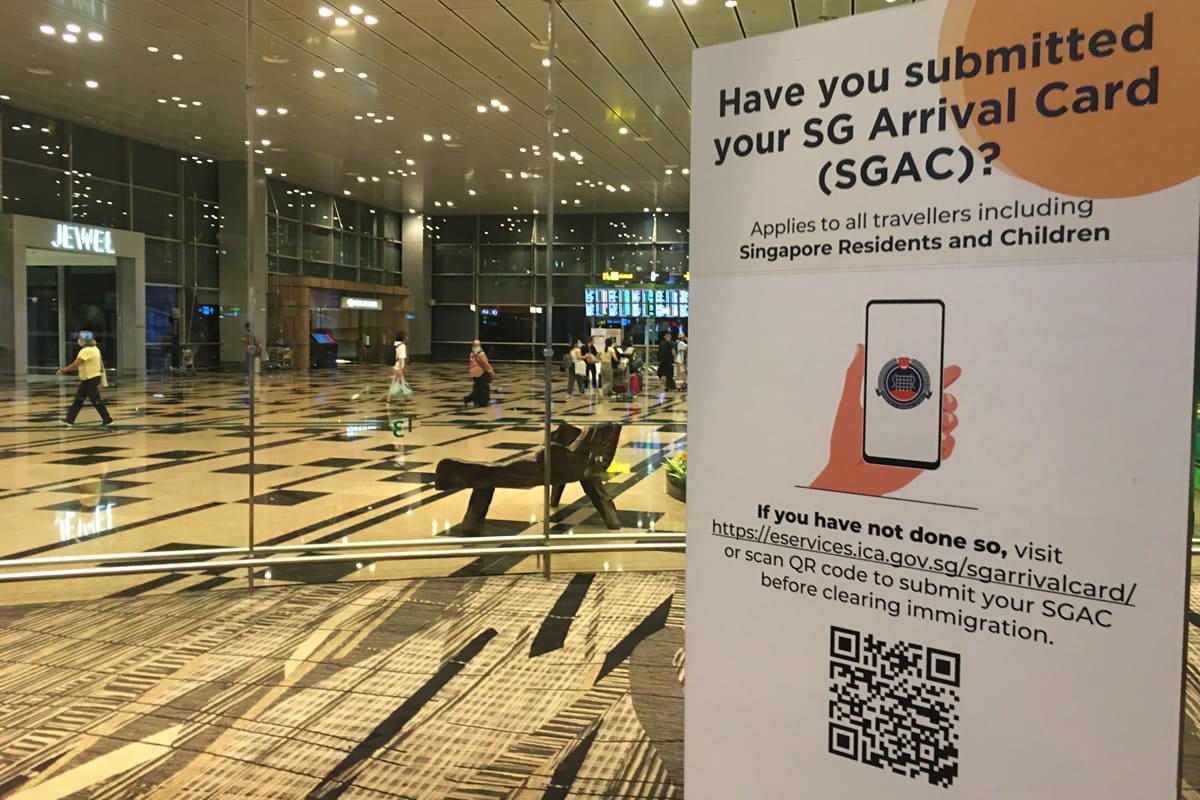
- an SG Arrival Card (SGAC) that has not been submitted or has been completed incorrectly;
- immigration or security records that lead authorities to classify a traveler as inadmissible or undesirable.
In some cases, the ICA may also instruct airlines to carry out additional checks at check-in before authorizing a passenger or crew member to board.
Strengthening Singapore’s border security
According to the ICA, the purpose of the NBD system is to prevent potential threats from reaching Singapore by stopping their travel at the point of departure.
This approach reflects the evolution of border controls, which increasingly rely on data analytics amid sustained air traffic volumes, as Singapore continues to record high levels of international travel.
According to the Singapore Tourism Board (STB), the city-state welcomed 16.9 million international visitors during the first three quarters of 2025, a 2.3% increase compared with 2024. Mainland China (3.1 million), Indonesia (2.4 million), Malaysia (1.3 million), Australia (1.3 million), and India (1.2 million) were the top five source markets.
The STB also forecasts between 17 and 18 million visitors in 2026, despite ongoing economic and geopolitical uncertainties, underscoring the importance of proactive and efficient border flow management.
For authorities, shifting controls to the departure point also reduces operational pressure upon arrival and avoids the need to return inadmissible passengers after landing.
Compliance with NBDs is mandatory. Under Singapore’s Immigration Act of 1959, an airline that fails to comply with a No-Boarding Directive may face fines of up to SGD 10,000.
Liability also applies at the individual level: a pilot or airline employee who knowingly or negligently allows a person subject to an NBD to board may face a fine, imprisonment of up to six months, or both.
Gradual expansion to other checkpoints
In a recent parliamentary response, the Minister for Home Affairs and Coordinating Minister for National Security, K. Shanmugam, outlined the appeal process in a written reply published by the Ministry of Home Affairs (MHA).
Travelers denied boarding may appeal to the ICA through its official feedback channel. If the appeal is approved, they may then book a new flight to Singapore. However, no immediate appeal mechanism is available at the time boarding is denied.
The NBD system currently applies to air checkpoints and will be extended to maritime checkpoints by the end of 2028. At this stage, the ICA does not plan to apply the system to land checkpoints, where most travelers arrive independently, making advance screening more difficult to implement.
For travelers, the message is now clear: entry screening for Singapore begins before boarding. Verifying document validity and compliance with entry requirements in advance has become an essential step before any journey to the city-state.