The rules governing electronic visas for Russia could undergo significant changes.
A draft law published on Russia’s official regulatory proposals portal outlines several changes to the country’s unified electronic visa system, including its validity period, permitted length of stay, and entry requirements.
Specifically, the proposal seeks to amend Article 25.16-1 of Federal Law No. 114-FZ of August 15, 1996, which governs entry into and exit from the Russian Federation.
The proposed changes could allow foreign visitors to spend more time in Russia, but they would also significantly shorten the period during which an issued electronic visa could be used.
The changes remain proposals and have not yet taken effect.
Russia could reduce e-Visa validity to 45 days
The most significant proposed change concerns the electronic visa’s validity period.
Since August 23, 2025, eligible travelers have been able to obtain an e-Visa valid for 120 days from the date of issuance, allowing them to stay in Russia for up to 30 days.
The draft legislation would reduce that validity period to 45 days.
Unlike the current system, which distinguishes between the visa’s validity period and the maximum permitted length of stay, the proposed rules would allow foreign nationals to remain in Russia throughout their e-Visa’s validity period.
Article 1 of the draft law would replace the current limit of “no more than 30 days from the date of entry” with permission to stay “throughout its entire validity period.”
While this could allow travelers to spend more time in Russia than they currently can, it would also have important implications for trip planning.
Travelers could stay until their electronic visa expires
The distinction between visa validity and permitted length of stay is the key point travelers need to understand about the proposed reform.
Under the current rules, travelers have 120 days from the date their e-Visa is issued to enter Russia, with a maximum permitted stay of 30 days. They must, however, leave the country before their visa expires.
Under the proposed system, the length of stay available would depend directly on when the e-Visa was issued and when the traveler entered Russia.
For example, someone entering Russia 30 days after their electronic visa was issued would have only about 15 days left to stay in the country.
Conversely, a traveler entering immediately after receiving their e-Visa could, in theory, remain in Russia for nearly the entire 45-day validity period.
The main differences between the current rules and the proposed changes are outlined below:
| Requirement | Current rules | Proposed changes |
|---|---|---|
| e-Visa validity | 120 days | 45 days |
| Maximum stay | Up to 30 days after entry, within the visa’s validity period | Until the visa expires, up to a maximum of 45 days |
| Number of entries | Single entry | Single entry |
The change could therefore provide greater flexibility for travelers planning longer stays in Russia, provided they apply for their visa close enough to their intended departure date.
At the same time, it would substantially reduce the window in which an issued e-Visa could be used for travel.
Russia could open more border crossing points to e-Visa holders
The proposed reform would also change the rules governing entry into and departure from Russia.
Currently, e-Visa holders may enter and leave the country only through border crossing points included on a government-approved list.
These include designated international airports, land border crossings, and seaports.
The draft law proposes removing the legal provision that imposes this restriction.
This could pave the way for electronic visas to be accepted at a wider range of border crossings, including international passenger checkpoints that are not currently authorized to process e-Visa holders.
The change could make certain journeys easier to arrange, particularly for travelers entering Russia by land or using less common international routes.
However, the proposal does not specify how the expanded access would work in practice. Further clarification from Russian authorities would be needed before implementation.
Electronic visas could also be used to transit through Russia
Another proposed change would add transit to the list of permitted purposes of travel under Russia’s electronic visa system.
Currently, Russian e-Visas are intended for tourism, private visits, business travel, and participation in certain scientific, cultural, political, economic, or sporting events.
The draft law would explicitly authorize transit through the territory of the Russian Federation.
This could benefit travelers whose overland or international itineraries require them to pass through Russia on their way to another destination.
However, the proposed legislation does not provide details on the practical requirements for using an e-Visa for transit, including any supporting documents that might be necessary or specific transit procedures.
Previously issued e-Visas would remain subject to existing Rules
The draft legislation also includes transitional provisions designed to preserve the conditions attached to visas issued before the changes take effect.
Electronic visas issued before the new law enters into force would retain:
- A validity period of 120 days from the date of issuance;
- A maximum permitted stay of 30 days after entry into Russia, without exceeding the visa’s validity period;
- The requirement to enter and leave Russia through government-designated border crossing points.
This provision would be particularly relevant to travelers who had already obtained their electronic visa before the new rules came into effect.
The proposal also states that, if adopted, the law would enter into force 90 days after its official publication.
No specific implementation date has therefore been confirmed.
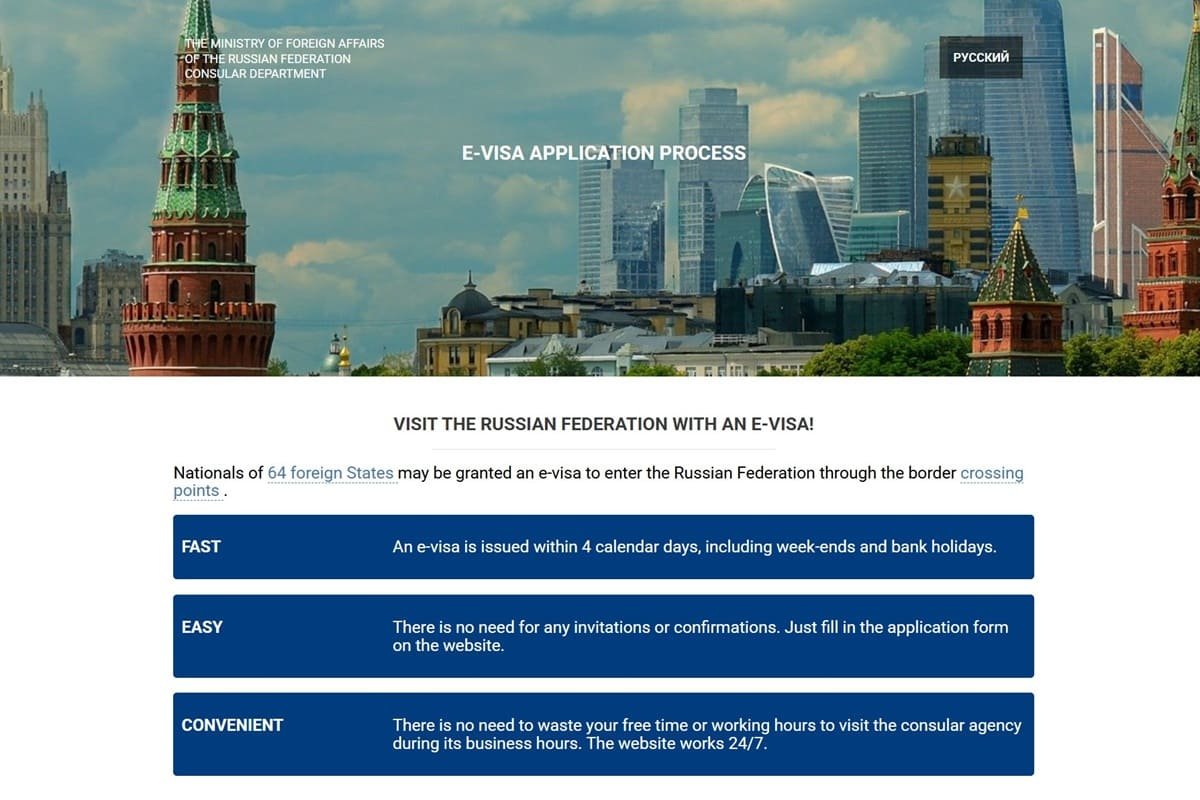
Until any changes are formally adopted and implemented, the existing rules remain in place. Travelers from eligible countries, including France, can continue applying for an e-Visa through the Russian Ministry of Foreign Affairs’ official portal.
As for application fees, the cost of a Russian e-Visa increased on October 14, 2026, rising from 202 to 238 UAE dirhams (AED), equivalent to approximately €58.
Russia has issued more than 360,000 electronic visas in 2026
The latest proposal comes as Russian authorities report continued strong use of the country’s electronic visa system.
In an interview published by the TASS news agency on October 31, 2026, Alexey Klimov, director of the Consular Department at the Russian Ministry of Foreign Affairs, said that 361,115 electronic visas had been issued between January 1 and October 12, 2026.
German nationals accounted for the largest number of e-Visas, with 57,233 issued, followed by travelers from Turkey (55,818), India (37,814), China (30,922), and Estonia (20,391).
The consular official also highlighted interest in the electronic visa system among business travelers, participants in events held in Russia, and foreign nationals making private visits.
Following the extension of e-Visa validity and the permitted length of stay in August 2025, Russia is now considering another overhaul of the system, combining a shorter validity period with potentially longer stays and more flexible entry options.
VisasNews Take
Russia’s proposed e-Visa reform comes with an important distinction: although travelers could potentially stay for up to 45 days, they would not automatically receive 45 days from the date they enter the country. Their permitted stay would still be limited by the visa’s expiration date, with validity reduced from 120 to 45 days from issuance. Travelers would therefore need to pay particular attention to when they submit their applications. The proposed expansion of eligible border crossing points and the addition of transit as an authorized purpose of travel would, however, make the system more flexible. For now, none of these changes has taken effect, and the existing Russian e-Visa rules remain in place.