Kazakhstan has officially set July 1, 2027, as the date when its electronic travel authorization (ETA) will become mandatory for foreign nationals covered by the new requirement.
The deadline is established under Government Decree No. 890 of October 10, 2026, which amends Decree No. 148 of January 21, 2012, governing the entry, stay, and departure of foreign nationals.
The decree, scheduled to take effect on October 24, 2026, establishes a phased rollout of ETA checks at border crossings throughout the country.
The decision provides a clearer timeline for a travel requirement whose preparations and previously proposed implementation dates VisasNews has been tracking. Earlier plans suggesting that the authorization could become mandatory as soon as November 2026 have now been replaced by an extended transition period lasting until summer 2027.
QazETA rollout to begin November 1, 2026
Kazakh authorities have adopted a four-stage implementation schedule to gradually introduce electronic travel authorization checks at the country’s borders.
From November 1, 2026, through June 30, 2027, travelers will not be denied entry solely because they do not have an ETA. Border officials will instead inform travelers about the new authorization requirement.
The rollout will follow this schedule:
- November 1, 2026: Initial implementation at Aktau International Airport and four road border crossings: Urlyutobe (Pavlodar Region), Aukhatti (Zhambyl Region), Atameken (Turkistan Region), and Nur Zholy (Zhetysu Region).
- January 1, 2027: Expansion to Astana and Almaty international airports.
- March 1, 2027: Extension of ETA checks to all remaining border crossings in Kazakhstan.
- July 1, 2027: The ETA requirement becomes mandatory. From this date, travelers who do not have the required authorization may be denied entry into Kazakhstan.
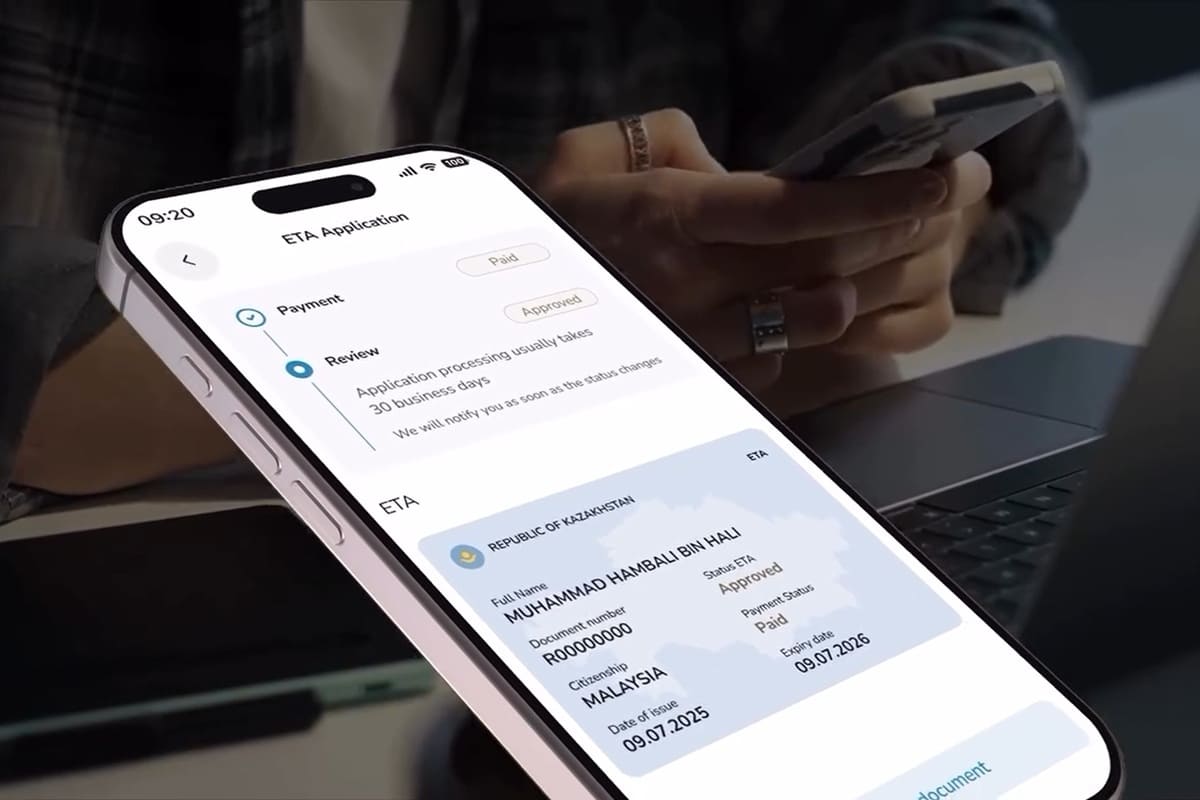
The transition period will give travelers time to become familiar with the system, which is already accessible through the QazETA mobile app on the App Store and Google Play, while allowing authorities several months to expand its use to all border checkpoints.
Who will need an ETA to travel to Kazakhstan?
The new electronic travel authorization is primarily intended for nationals of countries whose citizens can currently enter Kazakhstan without a visa.
US, UK, Canadian, and Australian passport holders are among those covered, along with travelers from many European countries, Japan, South Korea, and other visa-exempt nations.
The requirement will also apply to certain nationalities that benefit from special visa-free travel arrangements, including citizens of India, Iran, and Turkey.
The new provisions also refer to citizens of Eurasian Economic Union (EAEU) member states, including Russia, Belarus, Armenia, and Kyrgyzstan. The implementation of these provisions will, however, need to be reconciled with international agreements governing freedom of movement within the organization.
The ETA does not replace a visa or change the permitted length of stay. Travelers who currently qualify for visa-free entry will remain subject to the existing conditions and stay limits applicable to their nationality.
The electronic travel authorization will simply introduce an additional requirement that eligible travelers must complete before departure.
Free ETA valid for 180 days, with applications required 72 hours before arrival
Another important clarification in the new rules is that the ETA will be issued free of charge.
Although earlier regulatory proposals contemplated charging travelers for the authorization, the adopted system provides for free issuance to eligible applicants.
The main conditions are as follows:
- Fee: Free.
- Validity: 180 calendar days.
- Application deadline: At least 72 hours before the planned date of entry into Kazakhstan.
- Application process: Online submission through the digital platform for foreign nationals, including applicant identification and/or authentication.
Authorizations will be issued by Kazakhstan’s Ministry of Internal Affairs in coordination with the country’s national security authorities.
At the border, travelers will need to present the identity document used for their application. Border guards will be able to verify the authorization through the national Berkut information system.
The ETA’s 180-day validity period should not be confused with the length of time a traveler is permitted to remain in Kazakhstan, which continues to be determined by the country’s immigration rules.
Holding an electronic travel authorization also does not automatically guarantee admission. Kazakh authorities retain the right to refuse entry under circumstances established by national law.
Children, seniors, and visa holders: Who is exempt from QazETA?
The new system provides exemptions for several categories of travelers, provided they can present the appropriate supporting documentation.
The main exemptions include:
- Children under 16 and travelers aged 65 or older.
- Holders of a valid Kazakh visa.
- Foreign nationals holding a temporary residence permit or permanent residence permit in Kazakhstan.
- International air transit passengers who remain within the airport’s transit area without formally entering Kazakhstan.
- Certain diplomats, government officials, and members of official delegations.
- Aircraft, ship, and train crew members, subject to the applicable regulations.
- Certain truck and bus drivers engaged in international transportation, including transit operations.
Additional exemptions apply to refugees, asylum seekers, and certain individuals participating in humanitarian missions or emergency response operations.
For most travelers, the exemptions based on age, residence status, or possession of a valid visa will be the most relevant.
How does the QazETA app work?
Kazakhstan began testing its electronic travel authorization system well before adopting the new implementation schedule.
As VisasNews reported when Kazakhstan launched its QazETA mobile application, the platform allows foreign travelers to complete several immigration-related procedures, including electronic visa and travel authorization applications.
The system requires travelers to register their travel documents and complete identity verification procedures. Depending on the passport and smartphone being used, the process may involve electronically reading the passport’s chip and completing biometric checks.
The new rules establish the legal framework for submitting applications and checking authorizations at the border, but do not provide additional details about features that might allow travel agents or other intermediaries to manage applications for multiple travelers.
Practical information and access to the service are available through the official QazETA portal.
A new deadline for international travelers
With its October 10, 2026, decree, Kazakhstan has resolved one of the main uncertainties surrounding the introduction of its electronic travel authorization system.
November 1, 2026, will not mark the start of a nationwide mandatory ETA requirement. Instead, it will be the beginning of a gradual rollout accompanied by an information campaign at border crossings.
The key deadline for affected travelers is now July 1, 2027, when failing to obtain the required authorization could prevent them from entering Kazakhstan.
The phased approach will give Kazakhstan several months to expand its border control procedures while providing travelers with a transition period before the new requirement takes full effect.
VisasNews Take
The October 10, 2026, decree clarifies two major points: Kazakhstan’s QazETA will become mandatory on July 1, 2027, and the authorization will be free of charge. Contrary to earlier proposed timelines, visa-exempt travelers will still be able to enter Kazakhstan without an ETA during the transition period, through June 30, 2027, provided they meet all other entry requirements. Once mandatory, QazETA will become an additional pre-travel requirement for many nationalities, without affecting their visa-free status or the length of stay they are permitted.