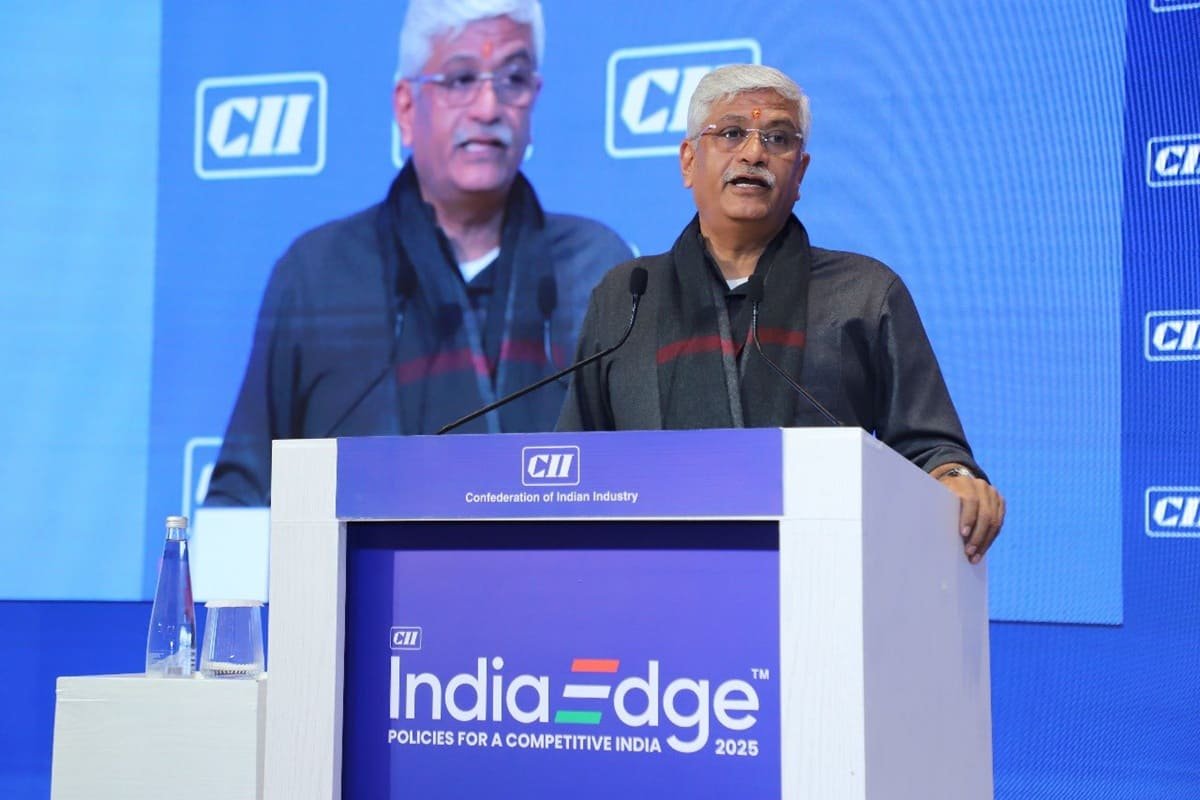
Held this week in New Delhi, CII India Edge 2025 brought together numerous public and private stakeholders to discuss the challenges of competitiveness and the transformation of the Indian economy.
As part of the event, a session titled “Unlocking the Growth and Employment Potential of Tourism” took place yesterday, during which Gajendra Singh Shekhawat, India’s Minister of Culture and Tourism, shared a comprehensive analysis of the tourism sector’s strategic role in national development, framing it within the vision of India becoming a developed nation by 2047.
Addressing hospitality representatives, industry leaders, and institutional partners, the minister emphasized that enhancing the traveler experience is now central to supporting the country’s transformation.
He noted that tourism is increasingly recognized as a strategic pillar of growth, expected to contribute around 10% of India’s GDP, up from the current 5–6%.
In this context, easier access to the country has become a key lever for growth, prompting the government to introduce new measures on visa facilitation.
Towards a visa-on-arrival in India applied on a reciprocal basis
The minister confirmed that the government is working on a visa-on-arrival scheme that would apply on the basis of reciprocity, limited to citizens of countries that already offer the same benefit to Indian nationals.
“On a reciprocal basis, we are exploring how to grant a visa on arrival to citizens of countries that already offer it to Indians,” said Gajendra Singh Shekhawat.
Currently, India provides visa-on-arrival facilities to citizens of Japan, South Korea, the Maldives, and the United Arab Emirates.
Meanwhile, Indian travelers themselves can obtain visas on arrival in more than 35 countries, including popular destinations across Asia and beyond such as Thailand, the Maldives, Indonesia, Sri Lanka, Cambodia, Vietnam, Myanmar, Iran, and several nations in Africa and Oceania.
Although no specific timeline or country list has yet been announced, the minister described this move as an essential step to maintain India’s competitiveness against regional destinations that strongly emphasize ease of entry.
According to Shekhawat, such a mechanism would help bring India in line with global tourism standards.
A widely used e-Visa system that still needs refinement
Shekhawat also pointed out that most international visitors already no longer need to visit an Indian diplomatic mission to obtain a visa, as they can now secure electronic travel authorization (ETA) with just a few clicks.
“A few days ago, a foreign delegation met with me, and everyone acknowledged that India’s new visa regime, especially the way we’ve developed the e-Visa, means that today, in most countries, no one needs to go to an embassy in person to get a visa for India,” the minister said.
Explaining that the Indian visa was “available as an e-Visa, and within 72 hours, if you apply from your phone, the e-Visa is ready,” Shekhawat nevertheless acknowledged that the current e-Visa application form was still too long and assured that the government was actively working to optimize it.
“We’re working to make the form even simpler, to reduce the number of pages and make it more user-friendly,” he added.
As part of this broader simplification effort, India has also introduced the digital “e-Arrival Card”, designed to gradually replace the paper forms currently filled out at airports. The digital version aims to speed up entry procedures and streamline immigration checks for international travelers.
These initiatives are intended to align India with global destinations that prioritize speed, clarity, and administrative ease, in what the minister described as a context of “intense global competition.”
Easier access as an economic imperative
Shekhawat also highlighted the economic benefits of a stronger tourism sector: one rupee invested can produce “a multiplier effect of 3.5 times”, and tourism is set to become “the largest generator of jobs after agriculture” in India, according to him.
He stressed that perceived safety and administrative simplicity play a decisive role in how international visitors choose their destinations.
In this perspective, a streamlined e-Visa and a reciprocal visa-on-arrival system represent two cornerstones of the same strategy:
to make India more accessible, more competitive, and more attractive, as the government aims to scale up its tourism ambitions on a global level.