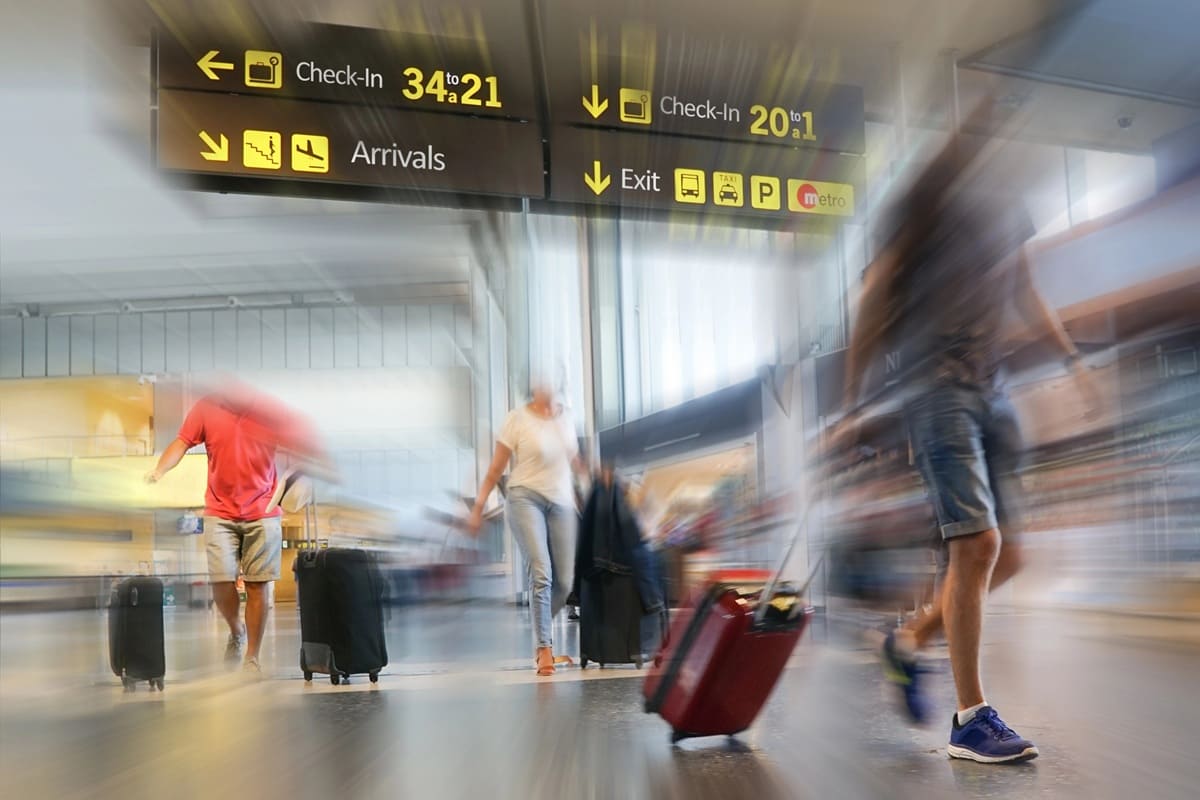
Could crossing an international border one day become almost imperceptible to travelers?
Air transport technology specialist SITA unveiled a new solution called “Border Flow Lane” on September 9, 2026, designed to shift a significant share of today’s border checks to earlier stages of the passenger journey.
The goal is not to eliminate immigration controls, but to change how they are carried out. Instead of requiring every passenger to stop in front of an officer, kiosk or automated gate, eligible travelers could be screened in advance and then biometrically identified as they move through the immigration area.
From immigration counters to eGates, and then to no-stop border checks
In recent years, many countries have automated border processing through eGates, which can automatically compare a traveler’s face with the photo stored in their biometric passport.
This shift is already visible on a large scale. In Europe, for example, the Entry/Exit System (EES) has been fully operational since April 2026, combining digital entry and exit records with biometric data for millions of non-EU nationals traveling through the Schengen Area.
With Border Flow Lane, SITA wants to take that process one step further.
Rather than simply speeding up processing at a checkpoint, the idea is to remove the need to stop altogether for some travelers. Identity and risk assessments would take place before the passenger reaches immigration, while biometric identification performed “on the move” would confirm the traveler’s identity as they pass through the border area.
The control itself would therefore become far less visible to the traveler, even though it would still be taking place behind the scenes.
According to SITA, more than 75% of travelers could potentially be cleared before departure under such a system. Immigration officers could then focus more attention on passengers requiring additional checks, while retaining the ability to stop any traveler at any time.
Travelers could be screened before they even reach the border
This development builds on a trend already well underway in air travel: governments increasingly have access to passenger information before a traveler arrives.
Booking and travel data, information transmitted by airlines, Electronic Travel Authorizations (ETAs), digital travel documents and biometrics are increasingly allowing authorities to determine in advance whether a traveler meets the requirements for their journey.
The underlying infrastructure is evolving in the same direction. In March, ICAO upgraded its Public Key Directory (PKD), a key system used to verify digital travel documents, paving the way for more advanced uses involving electronic passports, digital credentials and remote authentication.
Border Flow Lane is designed to build on this advance-screening model so that part of the border decision-making process can take place before the passenger physically reaches immigration.
Once at the border, a pre-cleared traveler would therefore no longer necessarily need to take out a passport or stop in front of a gate. Their identity could instead be confirmed automatically while they continue moving.
SITA estimates that this approach could make border crossing up to eight times faster than traditional eGates. That figure remains a projection from the technology provider, however, as the system still needs to be tested in real-world operating conditions.
An “invisible” border, but not a border without controls
Removing the counter or automated gate would not mean eliminating entry formalities.
Instead, part of the screening process would simply take place earlier in the journey and in a less visible way for travelers whose profiles do not require additional examination.
The system would also rely on travelers voluntarily opting in to the biometric data use required for the service. SITA emphasizes that national authorities would retain control over identity verification and, most importantly, the final decision on whether a traveler may cross the border.
The approach could also address another challenge facing major airports: handling growing international passenger volumes without continually adding more immigration counters, automated gates and waiting areas. In theory, the more travelers who can keep moving without stopping, the more passengers existing infrastructure can process.
Border Flow Lane still has to prove itself
For now, Border Flow Lane is not a new border-control system already being rolled out across airports worldwide.
SITA is currently looking for government partners to test and refine Border Flow Lane under real-world operating conditions. The company itself says the model is not yet fixed and that its first partners will help shape how the system ultimately works.
Its launch nevertheless highlights a clear direction in international travel formalities. After the digitization of visas through e-Visas and travel authorizations through ETAs, followed by the automation of border checks through eGates and biometrics, the next step could be the gradual disappearance of the physical checkpoint for certain travelers.
Not because the border would stop checking them, but because those checks would have begun long before they arrived.
What is SITA?
Behind the project is a name that remains relatively unfamiliar to the general public despite playing a major role behind the scenes in global air travel.
Founded in 1949 by eleven airlines, SITA — originally short for the French name Société Internationale de Télécommunications Aéronautiques — is a technology company owned by the air transport industry and specializing in its digital infrastructure. Its systems are used by airlines, airports and governments for services including passenger processing, baggage tracking, aviation communications and border management.
SITA says it now works with more than 2,500 customers, operates in more than 200 countries and territories, and provides technology at more than 1,000 airports.
The company is also active in biometrics, digital identity, passenger data processing and systems that allow governments to assess travelers before they arrive.
VisasNews Take
Border controls are not about to disappear, but the way they work is changing rapidly. With systems such as Border Flow Lane, a growing share of traveler screening could take place before arrival, while biometrics would then automatically confirm a passenger’s identity at the border. The traditional immigration counter, followed more recently by the eGate, could eventually give way to a much less visible border for pre-cleared travelers. The next question is which governments will agree to test this model, and under what conditions.