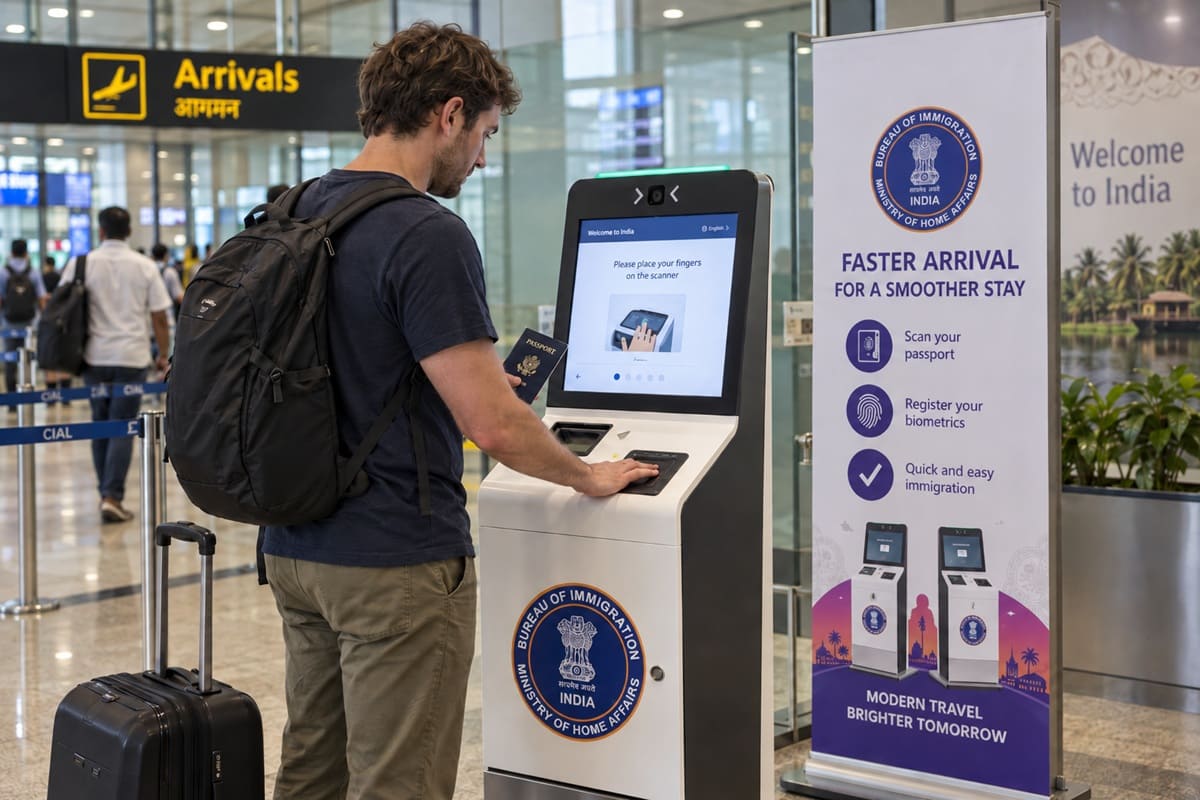
Travelers arriving in India with an electronic visa (e-Visa) are increasingly able to complete part of the immigration process themselves.
India’s Bureau of Immigration has brought four self-service biometric kiosks into operation at Netaji Subhas Chandra Bose International Airport in Kolkata (Calcutta).
According to immigration officials who spoke to the Times of India, the kiosks are intended in particular for foreign nationals making their first arrival in India on an e-Visa and who need to have their biometric data recorded.
Biometric enrollment is a mandatory part of the process for Indian e-Visa holders. The Indian government’s official e-Visa portal states that applicants’ biometric data are mandatorily captured by immigration authorities upon arrival in India.
Passport, photo, fingerprints: how do the biometric kiosks work?
Until now, biometric enrollment could be carried out directly at the immigration counter, taking up several minutes of an officer’s time.
The new kiosks move this step ahead of the face-to-face immigration check.
At airports where the kiosks are available, travelers must:
- scan their passport at the kiosk;
- have a live photograph taken;
- register their fingerprints using the biometric scanner;
- collect a confirmation slip showing that enrollment has been completed;
- then present that document and their passport at the immigration counter.
Once these steps have been completed, an immigration officer carries out the final checks and completes the traveler’s entry formalities.
The system is therefore neither an e-gate nor a fully automated border control process allowing travelers to enter India without seeing an officer. A final check by an immigration officer is still required.
According to specifications issued by the Airports Authority of India (AAI), the kiosks include a passport reader, a camera for facial image capture, and a scanner capable of recording all 10 fingerprints. They are also designed to read both the passport’s machine-readable zone (MRZ) and the electronic chip in biometric passports.
After using the kiosk, less than a minute at the immigration counter
The main goal is to reduce the amount of time travelers spend at the counter and, in turn, shorten arrival lines.
An immigration official interviewed in Kolkata said biometric enrollment for an e-Visa traveler could previously keep an immigration counter occupied for six to seven minutes.
When the passport, photograph, and fingerprints have already been registered at the kiosk, the final passport check at the counter can be completed in less than a minute, according to the same source.
That figure does not refer to the entire immigration process: travelers must first complete the different steps at the kiosk before proceeding to the counter.
The expected benefit also extends beyond those using the kiosks. By removing the relatively time-consuming biometric enrollment process from immigration desks, the Bureau of Immigration aims to ease congestion, particularly when several international flights arrive at the same time.
Kiosks already in use in Delhi, Mumbai, and Thiruvananthapuram
Kolkata is not the first Indian airport to introduce the system.
According to the Bureau of Immigration, similar biometric kiosks are already operating at three other major Indian airports: Delhi, Mumbai, and Thiruvananthapuram.
| Airport | Known status |
|---|---|
| Delhi – Indira Gandhi International Airport (DEL) | Biometric kiosks operational; 10 units officially recorded at Terminal 3 |
| Mumbai – Chhatrapati Shivaji Maharaj International Airport (BOM) | Kiosks reported as operational by the Bureau of Immigration |
| Thiruvananthapuram – Trivandrum International Airport (TRV) | Kiosks reported as operational by the Bureau of Immigration |
| Kolkata – Netaji Subhas Chandra Bose International Airport (CCU) | 4 newly operational kiosks |
AAI had planned 22 kiosks across five airports
The network could expand further.
In September 2025, the Airports Authority of India published a program covering the installation of 22 “Biometric Kiosks for Immigration” at five airports operated by the authority.
The planned distribution was as follows:
| Airport | Planned number of kiosks |
|---|---|
| Chennai (MAA) | 6 |
| Kozhikode / Calicut (CCJ) | 4 |
| Kolkata (CCU) | 4 |
| Tiruchirappalli / Trichy (TRZ) | 4 |
| Amritsar (ATQ) | 4 |
| Total | 22 |
The four kiosks now in service in Kolkata therefore match exactly the number of units planned for that airport under the AAI program.
At this stage, however, the public sources reviewed by VisasNews do not confirm with the same level of certainty that the kiosks planned for Chennai, Kozhikode, Tiruchirappalli, and Amritsar are already available to e-Visa holders.
Those airports should therefore be distinguished from Delhi, Mumbai, Thiruvananthapuram, and now Kolkata, where the use of biometric kiosks has been reported as operational.
The e-Arrival Card adds another digital step to India’s entry process
The rollout of biometric kiosks comes as India has also digitized its arrival card.
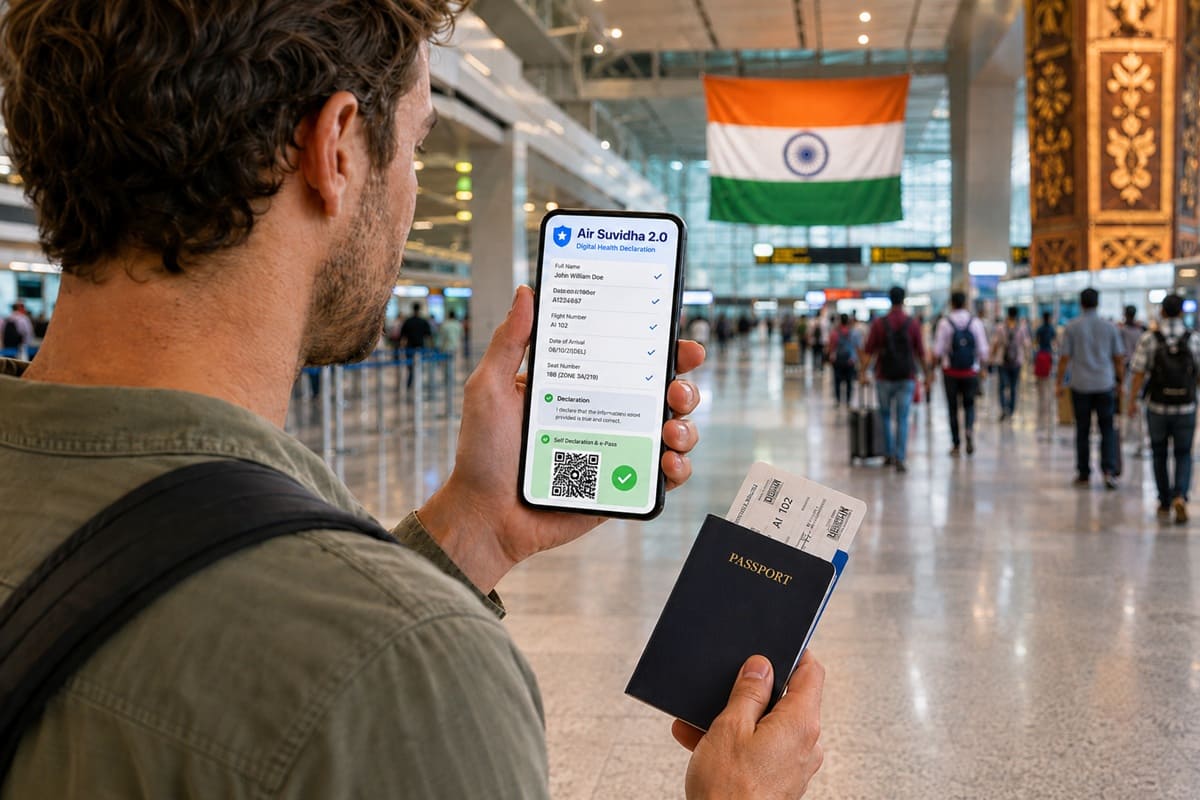
Foreign nationals, as well as holders of an OCI (Overseas Citizen of India) card, can now complete their e-Arrival Card online within the 72 hours before arriving in India, either through the official Indian Visa Online portal or the government’s Indian Visa Su-Swagatam app.
Authorities stress that the form is used only to submit arrival information and is neither a visa nor a travel authorization.
The digital arrival card and biometric kiosks serve two different purposes. The e-Arrival Card allows travelers to submit required entry information in advance, while kiosks installed at certain airports are used to record biometric data needed for immigration checks, including a photograph and fingerprints.
Another step in modernizing arrivals in India
The expansion of biometric kiosks is part of India’s broader effort to automate and modernize entry procedures.
The country is simultaneously expanding its FTI-TTP e-gates, developing the e-Arrival Card, modernizing immigration infrastructure, and continuing to expand its electronic visa system.
The purpose of the kiosks for e-Visa holders is straightforward: move the most time-consuming biometric steps upstream so that the face-to-face immigration check can focus largely on final verification.
However, not all entry points authorized for travelers holding an e-Visa are equipped with these kiosks. An airport or seaport’s eligibility for Indian e-Visa arrivals and the availability of a self-service biometric kiosk are two separate matters.
VisasNews Take
Biometric kiosks do not replace checks carried out by Indian immigration authorities. They allow eligible e-Visa holders to register their passport details, photograph, and fingerprints before reaching the immigration desk. Travelers must still present their passport to an officer to complete entry formalities. According to the Bureau of Immigration, this pre-enrollment process can reduce the final counter check to less than one minute.