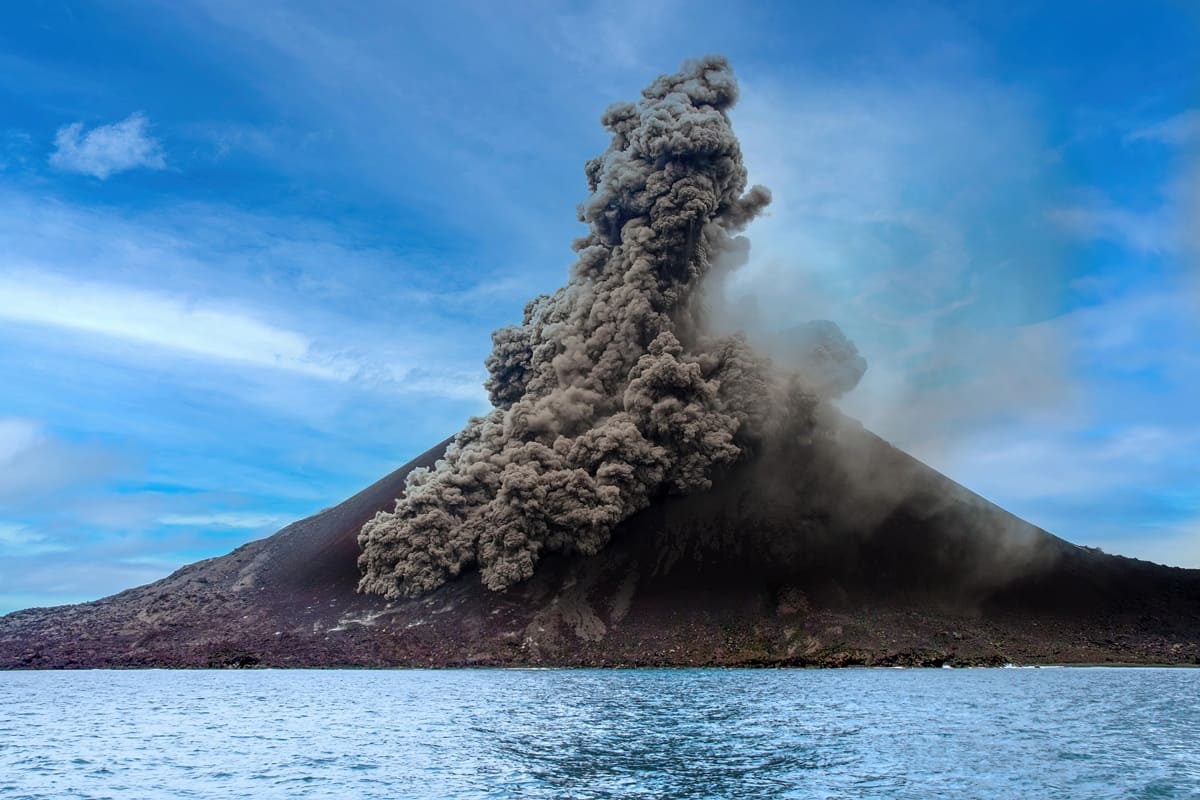
Since September 5, eruptive activity at Anak Krakatau and the spread of volcanic ash have severely disrupted air travel across several parts of Indonesia. Hundreds of flights have been canceled or diverted, while several airports temporarily suspended operations.
Foreign travelers stranded in Indonesia because of air traffic disruptions caused by the Anak Krakatau eruption should not face penalties if their authorized stay expires before they are able to leave the country.
Indonesia’s Directorate General of Immigration has announced emergency provisions allowing affected foreign nationals to temporarily regularize their immigration status.
According to the authorities, 520 flights and 86,760 passengers were affected between September 5 and 7, 2026 as a result of the eruption.
Air travel gradually resumes
Conditions are improving at several of the main airports affected by volcanic ash.
The Indonesian Ministry of Transportation announced on September 8 that several airports that had suspended operations in recent days had reopened.
Soekarno-Hatta International Airport, the main airport serving Jakarta, along with Halim Perdanakusuma Airport in Jakarta and Husein Sastranegara Airport in Bandung, resumed operations at 12:01 a.m. local time on September 8.
Budiarto Airport in Curug and Pondok Cabe Airport in the Jakarta area reopened at 2:25 a.m. Meanwhile, Atung Bungsu Airport in Pagar Alam, Sumatra, had already resumed operations at 9 a.m. on September 7.
At the time of the ministry’s latest update, Radin Inten II Airport in Lampung and Muhammad Taufiq Kiemas Airport, also located in Lampung Province, were still awaiting improved conditions before reopening.
Authorities say operations at reopened airports are gradually returning to normal, although additional precautions remain in place. Airlines and airport authorities are required to conduct aircraft inspections, while flight crews must continue to take into account areas of restricted airspace due to volcanic ash.
The reopening of airports does not immediately resolve the consequences of the cancellations and diversions that have occurred since September 5. Some travelers may therefore still be unable to leave Indonesia before their authorized period of stay expires.
Emergency stay permits available for up to 30 days
In a post shared on its official social media channels, Indonesia’s Directorate General of Immigration said foreign nationals who are unable to leave the country because of the ongoing disruptions may be granted an Izin Tinggal Keadaan Terpaksa (ITKT).
The ITKT is an emergency stay permit designed for situations involving emergencies or force majeure.
It may be issued for up to 30 days. Immigration authorities also state that the permit can be extended, when necessary, in accordance with applicable regulations.
The measure gives travelers whose authorized stay is about to expire, but who are physically unable to leave Indonesia, a way to maintain legal immigration status during the exceptional disruption.
No overstay fees when the delay is caused by force majeure
A second key measure applies to travelers who exceed their authorized stay because their flight has been canceled or diverted.
In these circumstances, the overstay fee is set at 0 Indonesian rupiah, provided that the overstay results directly from the force majeure situation.
This does not amount to a general waiver of overstay penalties in Indonesia. The measure applies specifically to foreign nationals who are unable to leave the country because of the exceptional disruption to air travel.
The Directorate General of Immigration says the measures are intended to provide affected travelers with prompt assistance and legal certainty while maintaining immigration enforcement and border security responsibilities.
26 applications already processed at Jakarta airport
As of September 7, 2026, the immigration office at Soekarno-Hatta International Airport had already processed 26 ITKT applications from foreign nationals affected by the disruptions.
An additional service counter has also been opened to speed up processing for affected passengers.
Travelers whose authorized stay is close to expiring and who are unable to leave Indonesia because of a canceled or diverted flight are therefore advised to contact Indonesian immigration authorities, particularly at airports, so their individual circumstances can be reviewed.
The official announcement does not describe the ITKT as an automatic extension of a traveler’s visa or authorized stay. Rather, the emergency permit may be granted to foreign nationals who meet the requirements associated with the emergency situation.
VisasNews Take
As air travel gradually resumes at several Indonesian airports, foreign travelers still stranded by the effects of the Anak Krakatau eruption do not automatically receive an extension of their visa or authorized stay. Indonesian authorities may, however, grant them an emergency stay permit (ITKT) valid for up to 30 days and extend it if necessary. When an overstay results directly from this force majeure situation, the applicable overstay fee is reduced to 0 Indonesian rupiah.