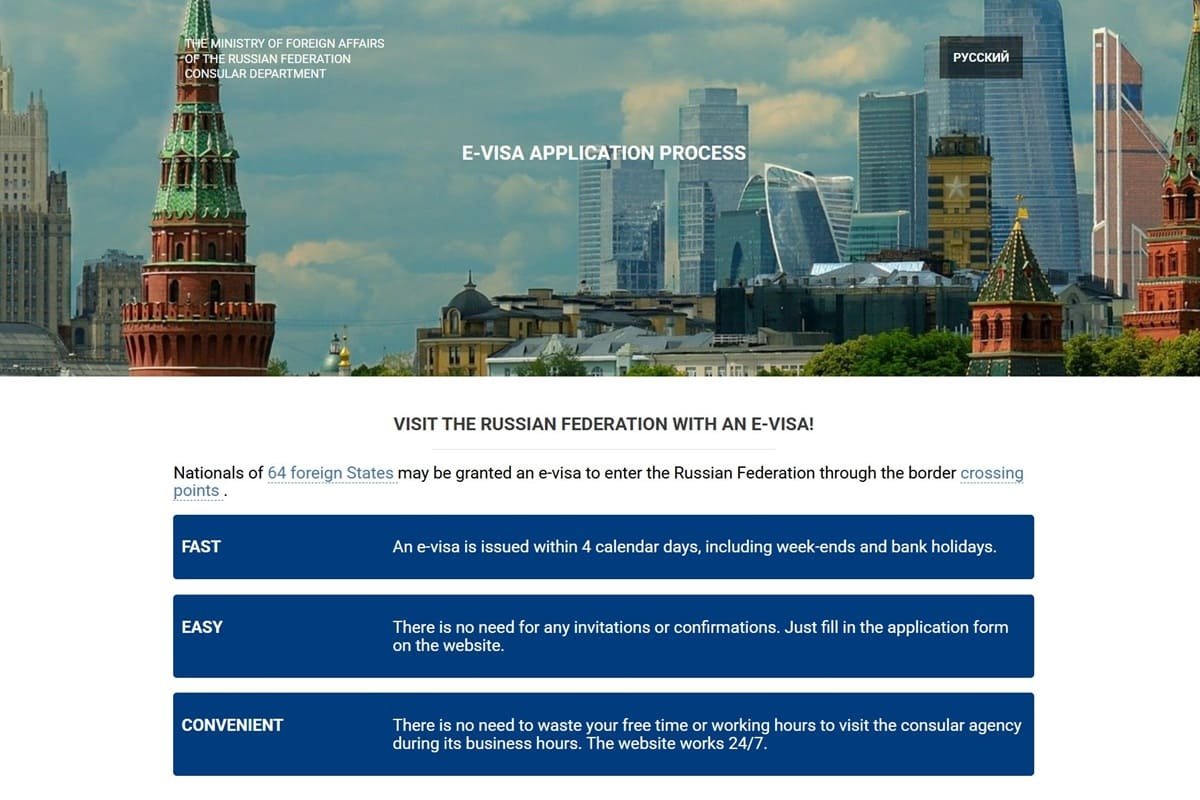
Russia is continuing to expand the network of entry points available to travelers using an electronic visa, or e-Visa.
Under a government order signed on June 23, 2026, two new border checkpoints were added to the official list: Yakutsk International Airport and the Kani-Kurgan road crossing in the Amur Region.
The decision comes just a few months after Kyzyl Airport, in the Republic of Tuva, was added to the system.
In total, three new checkpoints have joined Russia’s e-Visa network since the beginning of 2026. The list published by the Russian Ministry of Foreign Affairs now includes 109 authorized entry points at airports, road crossings, railway stations, seaports and river ports.
Yakutsk becomes a new gateway to Yakutia
Yakutsk International Airport has joined the list of authorized border checkpoints for travelers holding a Russian e-Visa.
Yakutsk is the capital of the Sakha Republic, also known as Yakutia, and serves as the main gateway to this vast region in northeastern Russia. The city is particularly known for its permafrost landscape, its mammoth museum and its historic district lined with wooden buildings.
It is also a starting point for exploring the Lena River Valley and the striking Lena Pillars, a series of dramatic rock formations listed as a UNESCO World Heritage Site.
The airport’s addition means travelers can now complete entry or departure procedures there using an e-Visa whenever Yakutsk is served by an international flight. Its inclusion on the official list does not, however, mean that direct international flights are available from every country whose citizens are eligible for the e-Visa.
Kani-Kurgan offers a new road crossing between Russia and China
The second addition is not an airport, but a land border crossing.
Kani-Kurgan is located in the Amur Region near Blagoveshchensk. The checkpoint serves the highway bridge crossing the Amur River between the Russian city and Heihe, China.
Its inclusion on the official list means eligible travelers can now enter or leave Russia at this crossing using an e-Visa, including as part of an overland itinerary between the two countries. Passenger transportation services use the bridge to connect the international terminals in Blagoveshchensk and Heihe.
Blagoveshchensk has an unusual geographic setting. From the city’s riverside promenade, visitors can look directly across the Amur River at the buildings of Heihe on the Chinese side.
Using a Russian e-Visa at Kani-Kurgan does not exempt travelers from complying with China’s own entry requirements.
How does Russia’s e-Visa currently work?
Russia’s unified electronic visa is currently available to citizens of 64 countries, including France, Belgium, Switzerland, Spain, Italy, Germany, China, India and Saudi Arabia.
Applications are completed entirely online through the evisa.kdmid.ru portal, with no invitation letter or proof of accommodation required. The stated processing time is no more than four calendar days.
The e-Visa allows a single entry into Russia. Since August 2025, it has been valid for 120 days from the date of issue and allows a maximum stay of 30 days.
Travelers must enter and leave Russia through one of the specifically authorized border checkpoints. Once admitted, they may travel within the country, except in areas requiring special authorization.
Russia could extend its e-Visa to three more African countries
Russia is also considering a further expansion of the list of eligible nationalities.
On July 27, 2026, the press office of Russia’s Ministry of Economic Development told the newspaper Izvestia that officials were working with the Ministry of Foreign Affairs on the possible extension of the e-Visa to citizens of Egypt, Ethiopia and Tanzania.
The ministry also reportedly confirmed that authorities were considering allowing the electronic visa to be used for multiple entries. Russia’s current system remains limited to a single entry, even when a traveler leaves the country before the visa’s validity period expires.
For now, however, these changes remain under consideration. No government act adding Egypt, Ethiopia or Tanzania to the list of eligible countries has been published, and no implementation date has been announced.
As of August 4, 2026, Russia’s consular portal still lists 64 eligible countries, and the three countries are not included. Eswatini, Kenya and Zimbabwe remain the only African countries whose citizens are currently eligible for the Russian e-Visa.
VisasNews Take
The two new entry points offer very different options for travelers eligible for Russia’s e-Visa. Yakutsk provides easier air access to one of Siberia’s most remote regions, while Kani-Kurgan creates a new overland crossing option between China and Russia. Any extension of the system to Egyptian, Ethiopian and Tanzanian citizens, however, will require an official government decision and an update to Russia’s consular portal.