A standard US tourist visa now costs $435. That’s not a typo.
The $250 Visa Integrity and Border Security Fee — signed into law on July 4, 2025 under the One Big Beautiful Bill Act — adds a mandatory charge on top of the existing $185 MRV fee for virtually every nonimmigrant visa category. B1/B2 tourist visas, F-1 student visas, H-1B work visas, J-1 exchange visas — all affected.
For a family of four applying for B1/B2 visas, total government fees jump from $740 to $1,740. That’s a 135% increase overnight.
When does it take effect?
Here’s the catch: the law is signed, but the fee isn’t being collected yet. As of March 2026, the Bureau of Consular Affairs has not issued implementation guidance to embassies. A Federal Register notice from July 2025 stated that “cross-agency coordination” was needed before collection could begin.
Columbia University’s International Students and Scholars Office confirmed in early March 2026 that it is still not possible to pay the fee. Implementation is expected sometime before September 30, 2026 — but no firm date exists. Applicants currently approved for visas are not being charged.
When it does launch, the fee will be collected at the time of visa issuance, not application. If your visa is denied, you don’t pay it.
Who pays and who’s exempt
Every nonimmigrant visa holder pays — including dependents. An H-1B worker with an H-4 spouse and two children faces $1,000 in integrity fees alone, on top of all other filing costs.
Exempt categories: Visa Waiver Program travelers (ESTA users from ~42 countries), Canadian and Bermudian citizens in visa-exempt categories, diplomatic and official visa holders (A, G, NATO), and immigrant visa applicants.
The fee is technically refundable — a visa holder who complies with all conditions can seek reimbursement after the visa expires. But the Congressional Budget Office projects that very few people will actually claim refunds, and the system to process them doesn’t exist yet. For B1/B2 holders with 10-year visas, that means waiting a decade for $250 through a mechanism that hasn’t been built. Immigration attorneys uniformly advise treating it as non-refundable.
How the US now compares to other destinations
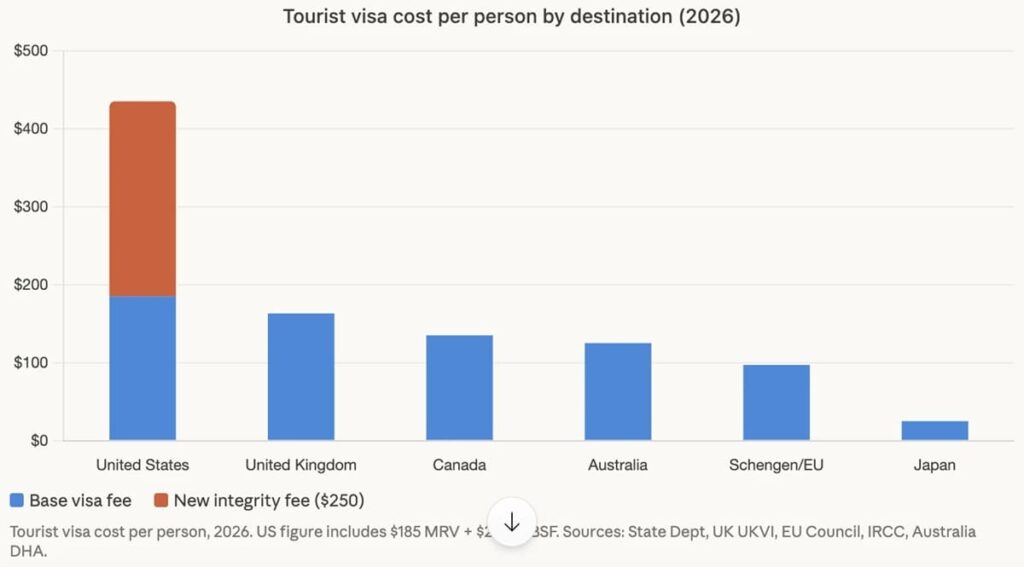
The gap with peer countries is dramatic:
| Destination | Tourist visa cost | Family of 4 |
|---|---|---|
| United States | ~$435 | ~$1,740 |
| United Kingdom | ~$163 | ~$652 |
| Schengen/EU | ~$97 | ~$388 |
| Canada | ~$135 | ~$500 |
| Australia | ~$125 | ~$500 |
The US now charges 3 to 4.5 times more than any comparable Western destination. Japan charges nothing for most nationalities.
The travel industry is sounding alarms
The U.S. Travel Association called the fee a “self-imposed tariff on one of our nation’s largest exports: international travel spending.” Tourism Economics projects it will deter nearly 1 million visitors annually and cost $3.6 billion per year in lost spending.
The timing is particularly painful. The 2026 FIFA World Cup kicks off in June across 16 US cities. The 2028 Los Angeles Olympics follow. These events are designed to attract the world — while the fee structure signals the opposite.
International arrivals were already declining before the fee was announced. Overseas visits (excluding Canada and Mexico) dropped 11.6% year-over-year in March 2025. The World Travel & Tourism Council found the US was the only country among 184 analyzed to see international visitor spending decline in 2025.
Part of a broader wave of US visa fee increases
The integrity fee doesn’t exist in isolation. Over the past year, the US has rolled out an unprecedented series of cost increases:
ESTA fee doubled from $21 to $40 (September 30, 2025). Land border I-94 fee jumped from $6 to $30 (same date). A new $30 EVUS charge now applies to Chinese nationals with 10-year B visas. The Visa Bond Pilot Program requires $5,000–$15,000 refundable deposits from B1/B2 applicants from designated countries. And interview waivers have been eliminated for nearly all nonimmigrant categories since September 2025 — meaning more in-person appointments, longer wait times, and higher indirect costs for applicants who must travel to consulates.
All fees enacted under the One Big Beautiful Bill Act are indexed to inflation annually, meaning they’ll rise automatically each year.
What applicants should do now
The fee isn’t being collected yet, but it will be — likely within months. Applicants with upcoming travel plans should consider accelerating their applications to potentially lock in pre-fee processing. Those already in the pipeline are unaffected until collection begins.
With the financial stakes of a US visa application now significantly higher, thorough preparation matters more than ever. A denied application means losing $185 in MRV fees with nothing to show for it — and once the integrity fee launches, approved applicants will pay $435 whether their trip goes perfectly or not. Resources like AI-powered visa interview practice tools can help applicants prepare for the consular interview, which remains the single most decisive moment in the process.
The bottom line: visiting the United States is getting substantially more expensive, and the trend shows no sign of reversing.





Good