
Key takeaways
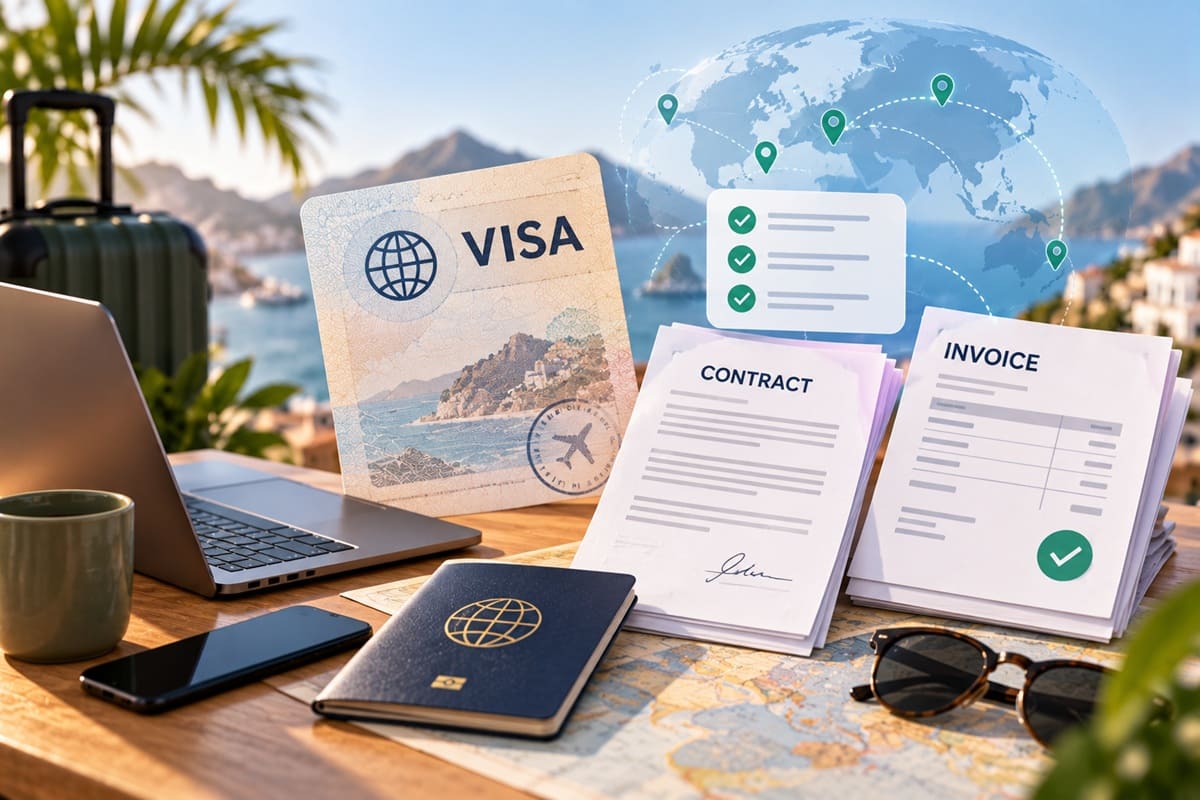
- “Proof of income” is not one document. It usually means a contract or client letter, an invoice history, and bank statements that show the money actually arrived — the exact mix depends on the country’s own checklist.
- Payslips only apply if you are formally employed by a foreign company. Independent contractors and freelancers are asked for invoices and payment records instead.
- Immigration officers cross-check documents against each other: a contract states the arrangement, an invoice bills it, a bank statement confirms it was paid. Gaps between the three numbers are what get an application queried.
- If a client pays through a contractor platform instead of paying you directly, the platform’s own contract and payment records can replace a stack of separate invoices — as long as the country’s checklist accepts that kind of documentation.
A remote developer starts a digital nomad visa application expecting to attach a bank statement and move on. The checklist asks for something more specific: a signed contract, an invoice history that matches the bank statement line by line, and — depending on the country — a letter from each client confirming the working relationship. None of that shows up automatically in online banking. It has to be assembled from whatever paperwork already exists, and for someone who has been invoicing clients informally for a year, that paperwork is often incomplete.
Usually the shortfall is paperwork, not income. Freelancers who bill several clients directly end up with several invoice formats, several payment cadences and no single document that ties them together. Some clients now route the contract and the invoicing through a contractor platform instead of paying a freelancer directly — 4dev works this way, issuing the contract and the payment documents from one account instead of leaving each client to draft its own. Whichever route the money takes, the visa officer is still looking for the same three things: an agreement, a bill, and proof the bill was paid.
What ‘proof of remote income’ usually means
Nomad visa programs exist because a government wants to confirm that the applicant’s income is genuinely earned abroad and won’t depend on working locally. Proof of income is the evidence for that claim, and it breaks into three layers:
- The source. Something that names who is paying and on what basis — an employment contract, a service agreement, or a set of client letters.
- The billing. A record of what was actually charged — invoices, or a payslip if the applicant is employed.
- The settlement. Evidence the money moved — bank statements showing deposits that match the billing.
Programs differ on how much of each layer they want and over what period. Some ask for a single dominant client; others are comfortable with income spread across several. Some want a fixed number of months of statements; others ask for a running average. A general guide can’t answer any of that for a specific case — every country publishes its own checklist for the visa category, and that list is the only source that matters for a specific application. Where a program’s list is unclear on a point, the applicant’s best move is to ask the consulate or a local immigration adviser directly.
What stays constant across programs is the underlying question: does this income exist independently of the country the applicant wants to move to. A contract with a client based elsewhere, invoices billed in a foreign currency, and payments landing from outside the destination country all point the same direction. Countries that run these visas — Portugal, Spain, Croatia and Costa Rica among them — vary mainly in paperwork format; the underlying test stays the same.
That test cuts both ways. A program built around remote income is usually also checking that the applicant isn’t quietly picking up local clients or a local job once they arrive — the paperwork that proves foreign income doubles as the paperwork that shows the applicant won’t be competing for work in the local market. This is why contracts and client letters usually need to specify where the client is based, not just how much they pay.
Contracts, payslips and invoices — which one fits your situation
Which document carries the most weight depends on how the applicant is actually paid.
- A signed employment contract or employer letter fits someone who is formally employed by a company abroad and paid a salary. The letter usually needs to state the role, the salary, and that the work is performed remotely and continues for the visa period. This is the strongest single document a program can ask for, because it comes with an accountable employer’s name attached.
- Payslips belong to the same category — they only apply where there’s an actual employer running payroll. A freelancer who calls an invoice a “payslip” doesn’t strengthen the application — the mismatch is easy for an officer familiar with the format to spot.
- Service contracts fit independent contractors with one or a few steady clients. A signed agreement — even a short one — that names the client, the scope of work and the payment terms gives the same kind of anchor an employment letter gives an employee.
- Invoices fit contractors billing per project or per hour, especially with more than one client. What matters is that the invoice numbers are sequential, dated, and reference a client that can be identified — an invoice reading simply “consulting services — payment due” gives an officer nothing to check against a contract.
A contractor working with a client based in the US will often also be holding a W-8BEN on file with that client — the form a US payer collects from a foreign contractor before paying them, instead of the W-9 it would collect from a US-based one. It isn’t proof of income on its own, but it reinforces the file: it shows the relationship is treated as a genuine foreign engagement, and it’s worth including in the pack if the visa checklist asks for anything beyond the core three.
Across all of them, consistency in the pack matters more than any single document’s polish. A contract that says one rate, invoices that bill a different one, and a bank statement that shows a third figure tells three different stories instead of one.
Bank statements and payment history
A contract or invoice describes an obligation; a bank statement shows whether it was met. This is usually the layer that decides an application, because it’s the hardest one to produce after the fact.
A few things matter more than others here:
- The deposits should match the invoices, both in amount and in rough timing. A pattern of invoices billed monthly and deposits landing weeks later, in matching amounts, reads as a real client relationship. Deposits with no corresponding invoice, or invoices with no deposit at all, read as the opposite.
- The account should be the applicant’s own, without unrelated transactions from a shared or business account mixed in. Where personal and freelance finances have been running through the same account, a short cover note pointing to the relevant lines saves an officer from guessing.
- The look-back period is set by the specific program — some ask for a handful of recent months, others want a longer run showing the income is not a one-off. Pull whatever period the checklist actually specifies instead of assuming a shorter statement will do.
- Statements in a foreign currency or a foreign bank’s format may need translation or an official stamp, depending on the country — confirm the specific requirement before the appointment.
None of this requires the income to be large — it requires the paper trail to be legible to someone who has never met the applicant and has a few minutes to review the file.
When income comes through a contractor platform
Some clients don’t pay a freelancer directly at all. Instead, they engage the person through a contractor platform, which holds the contract, issues the invoices or their equivalent, and runs the payment. 4dev.com is built this way: a client works with an individual contractor across any of the 150+ countries it operates in under a Contractor of Record arrangement, with one agreement between the client and 4dev.com replacing a separate contract per contractor. The contractor’s side of that relationship is self-onboarding — the applicant fills in their own details and documents through the platform instead of waiting for a client’s HR department to produce them.
For a visa application, this mostly changes where the paperwork comes from. The applicant is still an independent contractor, not an employee — 4dev.com works with contractors and doesn’t run employee payroll or offer employer-of-record services (that’s on its roadmap for 2027) — so the payslip route still doesn’t apply. What does change is that instead of assembling invoices and payment confirmations from several separate clients, the applicant can often pull a single, consistent history from one account: the contract, the billing record and the payment record all come from the same source and use the same format.
Whether that satisfies a particular program’s checklist is a question for the checklist itself. Some accept documentation issued by a third-party platform as readily as documentation issued directly by the client; others specifically ask for a letter from the end client. Where the requirement is unclear, it’s worth asking the platform for a supporting letter alongside the standard export instead of assuming the payment history will be read the same way as a client-issued one.
Building the document pack
Once it’s clear which documents apply, the practical job is assembling them into something an officer can review quickly.
- Start from the checklist. List every document the specific program asks for, in its language, before pulling anything from a bank or a client.
- Gather contracts and client letters first. These set the baseline the invoices and bank statements need to match — dates, rates, currencies.
- Line up invoices against payments. For each invoice, note the deposit that settled it. Gaps are easier to explain before submission than after a query comes back.
- Pull bank statements for the exact period requested, in whatever format the bank issues — official letterhead statements travel better than screenshots.
- Translate and certify where the checklist requires it. A document in the wrong language, submitted untranslated because it seemed obvious, is a common reason for a resubmission request.
- Write a one-page cover note mapping each document to the checklist item it satisfies. It costs little to prepare and saves an officer from having to work out the connection themselves.
- Note whether the program wants a single primary client or accepts several. If the checklist is silent on it, the safest approach is to present the actual client mix as it stands and let the documents speak for themselves.
- Keep a copy of everything submitted. Nomad visas are frequently renewed, and the same pack — updated — is usually needed again within a year or two; having the originals on hand saves rebuilding the file from scratch at renewal time.
FAQ
Does income from a single client count as proof of stable income? It depends on the program. Some digital nomad visas accept one steady client as long as the relationship is documented with a contract and a consistent payment history; others prefer to see income spread across more than one source as a sign the applicant isn’t dependent on a single relationship that could end. Check the specific country’s checklist to be sure.
What if I’m paid through a platform instead of directly by my clients? Treat it the same way you’d treat any other contractor income: gather the contract, the billing record and the payment history, whichever entity issued them. Most programs care more about whether the documentation is consistent and verifiable than about which company’s name is on the invoice — but if the checklist specifically asks for a document from the end client, get that in addition to the platform’s own records.
Do bank statements need to be translated or notarized? Sometimes. It depends on the issuing country’s format and the destination program’s rules — some accept English-language statements from major banks without extra steps, others want a certified translation or an apostille. This is worth confirming with the consulate or a local immigration adviser before the appointment, since these requirements change more often than the rest of the checklist. A bank can usually reissue a statement in whatever format the consulate wants if the first version doesn’t fit.
