As Washington continues to examine a reform of the ESTA system, with options officially under consideration including mandatory disclosure of social media accounts used over the past five years, the addition of new personal and family data, expanded use of biometric tools, and, eventually, a possible shift of new applications to the mobile app, one change is already very real on the current portal: scrutiny of the applicant’s selfie has tightened.
This development does not yet change the underlying regulatory framework, but it does show that image-based identity verification is already taking on a more visible role in the application process.
ESTA: a photo process that is now more tightly structured
Since April 1, the official ESTA portal no longer treats photo submission as a minor formality.
A new pop-up window now appears to guide applicants through the selfie upload process, with a detailed list of instructions: a plain, light-colored background, no shadows or patterns, a full-frontal face, a neutral expression, eyes open, and an original image that is distinct from the photo shown on the passport.
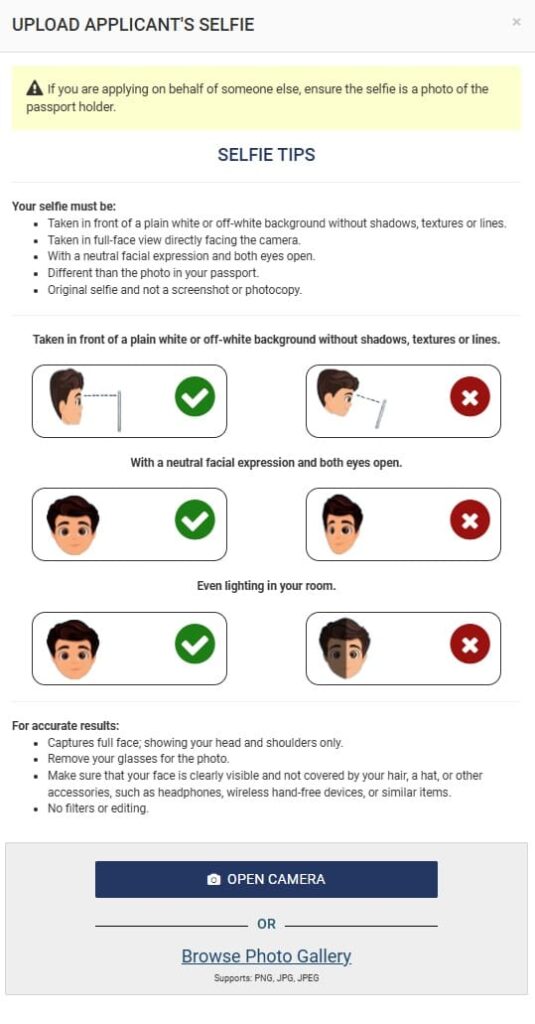
This first screen acts as an upstream filter.
From the outset, it places the applicant in a framework of technical compliance, making clear that the photo provided must be usable by the system. The selfie is no longer just a supporting image; it has become a control element in its own right, prepared for and framed from the very start of the process.
A second correction step when the photo does not pass
If the uploaded image does not meet the expected requirements, a second window appears. This time, the portal does more than restate general principles: it shifts into a correction and reframing mode, indicating that the face was not properly detected or that the submitted photo is not compliant.
The content of this second step is more detailed and more practical.
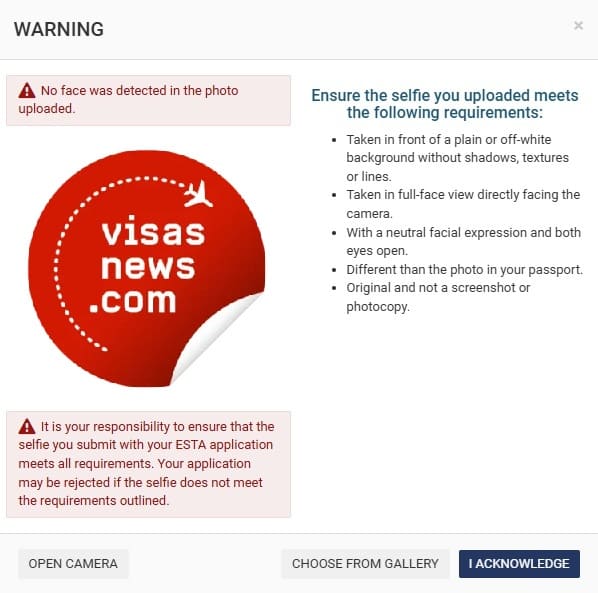
Applicants are instructed to show their full face clearly, with only the head and shoulders visible, remove glasses, avoid any accessories that could obscure facial features, use even lighting, and refrain from using filters or retouching tools.
The applicant is then invited to take a new photo or select another one. In other words, the portal no longer simply accepts or rejects an image; it now actively guides users toward a usable selfie.
The portal also makes clear that it is the applicant’s responsibility to verify that the selfie attached to the application complies with the stated requirements, warning that a case may be denied if the image does not meet the criteria. In practice, this means an application may still be submitted with a photo the system considers technically imperfect, and may then ultimately be either approved or refused during review.
A very concrete adjustment that fits into an already announced strategy
This tightening did not come out of nowhere.
In its notice published in the Federal Register in December 2025, U.S. Customs and Border Protection (CBP) had already explained that it wanted to require, on the ESTA website as well as in third-party submissions, a photo of the applicant’s face in addition to an image of the passport biographic page, in order to better verify that the person seeking authorization is the legitimate holder of the document being used.
Although a selfie was already required on the ESTA website, its handling until now appeared more flexible and far less detailed in its technical requirements. The text also stated that this change was intended to bring the website’s requirements more closely into line with those of the mobile app, where selfie capture is already built into the process.
The same federal document also sheds light on the reasons behind this tightening. CBP refers to low-quality image uploads on the web portal, facial comparison failures, and the exploitation of certain technical weaknesses by fraudsters.
By contrast, the U.S. administration points to the greater robustness of the mobile app, which allows live facial capture, liveness detection, NFC reading of the electronic passport chip, and more advanced biometric checks. In light of those elements, the tougher approach now seen for selfies appears to be a highly consistent operational adjustment, even before any broader reform of the system is formally adopted.
A modest change on the surface, but far from insignificant
At this stage, travelers are not yet facing the full set of changes discussed in recent months around ESTA.
The U.S. Embassy in France also reminded travelers last February that the proposed requirement to provide social media identifiers had not entered into force and that the current procedures remained the ones to follow. According to the provisional timeline mentioned at the time, any new requirements, if approved, could not take effect before around mid-2026 at the earliest. But what is already changing on the photo side shows that part of the broader logic of the future reform is already beginning to take shape, little by little, in the interface itself.
This development is both limited in its immediate impact and revealing in substance.
On the one hand, it does not yet fundamentally alter ESTA formalities. On the other, it confirms that the U.S. procedure is increasingly being structured around tighter identity verification, more visual, more technical, and potentially more biometric. That prospect is already raising questions among international tourism stakeholders, from Hawaii to European data protection actors.
As the 2026 World Cup approaches, a detail that will matter for travelers
At first glance, the appearance of these new pop-up windows may seem minor. Yet for travelers planning a trip to the United States in the coming months, this kind of very practical adjustment can make a real difference when submitting an application.
And this point will take on particular significance as the 2026 FIFA World Cup draws closer. The tournament, hosted by the United States, Canada, and Mexico, is expected to generate massive flows of supporters across North America.
In that context, the applicant’s photo now deserves much closer attention than before. The change is subtle, but the message is clear: on the ESTA portal, selfie-based identification is no longer just a technical step. It is becoming one of the more sensitive parts of the application.