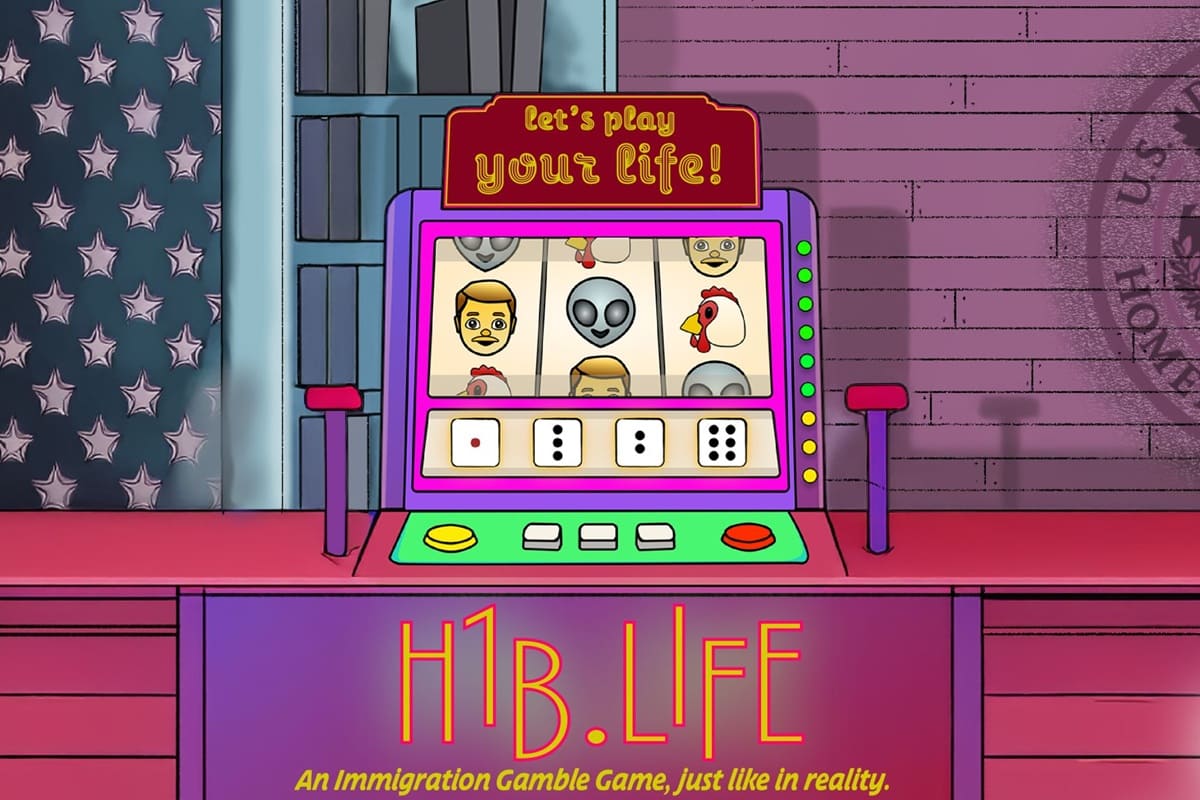
With H1B.Life, Reality Reload, the studio founded by Allison Yang Jing, a former journalist turned game developer, takes on a subject rarely explored in gaming: the human experience behind the H-1B visa process.
The project is based on interviews with people who have gone through, or tried to go through, this administrative path. The goal is not to recreate a legal procedure step by step, but to convey what it can mean in the daily lives of those who depend on it: waiting, uncertainty, personal trade-offs, and a sense of vulnerability.
In the project’s presentation, Allison Yang Jing sums up the idea in a simple phrase: “In the U.S., high-skilled immigration is often framed as a path where effort leads to success. In reality, it feels much more like a systematized gamble.”
The player takes on the role of an immigrant trying to build a life in the United States, balancing studies, work, personal relationships, and immigration constraints. Individual choices matter, but outside events can also reshape everything at any moment.
H-1B: skill, competition, and a lottery

The choice to focus on the H-1B visa is far from incidental. This category remains one of the main routes into skilled employment in the United States for foreign professionals in specialized fields, particularly technology, research, finance, and engineering. But the program is also tied to intense competition, with the number of applications regularly exceeding the number of visas available.
It is precisely this tension between merit and randomness that H1B.Life seeks to portray. Allison Yang Jing put it very clearly in comments to The Independent: “It’s like a game. Whatever card you hold, whatever paper you hold, determines your superpower and your weakness.” In the game, that logic takes the form of a system in which the character’s skills, resources, and decisions matter, without ever being enough to fully eliminate the role of chance.
The project does not simply highlight the technical complexity of the H-1B system. More importantly, it underscores the fact that, for many people, getting or not getting a visa does not just determine a job, but also a way of life, a sense of stability, and sometimes a long-term future.
A satire focused more on lived experience than argument
Part of H1B.Life’s originality also lies in its tone. The game adopts a satirical, sometimes absurd style, with a world populated by symbolic figures and casino-inspired mechanics. That narrative distance makes it possible to approach a serious subject without relying on the usual conventions of bureaucratic or activist storytelling.
Allison Yang Jing said she wanted to capture less the rules themselves than the way they are experienced: “We wanted to capture the bizarre mentality around this topic. A lot of things are not factual, [but] correspond to people’s dreams or desires or fears.” The project therefore gives significant space to beliefs, rituals, and coping mechanisms that emerge in situations of prolonged uncertainty.
One of the game’s more unusual elements is a reference to a superstition mentioned in several testimonies: the idea, shared in some online circles, that eating Chick-fil-A fried chicken might bring good luck in the H-1B lottery. Allison Yang Jing sees it less as a quirky anecdote than as a deeply human response to a lack of control: “In a very uncontrollable situation, I think it’s human nature to rely on something like horoscopes or fortune-telling — so that you can control something.”
A cultural work about a deeply contemporary issue
Through this project, the H-1B visa moves beyond the administrative sphere and becomes a cultural subject as well. H1B.Life shows how an immigration procedure can generate narratives, representations, and new forms of awareness. The game does not claim to replace regulatory information or professional guidance, but it does illustrate how questions of international mobility are now making their way into video games, interactive storytelling, and online communities.
This approach comes at a time when skilled immigration continues to fuel debate in the United States across business, technology, and political circles. Without presenting itself as an institutional advocacy tool, H1B.Life aims to make the lived reality of some of the people who depend on this type of visa more tangible.
Allison Yang Jing also emphasizes the contradiction at the heart of these journeys: “People enter drawn in by different versions of the American dream, only to discover that the rules are both complex and deeply arbitrary. Even the “perfect” candidate can be told, by pure chance, better luck next time.”
Gradual access before a release planned for this summer
At this stage, H1B.Life is not yet available in its final version. The project has already been shown as a prototype at public events, including in San Francisco last month. The team says a demo is coming soon, along with the launch of a Discord community. A Kickstarter campaign is scheduled for May, while the mobile game is still targeting a summer 2026 release, subject to development changes.
For now, access to the project mainly comes through its online communication channels, public showcases, and its upcoming crowdfunding campaign. The team also says it wants the game to exist both online and offline, in connection with immigrant communities, players, and cultural venues.
Allison Yang Jing summed up that ambition by saying it is “a game about immigrant communities,” and that she wants it to be “freely accessible,” while also being something people can discover collectively in physical spaces.
By turning a visa process into an interactive experience, H1B.Life offers something beyond a simple regulatory debate. The project is a reminder that beyond quotas, forms, and legal categories, there are also personal trajectories, decisions suspended by outside forces, and a constant need to adapt.
Without giving up humor or caricature, the game above all seeks to convey what it means to live while waiting for a status, a decision, or a sense of stability. Its most universal dimension likely lies there: in a story about uncertainty, resilience, and the difficulty of holding onto one’s future when the rules of the game can change midway through.